Opening up to big changes
THIS WEEK'S TOPIC: Can open-plan offices survive the Covid-19 crisis? What will the need for physical distancing at work mean for office culture post-pandemic?
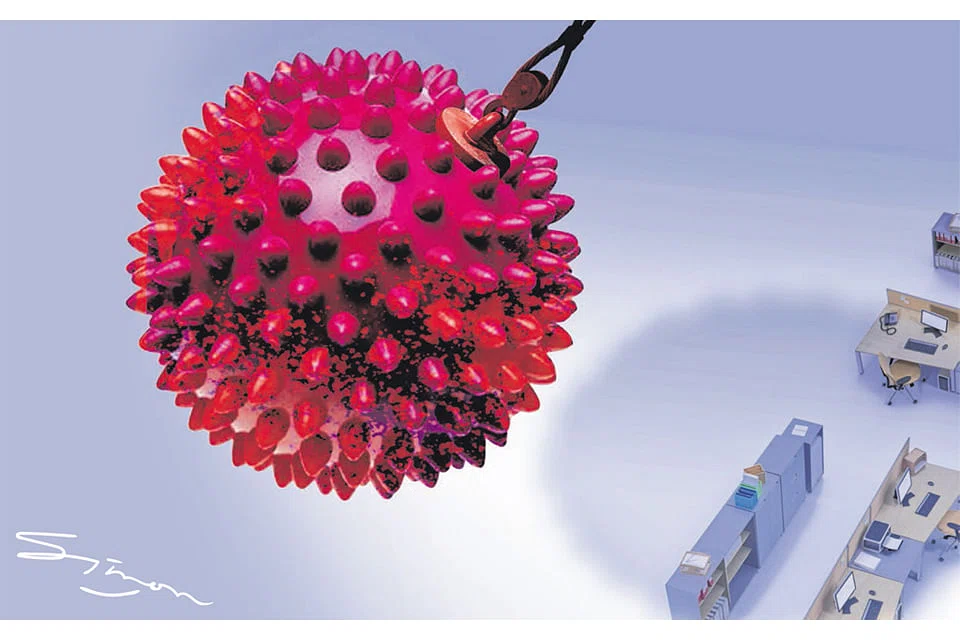

THIS WEEK'S TOPIC: Can open-plan offices survive the Covid-19 crisis? What will the need for physical distancing at work mean for office culture post-pandemic?
Lawrence Loh Director, Centre for Governance, Institutions and Organisations NUS Business School
The boundary separating home, office and everything in between will be radically blurred. It will be more than just a rethink of the open-plan office. It is about the very existence of the office. Work will evolve to an omni-location concept, where there is no assumed primary place for its conduct. There will be a fundamental shift not only to an outcome-based culture, but to one rooted in trust. Covid-19 has forced a long-delayed transition to a virtual work environment. The change will be irreversible - the office as a sacrosanct physical entity may be like Humpty Dumpty, which had a great fall and could not be put together again.
John Bittleston Founder and Chair Terrific Mentors International Pte Ltd
Of course, open-plan offices will survive the virus, but only to the extent that the office as a concept does so. Working from home is usually more efficient if your employees are trustworthy and you trust them. If they are not trustworthy or if you do not trust them, you should not employ them. At least 50 per cent of office work should be doable from home. Post-pandemic, we should not need to keep distance. Medication to contain the worst effects of the virus should be with us within two years. A world in which we can never shake hands or touch another human being is not one I want to live in.
Victor Mills Chief Executive Singapore International Chamber of Commerce
The future of the office as we have known it is in doubt. The pandemic has made us all accustomed to working from home (WFH). Many businesses are now asking themselves if they need so much office space in the future. The answer is they do not, both for cost reasons and because most jobs can be done remotely thanks to tech tools. Open-plan offices will survive Covid-19, but they will be used by fewer people because of fear and the need to facilitate social distancing. The implications for commercial real estate are clear.
Yeoh Oon Jin Executive Chairman PwC Singapore
We do think open-plan offices will survive the Covid crisis, but its survival will require significant changes to employee behaviour and some help from digital technology. As we looked at how to bring our teams back to our open-plan office, we realised that we needed to ensure our employees feel safe and confident, as well as equip them to adopt and maintain good social-distancing disciplines. So we created a safe-distancing and contact-tracing solution, Contact Tracer, to help build confidence, manage behaviours and automate contact tracing in the event of an infection. The workplace culture and behaviour will clearly change through social distancing, with redesigned office spaces and different usage patterns between virtual and physical office working. As always, we believe our people will find ways to adapt and to enjoy the re-imagined post-pandemic workplaces of the near future.
Dirk-Peter van Leeuwen SVP & GM, Asia Pacific and Japan Red Hat
The pandemic is changing the way we think about office spaces. Until this virus is gone or until we have a vaccine, social distancing rules are making us consider having one-way walk corridors, installing plexiglass panels, and implementing office-work rotations. In the meantime, working from home does not have to be isolating. We are giving our staff all the online tools and resources they need to work and collaborate with one another. At the core of it all, it is important to note that corporate culture is no longer built within the walls of an office. It is about how your organisation works with transparency, adaptability and collaboration. This will lead to greater team alignment in a post-pandemic world.
Moray Armstrong Managing Director CBRE Singapore
We have all come to realise that the common open office is a "one size fits nobody" solution that is focused on capacity rather than enabling effective work. Thankfully, this concept has evolved to today's carefully considered high-performance workplaces that recognise the need to support an individual's deep thinking and effective collaboration, while reinforcing desired corporate culture. Such workplaces, in our opinion, will remain effective and will continue to be sought after by companies post-Covid. Perhaps what we are learning about remote working will help us better understand why we come together in offices - reasons which are based in building communities, trusted relationships and spontaneous creativity. The fundamental human desire for social connection will drive us to find new ways to connect and work together, whether it is from home or at workplaces that require physical distancing.
Ben Elliott Chief Executive Officer Experian Asia Pacific
Offices still have a role to play in employee engagement, as it serves as an anchor in building organisational culture by providing a physical space for employees to interact and a meeting point. While offices remain an important touchpoint of contact, Experian Asia Pacific believes traditional work arrangements will no longer exist - the future is about flexible work models and employees having a choice. At Experian, our people-first agenda means that the health and safety of our employees comes first, so we are letting them decide whether they want to come in once the government eases restrictions.
Sylvie Ouziel International President Envision Digital
For many jobs which do not require physical tasks, the "anywhere-ing" trend pre-Covid was already very strong. New generations joining the workforce never understood why they should show up at the office every morning. Technology enables access to company systems, virtual meetings and collaboration around jointly developed documents.
We think this trend will expand, which means two things. First, corporations should rethink the work experience, making "remote" engaging and exciting as well as "at-the-office" meaningful and truly value-added. Convey the "inspiring view" or the "quiet meditation booth" feeling remotely. Make physical interactions safe and connection-rich, versus classic meetings where everyone half-listens and fully double-tasks. Second, traditionally physical activities will evolve faster towards smart automation, changing the nature of underlying jobs. Work will be more about defining, deploying and improving the system, rather than performing the actual on-site tasks.
Toby Rakison Managing Director, Asia Unispace
Unispace has been advising clients on their return-to-work strategies. Clients are mainly concerned with two things: first is the initial return to work and getting people back into the office safely; second is the future of work and what this means for their real-estate portfolios going forward.
Traditionally, workspaces have been designed with around 50-60 per cent desk space, but what we are hearing is that the future value of the office is less about individual desks and more about those experiences that satisfy our social needs, reinforce the brand, and allow individuals to collaborate to solve complex problems.
Andrew Au Regional MD, Asia Pacific Eight Inc
As countries start to re-open their economies, there is much discussion about how offices should be redesigned and social distancing measures that need to be put in place. We should not get carried away as a vaccine should be available by mid- or end-2021 - at which point I predict a greater rush back to a pre-Covid normal. So investment of resources to substantially redesign workplaces may be for naught. However something that businesses do need to reconsider is their real-estate requirements. We have real-time proof that WFH is viable - not ideal, but viable. Where an entire floor may have been required pre-Covid, half a floor may be sufficient post-Covid, and this will have significant impact to landlords and developers.
Christopher Wehner Managing Director BMW Group Asia
Office plans, just like business plans, need to be reviewed and revised in the new working world. I personally do not believe open-plan offices will be as desirable as they used to be; however, as many companies have this setup, it is the employer's duty to ensure that employees feel safe in their working environment when they return.
This pandemic has made us realise how much we need personal contact, not just with our family and friends, but also with our colleagues. In this new world of work where physical distancing will be required, it will be a challenge, so our only option is to be creative! We have to try new things, be flexible, and find a balance that works for everyone. The bigger the challenge, the bigger the opportunity for growth.
Sujith Sivaram Managing Director ESCO Pte Ltd
For practical reasons, it is unlikely the open space office will go away even after the Covid-19 crisis. Though people are likely to be more conscious about sharing spaces and personal hygiene, the major change should be the increase in demand or preference for WFH.
On a side note, I think new hires are likely to be attracted to companies that can offer WFH options. The open space office is adaptable and allows for flexibility and quick changes. This flexibility will also allow companies the option to push workstations further apart, create new spaces, redesign areas to fit changing needs and expectations. Hot-desking is likely to be on the decline, as most would be uncomfortable with the idea of co-sharing a desk. Post-Covid, I think businesses would be more focused on beefing up their technologies to enable collaboration rather than spending on cubicles or private spaces, to cater to a new norm in work arrangements.
Damian Tan Managing Director Vickers Venture Partners
Offices have typically become smaller and smaller with time. The prestige of a large room of your own had lost its practicality a long time ago. The office is now literally in the palm of your hand. You can get more done with your mobile phone, which has in effect the power of a supercomputer 50 years ago, than ever imagined. Soundproof video-friendly rooms should be important for effective conference calls. Conducive meeting rooms for face-to-face discussions should take priority. But for the most part, your office can be anywhere since you have that supercomputer with you.
Physical distancing is absolutely wrong; such behaviour is anti-social and breeds mistrust and discrimination. Humans need to trust and collaborate more than ever in order to tackle the world of problems and opportunities, and not be polarised and distanced. Office culture should be even closer and supportive than before.
Ho Nyok Yong President Singapore Green Building Council
The necessary safeguards, such as physical barriers and spaced-out workstations, will need to be in place in post-pandemic workplaces. The wealth of connectivity tools available can be utilised to keep staff engaged, especially in light of WFH, split-team and staggered working arrangements.
The quality of the indoor environment is also paramount to keeping staff safe and healthy. Green buildings, with their emphasis on occupant health and wellbeing on top of environmental sustainability, form an additional layer of protection against harmful pathogens and indoor pollutants. Worldwide, building-based prevention and control measures have become one of the most important methods of fighting the effects of Covid-19, and these will undoubtedly take centre stage in the months ahead as we return to the workplace.
Aaron Tan Chief Executive Officer Carro
Open plans will survive Covid-19 - primarily for practicality and efficiency reasons. I am sure it is the last thing on our minds now to undertake renovations to fit rooms into our offices. In fact, I think we will see more open offices as we are implementing more safe distancing measures, as it is the most efficient use of space.
Social interaction will also be greatly limited, so office culture will never be the same. The way we impart values and form a cohesive working culture will change, and we will have to inculcate culture through different activities.
Jayaprakash Jagateesan Chief Executive Officer RHT Fintech Holdings
With large-scale remote working now tried and tested, most people will likely spend part of their work week out of the office post-pandemic. Flexible open-plan offices could evolve into hot-desking centres to accommodate split-team arrangements, with rigorous cleaning during handovers between the two teams. This will leave more floorspace available for collaborative spaces.
Office culture is guided by our values and ultimately reflected in our actions, be it virtual or physical. Regardless of the physical distancing measures, humans are wired to connect. During the circuit breaker period, we held virtual coffee talks and other activities to connect with colleagues. We believe that new channels will emerge to promote a positive office culture as we adapt to a new normal.
Benjamin Tan Vice President Ultimaker Asia Pacific
A few months back, many companies in Asia would baulk at the thought of their employees working remotely. Ironically, it is what has made business continuity possible since the onset of the pandemic. While reconfiguration of the office layout is not impossible, it will be tough given the constraints of the physical space. Hence, we would see the re-introduction of cubicles, and teams on split shifts to continue in the foreseeable future.
The distribution model enabled by 3D printing has allowed manufacturers to circumvent supply-chain disruptions. Post-Covid, engineers can continue to work remotely, sending digital files to be printed onsite instead. This pandemic has shown that humans are highly adaptable, and we will fully embrace the new norms of working, leveraging on technology.
Graeme Beardsell VP and MD, Asia Pacific and Japan Akamai
When employees do start to return to the office, we are going to have heightened measures around social distancing and hygiene protocols. This will mean that in the short to mid-term, it is unlikely that our employees will be making full use of their open-plan environments. We have implemented a global directive that allows employees to WFH for the rest of 2020, regardless of whether their local office has re-opened. In terms of office culture, a physical office plays a big role in building a certain corporate culture. As these office walls move to a more permanent virtual model, it will be vital for leadership teams to sustain employee engagement and office culture remotely. We have implemented many activities virtually to ensure that our culture continues to be inclusive. It is hard to predict whether these changes will be here to stay in the long term, but Akamai remains flexible as a business and ready to make changes that place employees at the centre of our decisions.
Andrew Yeo Chief Executive NTUC Income
Our office spaces are open and flexible to inspire creativity and drive a more collaborative working culture. Recent safe distancing requirements for continued pandemic risk management has made it necessary to review our office layout so that our staff continue to work in a safe and protected manner. In addition to wider physical distancing, alterations may include temporary barriers between workstations and discouraging congregation even at designated "break-out" areas. The changes that we will make, even if temporary, must continue to support and empower our staff to operate creatively, innovatively, and collaboratively. This is why we have set up a taskforce to look into what is best for the company post-circuit breaker through to post-Covid, so that these changes are not just reactionary and can help to shape the company culture that we want to build for the future.
Long Jek Aun Partner, Singapore Office Head Simmons & Simmons JWS
Many organisations will certainly find themselves reflecting and rethinking and, in turn, recalibrating or reshaping past ideas and assumptions, taking into account the lessons the pandemic has thrust upon us. With vast numbers of us having been compelled or encouraged to work from home for an extended period, the new modes of communication adopted to stay in touch will likely be rooted in the rhythms and habits of our new normal. Office culture will be increasingly a comingling of in-person and virtual interactions, behaviours and ways of working.
Alan Watts President, Asia Pacific Hilton
In line with Hilton's mission of becoming the most hospitable company in the world, our team member value proposition, Thrive@Hilton, has allowed us to successfully integrate flexible working practices, together with inspirational and inclusive work environments since its launch in 2017.
While the Covid-19 crisis has now fast-tracked such flexi-work arrangements, it may not necessarily mark the end of open-plan offices. Conversely, when the crisis ends, the acceleration of such work arrangements will encourage more employers to become more flexible, providing team members with the choice to either work remotely or from the office. It will also promote a more mature employer culture and increased employee-employer trust, while ensuring that we can still accord top priority to the safety of our team members.
Shahid Nizami Managing Director, Asia Pacific HubSpot
One benefit of open-plan designs is that they are easily modifiable. At HubSpot, our short-term focus is on adapting our space to accommodate social distancing.
Leaders are now learning a lot about what is possible with remote work, and making teams more remote-inclusive. Companies placing greater emphasis on impact and ability instead of location or hours in the office are not just good for culture, but also for diversity and inclusion. More than ever, this proves that culture is about how people feel valued, included and connected to the company's mission - which goes above and beyond physical setting.
Office designs come and go, but the way in which people connect, convene and celebrate will continually evolve to focus more on "why" than "where".
Toby Koh Group MD Ademco Security Group
It does seem a little premature to sentence open-plan workspaces to the gallows at this time. I am still confident that the global medical science talents will resolve Covid-19 and subsequent strains, with accelerated timelines in the future. Workspace requirements will contract after Covid-19, with WFH becoming a norm. The future office will be compartmentalised with multiple entrances, increased numbers of meeting rooms and work rooms to accommodate split teams. Materials used in furniture and fixtures will feature anti-microbial coatings. Workspaces and meeting rooms for hourly rental will mushroom around the island for in-person meetings and will meet specific sanitation standards. Companies will choose pay-per-use workspaces rather than be committed to large offices. Landlords will repurpose their assets to meet this trend. There is no turning back to past practices; the workplace has shifted.
Leon Perera Chief Executive Officer Spire Research and Consulting
Working from home is unlikely to ever replace office work completely. Some work activities cannot be performed from home - face-to-face interaction plays a role in forging camaraderie, and socio-economic inequality influences the ability and inclination of people to work from home. Having said that, the post-Covid period will see the balance between office and home work tilt in favour of home. After Covid-19, many firms may want to introduce larger meeting rooms to allow for proper distancing as well as more meeting rooms, to discourage casual interaction "around the water cooler", alongside practices like staggered work and lunch hours and tighter segregation of guests from staff. Startups and smaller firms that cannot afford such facilities are likely to encourage WFH to a greater extent.
Rayhan Perera Founder OneDash
The future of offices will be experiential and brand-oriented. Walking into OneDash (as an example) would be an operational journey. It will be a place to welcome clients, have creative team meetings, a stellar ambience that reflects the company culture and freedom of expression. The cloud will perhaps be the office, and a suite of apps would bring the productive environment to the forefront, absolving the need for our daily commute, which becomes one of necessity rather than obligation.
Uno Motohiko President Fujitsu Asia
Workplaces will continue to be reshaped beyond the pandemic and the concept itself may well be changed - no longer defined by physical space or time, but where value-creation happens. Employee agility will become a mainstay - digital workplace solutions to foster mobility, productivity and collaboration will empower employees to excel in their jobs. Companies can also incorporate elements that promote collaboration and innovation so that harder-to-measure benefits like creativity and innovative thinking can be realised, wherever the employees are.
Mario Singh Chief Executive Officer Fullerton Markets
Open-plan offices have their fair share of advocates and critics. On one hand, those who love them point to the higher levels of transparency and collaboration, while the detractors cite distraction and noise as disadvantages.
With the current Covid-19 crisis, the open-plan concept would certainly be seen as more of a health hazard. Even when Singapore's circuit breaker eases on June 1, offices are expected to comply with mandatory measures like reduced physical interaction and safe distancing measures.
If businesses deemed non-essential continue to have staff WFH, it is imperative for the top management to ensure that their corporate culture stays intact. I am a big believer in installing and maintaining a winning culture.
We do this in two ways. Firstly, ensuring that everyone is clearly aligned with our shared goals, and secondly, reinforcing that everyone's role is important to the company and to each other. When these two objectives are met, it does not matter whether it is done at the office or online. Culture is never impeded by physical or geographical barriers.
Thomas Holenia President Henkel Singapore
To stay agile amid a fast-changing environment, the open office concept has helped to enable dynamic collaboration, best-practice sharing, and spark many innovative ideas among our teams in Henkel Singapore and Henkel Global Supply Chain Hub. The gradual return to work will take place under new safety and hygiene measures, which we adhere to strictly. Post-pandemic, we believe that an open-seating arrangement, supported by smaller conducive collaborative spaces, will remain important to fostering trust, diversity and inclusiveness, leadership and agility as key elements of our entrepreneurial corporate culture. To protect the health and safety of employees, safe distancing rules are already enhanced to limit the number of people at each space and meeting duration. We are also already seeing more combined physical and virtual meetings as more employees continue to WFH.
Nick Lambert Senior VP, Asia Pacific Orange Business Service
Many organisations will be redefining their operations and processes to prepare for the new normal, with remote working an accepted practice. The Asia-Pacific region will likely morph into what will effectively be a contact-free economy.
The post-Covid future will need companies to be resilient, innovative and sustainable - not only to be well-equipped for physical distancing, but also to create and sustain the human touch of the office culture. It will need to be supported by digital technologies to allow extensive infrastructure, particularly with bandwidth needs and security solutions. To quickly adapt to the new normal may be a challenge, but I believe that with collaboration and digital-readiness, we can come out of this situation stronger.
Joanne Wong VP, Asia Pacific and Japan LogRhythm
There is no doubt that the new workplace, whether physical or virtual, will look drastically different from before. We have certainly reaped the benefits of an open-plan office - with increased collaboration and effortless relationship-building - but at LogRhythm, our priority will always be our employees' safety and wellbeing.
With that, we must reinvent the way we think about office culture. An internal LogRhythm survey revealed that a majority of our employees actually like WFH, and are confident of doing so productively. It is then crucial that we become more intentional about creating an environment that provides choice and comfort, encourages collaboration, while fostering a strong sense of community and trust among the team, so that this arrangement is sustainable in the long run.
Luigi La Tona Chief Operating Officer StorHub Self Storage
Our strength is space. Post-pandemic, the use of space in Singapore will change, given the lack of it both in our homes and offices. Utilising space while observing physical distancing will surely challenge us. Open-plan offices can and should be sustained despite physical distancing measures. Collaboration, brain space for new and innovative ideas, and opportunities to communicate better are made possible by open-office settings. More than ever, these spaces need to be re-imagined, not replaced. Leaders must take the opportunity to envision how to integrate creative design, flexible workspaces (including WFH structures) and innovative technology to best continue a successful, sustainable and happy office environment.
Foo Mao Gen Head of Southeast Asia Qualtrics
Open-plan offices and workplace culture will survive the pandemic once circuit breaker measures are completely lifted. However, these environments will need to evolve with rapidly changing employee expectations, such as greater workplace flexibility, for them to remain effective.
Immediately, all organisations need to understand from employees the changes they need to make to workplace environments to ensure people feel safe returning to the office, such as sanitising and distance between desks. Longer term, leaders need to understand how employee expectations have changed, and what is needed to satisfy these. Uncovering these insights will help businesses shape a new way of working suited to current needs, one which fosters a positive and productive culture.
Edmund Lee Managing Director Singapore TMF Group
At TMF Group, we believe that open-plan offices are here to stay, as they are well-suited to this moment of change. In fact, their flexible nature is what companies will be relying on as they strive to uphold social distancing measures. By now, many employees have become used to remote working and hope for it to continue. We expect an increasing preference for agile office settings that grant more flexibility in terms of where and when tasks are done. Hence, TMF Group envisages an increase in our hot-desking arrangements. It may no longer be necessary to have a permanent desk setting for our entire workforce, and we will allow flexi-work arrangements to continue. To truly succeed in maintaining culture and camaraderie, organisations will need to learn new ways to engage with their employees.
Helen Ng Chief Executive Officer Lock+Store
Office design has always evolved with the times. The trend of minimalist office interiors with open-concept floor plans, bright and airy brainstorming areas, and break-out lounges will not reverse because of the Covid-19 crisis, but will instead adapt to the need for physical distancing. Modular furniture systems will be widely adopted as they allow for space to be freed up dynamically. To reduce the risk of cross-contamination, work areas and office furniture should be disinfected daily or between shifts. As long as 50 per cent or more of employees continue to WFH or on staggered-hours arrangements, the modern workspace should be able to accommodate the changing workplace landscape caused by Covid-19.
Linus Lim Chief Executive Officer Phillip Capital Management
When I was visiting an office, I remember the tower we were in was designed as a "living organism" that "breathes" with windows that automatically open and shut to increase natural air flow for its occupants. Building designs will no longer just be about population density, but would also have to consider light and air flow rather than physical barriers to contain disease. I believe we will need to have flexible work spaces that can be easily reconfigured through both mobile furniture and fixtures, so the need for open-plan offices will be even greater. Effective communication between our teams and our clients is key for us so we will have to think about how our "kopi meetings" will still be both safe and fun. Our bustling meetings may have to be a little quieter because of distancing, but I hope the atmosphere continues to be vibrant and we still continue to build human relationships.
Dileep Nair Independent Director Thakral Corporation Limited
The Covid-19 crisis has indeed presented an opportunity to reimagine how we work. The nationwide WFH experiment has shown businesses the viability of operating with reduced staff in the office while keeping the rest at home. We need not revert to the status quo ante even as the lockdown measures are eased. Less staff in the office will allow for easier physical distancing. Digital tools can be used for safe workplace occupancy planning, starting with exiting office layouts. Open-plan offices are more adaptable to redesign, incorporating features such as plexiglass dividers or "cough shields". Good hygiene practices must also become an integral part of office culture.
Some may even question the need for offices at all. Most businesses, though, would find it essential to have a place to convene and collaborate in person when necessary. Some activities are still better done in the flesh. Until technology provides us with easy-to-use holograms and avatars, offices are likely to be retained, albeit in different forms.
Chia Ngiang Hong President Real Estate Developers' Association of Singapore
It is my view that open-plan offices will likely remain post-pandemic as many businesses adapt and prepare for the new post-Covid norm. The immediate priority for businesses is to look at optimising the existing space while implementing a "Work Safe" environment which incorporates physical safe distancing, WFH arrangements, and an office culture that continues to embrace open communication, socialising among staff and activities to improve workers' mental well-being and productivity.
I believe many buildings will be looking at using materials with antimicrobial and antibacterial properties as well as be future-ready to cope with unprecedented crises like the Covid-19 pandemic.
Tony Lombardo Chief Executive Officer, Asia Lendlease
In the wake of Covid-19, the focus on safety and wellbeing will significantly increase for everyone. Hygiene, cleanliness and health will come to the fore at work. This will include everything from choice of materials, clean air systems, spatial designs, touch-free access, changes in density and an increased use of technology to aid connectivity and to monitor access and health. A new mantra of sustainability will emerge around hygiene.
The traditional office that provides just deskspace has little to offer in a world of connected technology and remote working. The future winners will be workplaces that enhance people's health, inspire creativity, promote exchange of ideas, boost productivity, provide leading technology and foster positive brand and cultural outcomes. Businesses still succeed by attracting and motivating the best talent, and the new people-centric workplaces - focused on technology, amenities, health and well-being - will prevail.
Tomas O' Farrell Co-founder Workana
Although changes to office spaces will be required post-pandemic, we believe that open-plan offices and hot-desk culture will endure, especially with demand rising from the growing number of freelancers. Many companies and startups will still need a place to work together and build ideas; this means taking into consideration social distancing, more natural light, and extra cleaning. There may be fewer social meetings in a common area, and perhaps half of the staff might be working remotely on any given day. More virtual meetings are still a good way to communicate. We will not forgo culture; just tweak it to ensure healthy measures are in place.
Ronak Shah Chief Executive Officer QBE Insurance (Singapore) Pte Ltd
The open-plan office has been the go-to for corporates since the 60s, and for good reason. Beyond its collaborative and social nature, where employees can communicate with one another quite easily, the adaptability of the open plan also allows companies to scale with ease. For this reason, along with the obvious cost argument tied to any form of office redesign, the open-plan office will outlive Covid-19. However, with today's strict safe distancing rules in place, the open plan is going to be even more open and spaced out, almost nullifying its social and collaborative design. While this may be so, I am confident that the gulf in physical social interaction will be filled online on the many virtual platforms we are now comfortable on.
Ng Tian Chong Managing Director, Greater Asia HP Inc
Our employees' safety is our top priority, so it certainly will not immediately be business as usual. The past months have shown how productive, collaborative and creative we can be through the use of technology. Employee initiatives such as virtual cookoffs and bringing our kids into online meetings allowed us to bond even more, and would not have happened if we were in the office. The open office and its associated culture will have to evolve. While businesses should provide flexibility to those who prefer remote working, we must be mindful of the merits in face-to-face interactions. This is particularly true for those just starting out in their careers who benefit from in-person guidance and mentorship. This is a situation we are all working through, and for us as a business, it is about being flexible and open to new approaches.
Tan Mui Huat President and CEO, Asia International SOS
Open-plan offices are still relevant, given the flexibility it offers and its ability to facilitate collaborative work. This is especially true for an organisation like ours, where time-sensitive and medically urgent situations will require instant collaboration between our medical, security and logistics experts.
However, the way open-plan workspaces are designed will change. While individual work can be done at home, most people will return to the office for group collaboration or other in-office work. To safeguard employees' health, clear glass screens might be installed, and personalised desks may also be done away with.
With remote working part of the new norm, office culture will see an increased emphasis on technology and empowering of employees to keep people connected and foster a sense of camaraderie. More importantly, organisations and employees alike will need to adopt an open and agile mindset to the myriad of new ways in conducting business.
Adam Reynolds APAC Chief Executive Officer Saxo Markets
While the design and form of office work may change, I believe that offices will still play a role in our work life. As a digital business, Saxo employees have adapted easily to WFH for extended periods, yet regular human interaction remains critical. Being with colleagues and clients in person is more engaging, rewarding and effective. With more physical distancing built into a refreshed office layout, it could encourage a more organised and efficient meeting culture. However formal meetings are not the only benefit of being in-office. The informal ad-hoc meetings which occur between colleagues are a key part of office communication, which are largely lost when working from home. People are also more able to express their empathy to colleagues having a tough time in their personal lives, which plays a big part to ensure colleagues are happy and productive.
Ong Ai Hua Company Group Chair, Asia Pacific Janssen Pharmaceutical Companies of Johnson & Johnson
Covid-19 has turned the world of work upside down, accelerating changes in the way we communicate and collaborate overnight. We have turned on our video cameras, seen each other's living rooms, met families and pets. The fundamentals that drive innovation and culture forward - such as trust and collaboration - will continue to be important - whether we are collaborating over Zoom or having a socially-distanced meeting in the office.
Eric Goh VP & Managing Director, Singapore Dell Technologies
As we have learnt in recent months, remote workforce can be productive and successful. At Dell Technologies, the past months proved that our decade-long flexible work policy worked positively in our favour, and we can now further reinvent and redefine work with new ways of working, while maintaining high levels of engagement and productivity.
Rather than focusing on whether an open-plan office design can create success, it is important to give team members the flexibility to do their best work. This means the option to use a combination of productivity-enabling tools, easy access to human resources (HR) support and training tools, as well as a choice to utilise the office space if necessary.
We have built a culture around the idea that work is outcomes-based and not tied to a specific place or time. Being able to work flexibly is deeply ingrained in our culture, and I believe that this mindset is core to helping our team members thrive at work in a post-pandemic world.
Santhosh Viswanathan MD, Asia Pacific and Japan Intel
June 1 is on the horizon, and with movement curbs being lifted over time, we will finally get to make that commute back to the office. While this new normal means we apply social distancing when we work, I look at this new workspace paradigm as one where ideas, interactions and our work relationships can still thrive. Part of the workforce can work remotely, while those who opt to go into the office should have spaces that enable collaboration, such as video-conferencing with remote teams, ideation and collaboration spaces. That said, whether a remote staff or split teams, it is clear that for businesses to succeed in the new environment, company culture will be more important than ever. Empathy, trust, collaboration, and inclusion in a world that now operates in both an office space and a home environment, will pave the way for organisations to succeed.
Stacy Ang Founder and Director The Right Spin PR
The pandemic will leave long-lasting impact on workplace design. But it is unlikely that open-plan offices will go away altogether, especially in the near term, with so much uncertainty at hand. Major refitting requires significant investments that would be unjustifiable financially during this period. Physical distancing at work will change the way relationships are being built. It is a significant issue for all organisations, and perhaps even more so for people-centric public relations agencies like The Right Spin. However, it has not affected the core values of our culture - team collaboration, integrity and agility. Over the past few weeks, our team has adapted quickly and adopted new practices to preserve these fundamental values to face the changing reality with confidence.
Svend Janssen Head of Asia Western Union Business Solutions
As companies cautiously prepare for a gradual return to their offices, the next challenge will be adapting to the new normal at work. The health and safety of our people remains a priority as we plan our next steps. Western Union has robust return-to-office plans that will enable employees who want to return to do so safely; we want to ensure that our employees return to the office only when they are comfortable doing so.
We believe that the future of work will continue to involve open-plan offices, as there remains tremendous value in face-to-face collaborations. However, flexibility needs to be at the core of work scheme considerations, including but not limited to flexible working hours and flexible choice of work locations. As part of our employer value proposition, we commit ourselves to staying responsive to the changing needs of our future workforce, both in the near and long term. Western Union is prepared to help our employees navigate this new landscape, whether they are physically in the office or not.
Lee Siang Chief Executive Officer Dyslexia Association of Singapore
Humans are social beings. Despite the need for physical distancing, I am confident that we will find creative ways to continue interacting and supporting each other. For example, an open feel can be provided at workplaces with acrylic dividers. At the Dyslexia Association of Singapore, we are already practising online company-level activities, such as a virtual steps challenge, online support groups by in-house colleagues with counselling expertise, food delivery to home-based colleagues for meetings, and staff celebrations. I am sure many more ideas will emerge to sustain a positive company culture in the office of the new normal.
Hari V Krishnan Chief Executive Officer & MD PropertyGuru Group
Covid-19 has presented new ways of working, and we may see offices evolve to be smaller with more individual spaces and less open-plan. Companies may be more inclined to take on co-working space, rather than have a physical office and have a sizeable portion of their workforce telecommuting. However, office landscapes and work plans should be based on the work culture in line with both the company and employee needs. Offices should be multipurpose and have different spaces - for work, for collaboration, loud spaces and quiet spaces. For cultures like ours at PropertyGuru Group, we need transparency, team collaboration and open communication, while balancing the increased need for flexible work options. We started down this path two years ago, and expect more diverse work options needed going forward.
Veronica Shim Founder and CEO Envysion Wealth Management
We will certainly start to see companies move away from massive, open-plan offices - be it due to cost, health or safety considerations. Having experienced minimal impact on productivity through lockdown, businesses are likely to continue with flexible working arrangements in the long run.
As part of this transition, hot-desking might be an option as it offers flexibility, which can be more cost-efficient or practical for businesses. Regardless, offices will have to be designed to strike the delicate balance between enabling safe distancing and providing avenues for interaction. While this will definitely affect office culture, employers can manage the change process. They have to be more discerning, adaptable and build a high level of trust with employees to ensure a smooth transition and a conducive work environment.
Sudhir Agarwal Chief Executive Officer Everise
I believe our world will be blended between "work at home" and "work at office" as we slowly reopen the economy. The traditional office is not going anywhere. These Covid-19 times have been a wake-up call for everyone, and I think people will prefer to have a workforce that is distributed. Everise is piloting concepts such as microsites and micro-offices of around 25 people, so rather than commuting to a central, densely populated location, they can commute to a site closer to home. We have to keep innovating new ideas with social distancing in mind to survive in a post-pandemic world.
Tan Sian Wee Co-Founder and Executive Director Finaxar
Covid-19 has shown us that substantial amounts of work can be done away from the open-plan office model. In Scandinavia, the number of employed persons working from home is over 20 per cent, reaching 29 per cent in Sweden. It is only around 5 per cent in the USA. I believe the coming years, will see this trend continue and grow in Singapore as we further transition into a knowledge economy. The conventional office culture will go through a substantial change in the coming years as businesses transition to more online models of interaction in administration, with split teams taking turns being in the office.
Axel Berkling Executive Vice President KONE Asia Pacific
Developments in offices and buildings often reflect changes in society and technology. While the Covid-19 crisis proves that the nature of work can be more fluid, interconnected and network-oriented, offices are still essential for critical staff. The post-pandemic era calls for open-plan offices to be redesigned and office cultures redefined, all with the common denominator of flexibility.
At KONE, we envision the future advances of technology and architecture will contribute to building flexible workspaces. While more employees WFH on a semi-regular basis in the near future, additional space in offices means greater scope to have areas to foster greater collaboration. This brings greater flexibility in the flow of people, while boosting productivity.
Eryk Lee Chief Executive Officer AAM Advisory
After the Covid-19 crisis, some things will change more permanently than others. There are still reasons for having open-plan offices. They can encourage interaction among staff, and senior managers to be more approachable. Rental cost of offices will also be a huge consideration, especially in prime locations such as Singapore, Hong Kong and Shanghai. An open-office layout can be more cost effective in the city. Like everything else, there is no one solution that can satisfy all scenarios. We need to find the right fit after considering the industry, location, demographics and culture of the employees in the company.
Sanjay K Deshmukh VP and MD, SE Asia and Korea VMware
I believe that open-plan offices will continue to be around if organisations are able to implement robust safe distancing measures. However, the mandate for physical distancing at work will fundamentally change the concept of an office, as remote working becomes a permanent feature for many office cultures.
Many offices will consist of different teams working together both on-site and remotely. For both teams to be able to work together effectively, organisations must enable a digital workspace that allows employees to collaborate seamlessly in a secure environment. In the longer term, the digital workspace will in turn become a mainstay for most offices, as more organisations harness technology to strengthen the business resiliency of their mobile-first workforce.
Pierre-Jean Châlon Senior VP, Asia Pacific Poly
As Singapore comes closer to the lifting of movement curbs, the need for physical distancing in the office only serves to reinforce that for everyone to remain optimally productive, collaboration and communications are critical.
Getting back to work is not just about floor plans, but about a dramatic shift in office life as we know it. Employers should set up meeting spaces and equip their people with collaboration tools to reinforce the experience of working as a team, while maintaining a moderate distance for safety. Whether remotely or from socially distant settings, constant and transparent communications with your people are critical; it is important to have structured check-ins and regular encouragement.
There is not going to be a one-size-fits-all solution, but I firmly believe that company culture should be led by transparency, and frequent and clear communications will go a long way in helping us ride through Covid-19 and beyond.
Maren Schweizer Director Schweizer World Pte Ltd
Pre-Covid open-plan offices and coworking spaces are not viable anymore. They need to be modified physically and by giving our employees digital clues.
Technology will play a pivotal role in managing our workplace supply and demand in a de-densified environment, facilitate cleaning in high-contact places, and monitor infection-prevention measures.
Employee experience is essential for Schweizer to keep our people connected, engaged and productive.
We are on the way to deploying digital solutions, including predictive data aggregation, to gradually return to more community spaces for social interaction between colleagues, such as those serendipitous walks to grab a coffee that lead to breakthroughs.
Seah Hong Kiat VP for Asia Pacific Sales Sennheiser Electronic Asia Pte Ltd
Modern offices that feature open-plan workspaces will see significant transformations post-pandemic. With the need for physical distancing measures, there will be two key changes happening affecting professional collaboration and communication. Firstly, companies will allow employees to WFH on a rotational basis. Secondly, with physical distancing measures in place, we will see more hot-desking given the need to sit apart from each other. Physical meetings will have to be minimised.
High-quality portable audio and speaker-phone solutions will be of great importance for this shift, as these devices facilitate easy collaboration and communication, no matter where or how employees are working. These audio solutions can mitigate pain points such as lost time due to miscommunication, and can help alleviate reduced productivity, efficiency and client dissatisfaction, which is usually a result of workers not being equipped with the right audio tools.
Arsh Chaudhry Chief Executive Officer Space Matrix
We are seeing some premature verdicts declaring the death of the office (which reminds me of the debate around how artificial intelligence will replace humans). I think we need some perspective here - WFH currently is a forced situation. We have done an admirable job of it, no denying that. Will this change how we work in offices? Yes, absolutely, with new standards around distancing and cleanliness. Will it pave the way for newer modes of virtual interactions? For sure!
But will it eliminate the office post-crisis? No, because you cannot undermine the human psyche. People crave physical interactions; our well-being hinges on them. Core to any organisation's success is its people, and you need personal interactions to nurture that.
Building a culture, the ability to collaborate, innovate, spark ideas from incidental exchanges, learning on the job from peers, networking and building relationships, mentoring, the need to immerse yourself in a setting other than your home - these are possible only when people physically come together. That human element is irreplaceable.
Kelvin Teo Co-founder and Group CEO Funding Societies
While the circuit breaker may feel like an eternity, the promise of vaccines will eventually reduce physical distancing. What will leave a lasting impact is the rise in digital adoption and the change towards home-based working habits, after tasting their goodness for months. Organisations will go more virtual to adapt to this new normal, and so will the rise of distributed teams. But as social beings, we still yearn for physical interaction. In a way, it will be a return in equilibrium from spending too much time in the office, to a better physical balance.
Simon Lee VP Asia Pacific Gigamon
I believe most organisations will adopt conservative approaches and continue to operate from home where functionally possible. As organisations phase out the return to physical spaces, we, like most others, will be ensuring sufficient distancing measures are in place. Offices with open-plan concepts will find it easier to implement these distancing measures if they adopt split-shift operations.
Office culture has definitely morphed with this pandemic, and will continue to adapt as teams gets accustomed to collaborating effectively via virtual means. Managers are seen to be more empathetic of challenges their teams face with remote working, and we see lots of social posts of teams having virtual happy or lunch hours via various telepresence platforms. Though not an exact replacement for building team cultures, it is the only substitute now, and perhaps we may see innovations from businesses identifying this as an opportunity to develop services that encourage team cultures virtually.
Vincent Goh Senior VP, Asia Pacific and Japan CyberArk
Office culture has been permanently altered by the pandemic. I think we will find that many of the virtual collaboration habits and processes adopted by necessity during circuit breaker will continue even when fuller levels of staffing in the office is possible. Where possible, companies may also allow employees to adopt flexible working arrangements to ensure physical distancing in the office. These options have some dependencies. Organisations, for instance, must be able to cope with remote staff accessing sensitive data on a routine basis, which means enhancing the technology that securely manages the privileged data and assets they need to do their jobs properly.
Sumir Bhatia President, Asia-Pacific Lenovo Data Centre Group
Office culture post-pandemic will be hugely different from what we are used to, with physical distancing precautions likely still in effect for months to come. Remote working will continue even after the circuit breaker is over, ushering in a new "smart normal". We have already seen the shift, with some of the biggest tech companies announcing that employees can WFH forever or till end-2020. This change will also open up human capital never thought of before. From people with disabilities to those juggling family responsibilities, companies have access to more talent, and the future workforce will be a remote and redistributed one. With all these changes, the future office will essentially be in the data centre. Post-pandemic office culture will be one where employees gather and collaborate online rather than offline - and underpinning it all is technology. Things will never be the same, and organisations should take advantage of this critical juncture to ensure business continuity and innovate for the future. Whether it is increased bandwidth, computing capacity or storage - these solutions are all powered by the data centre.
Frankie Chia Managing Partner BDO LLP
Covid-19 will change the way we work forever, impacting even our office space. The reality is that WFH works, but it does not mean the traditional office as we know it will disappear. Very likely, it will evolve where future office-space design has to incorporate experiences from this pandemic to make it better prepared for a similar crisis in the future. We can expect to see more employees working from home, workspace design optimised and catered for safe distancing, with space for collaboration in a clean office environment and with the use of innovative technology to enhance air purification and circulation. The office will be conducive and modern enough to bring out the best in our employees.
Adam Lyle Executive Chairman Padang & Co
There will be short-term solutions to meet current requirements around occupancy and utilisation, and longer-term solutions to meet the needs of users.
The modern office layout has evolved to meet the needs of users and the budgets of businesses, including collaborative approaches to working, use of technology, user enjoyment. There are, of course, privacy considerations - whether to enable quiet or focused work time, or to respect the security for sensitive personal or business information.
People like getting together, whether around the proverbial water cooler to share a story or a joke, or meetings with clients.
At the end of the day, good design needs to respect all aspects of the workplace to ensure the efficiency, wellbeing and health of its occupants as well as society at large in a balanced and measured manner.
John Ng Chief Executive Officer YTL PowerSeraya
With priority placed on the well-being of employees, organisations will now have to reconfigure existing workspaces. Open-plan offices will not go away completely, but will need to be re-looked into for the new normal at work.
An open plan in fact allows the flexibility to adapt - to reduce staff density, rearrange desks, and more. Beyond physical spaces, there is also a need to reconsider existing practices on employee interaction and staff safety moving forward.
Our open-office concept gives us the flexibility and potential to come up with many solutions to these post-Covid requirements. As physical distancing continues, collaboration will also have to rely more on technology. Importantly, everyone must be aware that behaviours will need to change, as these post-pandemic measures will have a huge impact on how we work and interact with one another.
David Leong Managing Director PeopleWorldwide Consulting Pte Ltd
It is the death knell for the concept of office. The concept where workers congregate in a fixed space in a location to work will soon be outdated. Office culture, with a fixed space, will morph into a hybrid model of varying kinds. Telecommuting or flexible work arrangements are not new concepts, but have always been on the sidelines. The spatial distancing needs of the pandemic have made telecommuting and flexible work schemes mainstream and the predominant way to work in this period. Habits and behaviours are shifting to fit this work model.
Post-pandemic office culture will change. Employer-employee relations will change. Work spaces will change. Work habits and behaviors will change. But work itself will not change. Work still needs to get done.
Leonard Cheong Managing Director AdNovum Singapore Pte Ltd
In AdNovum Singapore, our workspace has always been open-plan even for the executives - with desks spaced more than 1 metre apart - to promote a culture that fosters collaborations and connections. For businesses where space is a constraint, there may be costs to be incurred to meet the distancing requirement.
Back-end and client-facing employees should have the flexibility to continue WFH, and the number of key employees returning to the office should be minimised where possible. Businesses should place greater emphasis on providing the necessary platform for collaboration within and across organisational boundaries that would support employees' growth, and for themselves to thrive in this new environment.
Lim Soon Hock Managing Director PLAN-B ICAG
Businesses will have to modify office layouts or add fittings such as screens in work cells to comply with social distancing. This may result in insufficient or less workspaces for employees. However, with telecommuting, hot-desking, and WFH, this problem can be overcome. As additional expenditures will likely discourage companies to lease additional space or to create more offices, open-plan offices, with all their concomitant benefits, will stay.
Employees will have to adapt to less face-to-face interactions and social distancing. The human touch in the culture of companies will invariably be affected. Companies will have to find new and creative ways to preserve this, to keep the warmth, informality and above all, teamwork alive.
Dora Hoan Chief Executive Officer Best World International Ltd
Open-plan offices could survive the Covid-19 crisis mainly through behaviour change and safe management measures. Our office, for instance, is open but with partitions and a wide distance between every desk. To avoid contagion and to minimise physical contact, we will continue to implement split-team work arrangements, and take strict prevention and control measures such as temperature checks, wearing masks, and frequent hand-washing in the office setting.
The evolved office culture will see a higher focus on well-being, hygiene, and safety. With the advances in technology, work flexibility will be the norm. We will foster office camaraderie through interactions in online groups. However, with the acceleration of a more remote workforce, management teams may find it less efficient to ensure staff engagement under different work protocols. But these are temporary hassles; things will get back to normal post-Covid-19.
Annie Yap Chief Executive Officer AYP Group
The Covid-19 pandemic has caused massive disruptions. From the impact on the airline industry, to changes in work arrangements, change is truly the only constant in the current climate. Remote working arrangements have become the new norm across the world. But to the surprise of many, productivity has barely dipped. With huge office-rental savings among many other benefits, employers are now considering the option of continuing current work arrangements even post-Covid. In addition, as businesses prepare to reopen once the lockdown eases, challenges such as staggering work schedules and maintaining physical distancing may drive businesses to permanently allow their employees to work from home.