

Is the 60/40 balanced portfolio dead? Not quite
Stocks and bonds now offer attractive entry points and yields. This bodes well for long-term returns for a 60/40 portfolio

AMID a year of dismal asset returns, spiking correlations and volatility, several pundits have sounded warnings against the traditional 60/40 (stock/bond) portfolio that has been a mainstay of retirement investing.
But calling the death of a balanced 60/40 allocation may well be premature. Stocks and bonds, which this year suffered their worst year in decades, now offer attractive entry points and yields. This bodes well for long-term returns.
Sticking to a regular investment, however, still calls for courage. Year-to-date returns from both asset classes remain in the red, and uncertainty on various fronts hangs heavily. Double-digit losses on a 60/40 portfolio are the worst since the 1930s.
The silver lining is that starting valuations now for long-term portfolios are the most attractive they have been in the past decade. JP Morgan Asset Management (JPMAM) says in its recently released Long Term Capital Market Assumptions: “The turmoil of 2022 has brought asset return forecasts close to long-term equilibrium. The 60/40 can once again form the bedrock for portfolios, with alternatives offering alpha, inflation protection and diversification.”
It adds: “Opportunities for long-term investors with capital to deploy are the best we’ve seen since 2010. Meanwhile we would remind those shouldering losses from the last year that investors able to avoid selling during drops tend to be rewarded in the longer run, and that the sharpest gains are often banked early in the cycle as markets first turn.” The firm’s annual forecast for a 60/40 portfolio over the next 10 to 15 years has leapt from 4.3 per cent last year to 7.2 per cent, nearly 3 percentage points higher.
Bonds, it says, no longer look like “serial losers”. “Equities remain cyclically sensitive, but while margins still look high, valuations are not, and stocks are already at an attractive long-term entry point... The most important shift from last year is that real-return forecasts for assets right across the risk spectrum are positive once again.”
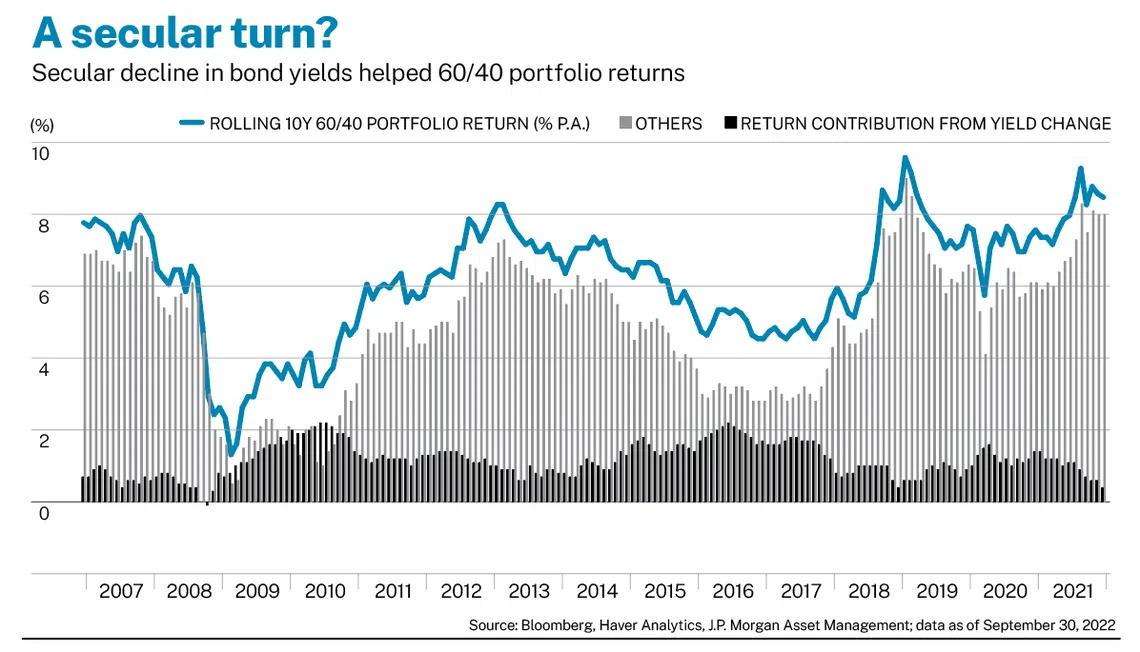
Bonds have endured a gruelling year. Surging inflation caused central banks to hike rates aggressively. This year alone, the US Federal Reserve has raised interest rates six times for a total of 350 basis points. The last four hikes were in increments of 75 bps. One more rate hike is expected when the Fed meets in December – an expected 50 bps this time, as the latest data points to some moderation in inflation.
Higher interest rates cause bond prices to drop and yields to rise. Today, the yield on US investment-grade debt stands at around 5.6 per cent, and high-yield debt at around 8.7 per cent. Emerging debt yields are under 8 per cent. In 2021, a 60/40 portfolio yielded less than 2 per cent.
For asset allocators, the biggest blow to bonds as an asset class is its failure to serve as a ballast for portfolios. Traditionally, investors rely on bonds as a stabiliser against the volatility of equities, because of low or historically negative correlation between the two asset classes. This year a series of inflation shocks caused correlation to spike; high inflation is seen as negative for both stocks and bonds. A 60/40 portfolio has so far lost more than 16 per cent year to date, based on the Morningstar 60/40 index. Its compilation of “moderate allocation” funds (35 per cent equity, 65 per cent bond) available in Singapore reflects an average loss of between 13 and 17 per cent.
Many strategists urge investors to allocate some assets into alternative investments, including hedge funds. Some hedge fund strategies such as CTA (commodity trading advisors) have generated returns in high double digits. CTAs invest in futures contracts linked to commodities, among others.
Retail investors, however, are in a bind, as access to alternative investments is severely restricted unless they qualify as accredited or sophisticated investors. Savers have flocked to low-risk options such as Singapore Savings Bonds and six-month Treasury bills, where interest rates are also the most attractive in decades. But even then the rising tide of applications may start to compress rates. The latest T-bill auction closed on Nov 24 with a cut-off yield of 3.9 per cent, compared to 4.19 per cent on Oct 27.
Providend investment head Cheng Chye Hsern cautioned against a knee-jerk prognosis for balanced portfolios. “This year is exceptional, and it is hard to say that bonds no longer work for portfolio diversification based on one data point. The yields on bonds are also much higher – 4-6 per cent in US dollars is possible in the investment grade space now. So even if a bond fund did nothing except to hold onto bonds, they would return 4-6 per cent a year for the next few years, much improved from the yields we saw previously. For an investor looking to invest right now, bonds are starting to look very attractive.”
Samuel Rhee, Endowus chairman and chief investment officer, says: “People can be contrarian when everybody calls for the death of the 60/40 portfolio. After the worst performance since 1937, we should be relooking at it based on today’s price points and valuations.”
“There are many hedge funds with good performance this year. But (for some) this may be the only year they’ve made good money. Or, there are those which didn’t even make money this year. Just like mutual funds, it is more about the manager of the fund, and not the exposure to the asset class. Also, alternative investments are generally less liquid; that is another key risk for which you should be compensated by higher returns.”
Here are some things to consider:
- Inflation factor. The big question is whether the traditionally low correlation between stocks and bonds would be restored. It depends on whether inflation is reined in, says Morningstar in a column. “If inflation is brought under control by the Fed, and should the economy slide into a recession, bonds could return to their recent role as an offset to the stock market.” JPMAM’s inflation projection for the next 10 to 15 years is modest – up only 30 basis points to 2.1 per cent for developed economies. “With prevailing global inflation of 7.3 per cent as at Sept 30, our faith that inflation will cool to levels close to central bank targets on average may seem optimistic… To be sure, risks to inflation are considerably more two-sided today, pointing to more volatility in inflation in the years ahead.”
- Fee factor. As always, lower fees reduce the drag on returns. Now more than ever, choose lower-fee funds, available at robo platforms such as Endowus.
- Rebalance. While 60/40 is often cited as a classic core allocation, the permutations are numerous depending on your investment horizon, risk appetite and savings goals. Now that fixed income yields are more attractive, it may be worth your while to rebalance towards a higher weighting in bonds.
- Essential income. While the appetite for income is perennial, it is even more essential for a long-term portfolio, as income is a big component of total returns. For the equity allocation, this suggests Reits and stable dividend payers.






