Asset managers freeze funds with notable exposure to Russia as sanctions bite
MSCI and FTSE Russell announce that they would drop Russia from their widely followed equity indexes

Singapore
ASSET management firms have suspended the dealing and valuation of unit trusts with significant exposure to Russia securities, as MSCI and FTSE Russell announced that they would drop Russia from their widely followed equity indexes.
FTSE Russell said the exclusion will take effect March 7. MSCI said its decision will be implemented "in one step" across all MSCI indexes at the close of March 9.
Based on Morningstar data, there are around 10 funds with exposure to Russia of over 30 per cent, authorised for distribution in Singapore. These include Russia single-country equity funds, as well as funds investing in emerging Europe or emerging Eastern Europe region where the exposure could be as high as 70 per cent.
Russia has a weighting of around 67 per cent in the MSCI Emerging Market Europe Index. In the broader MSCI EM index, Russia's weighting is roughly 3 per cent at end-January. But active managers of global EM equity funds tended to overweight Russia, with holdings at end-January of 5 to 7 per cent.
Year to date, the funds invested in Russia or emerging Europe are down by between 32 and 59 per cent, based on Morningstar data until mid-February. Investors who have an allocation will likely have to mark their holdings down to zero for now, given the inability to exit or to even obtain a valuation.
MSCI said it consulted with international institutional investors on the accessibility and investability of the Russian equity market. It said an "overwhelming majority" confirmed that the Russian equity market is currently uninvestable and that Russian securities should be dropped from the MSCI EM indexes. The MSCI Russia indexes will be reclassified from Emerging Markets to Standalone Markets status.
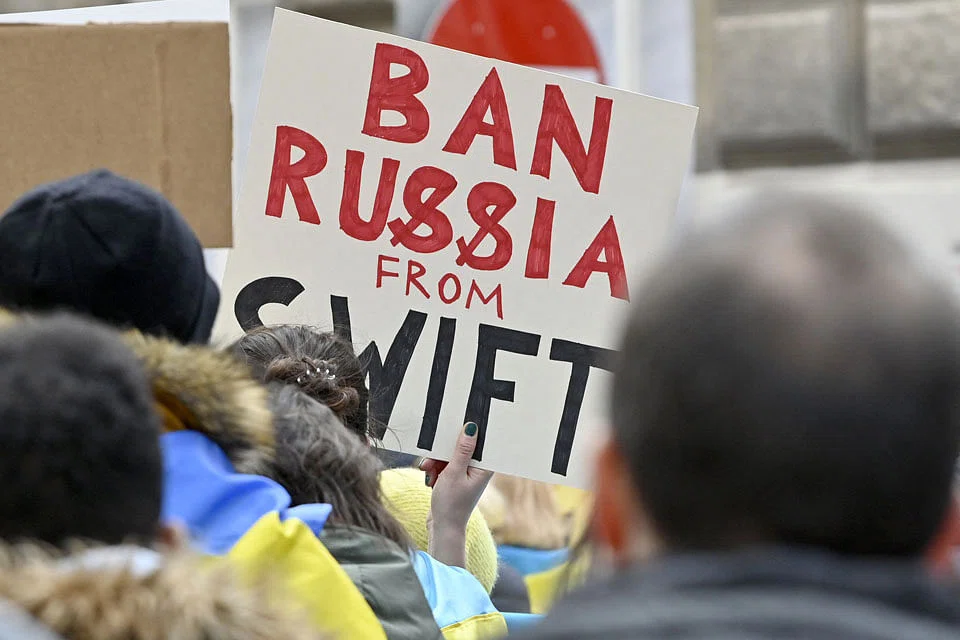
Among the most punitive of Western sanctions is the move to freeze the Central Bank of Russia's foreign reserves held overseas. The US, European allies and Canada also agreed to cut off key Russian banks from the Swift messaging system, which links over 11,000 banks and financial institutions in over 200 jurisdictions. The sanctions have effectively isolated Russia and severely impaired the liquidity of Russian assets, a key factor for inclusion in indexes. The rouble has tumbled for 3 straight days this week.
Russia in turn has imposed capital controls and reportedly instructed brokers not to execute sell orders from foreign shareholders.
In a note, OCBC said that it is currently unclear how capital outflows from Russia can take place. "It is unclear how index providers and other funds would be able to sell their shares and get their money out of the country. Without a liquidation of these positions, there is likely to be no rebalance flows across the rest of Emerging Markets.
"In the event that rebalancing can occur, (Russia's) relatively small weight would also be spread across the remaining countries. Meanwhile, capital flows that were originally meant for Russia could pivot to other emerging markets which share similar characteristics with Russia such as commodity-based economies."
Fidelity International has raised the ante to implement a firm-wide prohibition on investing in Russia and Belarus "for the foreseeable future".
Fidelity said: "We are addressing our existing exposure and, where it is possible and appropriate, we will look at options to reduce it in a thoughtful way which protects the interests of our clients and mitigates unintended consequences...
"At this stage, we have seen volatility increase and liquidity conditions deteriorate. Due to the uncertainty, market makers have become more conservative in their approach, leading market liquidity to become more challenging. Sanction conditions are likely to exacerbate this in the days ahead."
Wing Chan, Morningstar head of manager research (Europe and APAC), said: "Given that Russia makes up only a very small proportion of global emerging market benchmarks, material manager exposure is not widespread.
"The fortunes of Russian equities reversed quickly over the course of February. Fund managers are expected to reconsider exposures in light of increasing sanctions imposed by Western governments."
Funds that are currently frozen include Russia and Emerging Europe funds managed by UBS, JP Morgan Asset Management, Franklin Templeton, Schroders, BNP Paribas and BlackRock.
A BlackRock spokesman said: "Most of the BlackRock strategies holding Russia securities have relatively small exposures. We are working with investors to help them manage portfolios through this situation.
"Many of the funds with Russian exposure are index strategies that seek to track indexes with exposure to Russian securities. We are engaging with index providers on the treatment of Russian assets in these indexes."
It added: "We are taking all necessary actions to ensure compliance with applicable laws and regulations, including sanctions, including the US, EU, UK, Canada, Australia, and Japan."
More reports on Ukraine conflict: