

Bonds more attractive now than ever before, says Capital Group chair of fixed income
2023 could be a year of reinvestment in fixed income, and market leadership in equities is also broadening in a healthy sign

Genevieve Cua
FIXED income assets suffered a bad rep this year, as aggressive interest rate hikes by the Federal Reserve caused losses across the board, and robbed the asset class of its ability to provide diversification benefits to a portfolio. But this is expected to reverse in quick order by next year, says Mike Gitlin, Capital Group’s chair of fixed income management committee.
Even with the overhang of inflation, a possible recession and the uncertainty of when the Fed might pause its rate hikes, Gitlin expects 2023 will be a year of reinvestment in fixed income. To date, Investment Company Institute data for US mutual funds reflects a record outflow of nearly US$450 billion from bond funds. Year to date, both the Bloomberg Global Aggregate Total Return index and the S&P 500 are down by around 17 per cent.
“Fixed income is now so much more attractive than it has been at any point in a long time. You could put together a blended investment-grade and high-yield portfolio for a yield of 7.5 per cent, with the high-yield in short-duration assets.
“I think people are going to find it very interesting to invest in fixed income. Over the next two to three years, you’ll probably see the same amount and more come back into fixed income, that went out in 2022. I think you’ll see US$1 trillion come back, and you’ll get really attractive yields.”

While returns from various segments of the fixed income market remain in negative territory year to date, bonds have rallied in recent weeks, causing yields to fall and spreads to tighten. The catalyst was recent inflation data; headline inflation came in at 7.7 per cent for October, 0.2 percentage point lower than forecast. This has caused markets to expect a moderation in the Fed’s hiking path in 2023.
The fed funds rate, currently at 3.75 to 4 per cent, is widely expected to rise to 5 per cent in 2023. Gitlin says: “Most folks would say that’s factored into the short end of the Treasury curve, but is it? The question is how much is factored into credit spreads.
“There, it sort of depends on whether you believe we’ll have a recession. If we have a recession in the first half of 2023, you should assume that Treasuries will rally and credit spreads will widen… But you’ll also have a period when the Fed will have to stop and cut rates. I don’t think the Fed can cut in 2023. But as you get to 2024, the market is pricing in a 50 basis point cut.”
As the economy softens, default rates are expected to rise “probably to 4 or 5 per cent, instead of 2 per cent”. But the yield in the high-yield segment is currently close to 9 per cent. “There has never been a bad five-year (outcome) on a forward-looking basis when your inception yield is 9 per cent.”
For Jody Jonsson, member of the Capital Group management committee and president of Capital Research and Management Company, the scale of the downdraft in both equities and bonds is cause for optimism. “You just almost never have had this confluence where both asset classes are down at the same time to this magnitude, which makes me think something is going up next year. It actually makes me pretty bullish that maybe we’ve seen the peak in rates or are about to see it.
“I think stocks have had a first leg down and more recently we’ve had a de-rating of the whole market… We’re seeing the market leadership broaden out; we’ve been dominated by a narrow group of tech stocks for a decade. That’s changing and that’s really healthy.”
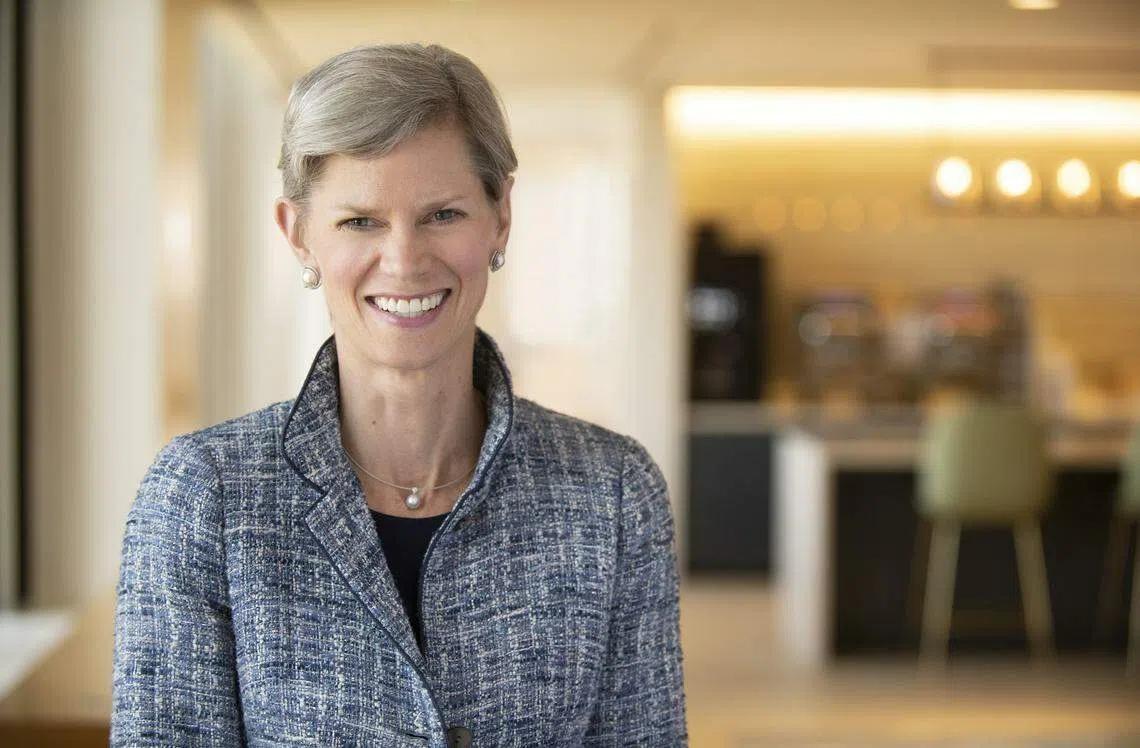
The technology sector, she says, remains attractive, but other sectors such as industrials and healthcare also deserve a look. “In a market where tech is cooling a little, there are a number of industrial companies which are very well-positioned to help in the energy transition. Tech stocks are going to have more of a service component, a recurring revenue component that makes them look more like a software company. The market pays up for that.”
Currently, when stocks and bonds are down at the same time, observers and even some asset managers have sounded the death knell for the traditional 60/40 portfolio. That is premature, says Jonsson. “60/40 is a simple concept of balance between stocks and bonds. For someone that might be 40/60.
“There are four reasons to hold fixed income – diversification from equities, income, inflation protection and capital preservation. Any individual will want some (bonds) in their balanced portfolio, whether they’re 90 or 40.”
Capital Group is known for its flagship New Perspectives equity fund, where Jonsson has been a portfolio manager since 2006. The strategy’s track record began in 1973. “What’s our advantage in an increasingly competitive world where everyone employs similar tools? I think the only truly enduring advantage when everyone has the same information is that we’ve seen companies and followed them over decades. We’ve built an institutional knowledge base of a company or industry that very few market participants have.
“I have companies I’ve owned the entire time since 2006. To be able to take that kind of view and look past all the noise, I think that’s truly differentiated.”
Capital Group manages around US$2 trillion in assets as at end-June. Its investment process – “The Capital System” – is a multi-manager system, as opposed to a single star or lead manager. A core offering such as a global equity fund may be divided into four to five ‘sleeves’, each independently managed by a portfolio manager who deploys a high-conviction, concentrated basket of stocks. This allows a fund to benefit from a diversity of styles, approaches, backgrounds and convictions. Fixed income assets are invested similarly.
TRENDING NOW

Two Singapore-listed palm oil firms named in Greenpeace report on Indonesian plantation fires

Singapore Airlines flight returns to San Francisco after ‘unruly’ passenger incident

Singapore looking into which companies responsible for haze-causing fires: PM Wong

Deluge IPO 3.86 times subscribed ahead of SGX debut

