What do you really 'own' when you buy an NFT?
A common question that has arisen among folks who have bought non-fungible tokens (NFTs) and those who are looking to buy, is: "What do I really own when I own an NFT?"
This question is even more pervasive now after a recent parliament session, where Finance Minister Lawrence Wong announced that Singapore's income tax rules will soon consider NFT transactions.
An NFT is an image or media backed by a unique digital key or a property title, visible transparently to everyone because it's on the blockchain.
Since the original creator still owns the copyright to the artwork, what you can do with your NFT really depends on the accompanying licences that come with the sale.
For all the brouhaha about coders replacing lawyers in the web3 world, these lengthy licences are still drafted by lawyers and are as verbose and lengthy as anything in the web2 universe.
Given the complexities and nuances of a commercial-use licence, my hunch is that they will only get more complicated in the future.
Value is often determined by the fine print. What NFT creators and buyers need most is an honest look at the parameters, which could shape the industry and national conversation.
Personal, non-commercial use only
This is the most restrictive form of licensing. The owner of the NFT cannot use the artwork for anything other than personal use.
For example, the NFT I own from the Goblin Laboratory states quite clearly in the licence that I "own only the NFT, not any associated Art".
I can use the NFT for personal, non-commercial use - as my display picture on Twitter, for instance - or I can list it for sale on a platform like solanart.io.
With this licence, there is an explicit restriction on my ability to produce or sell merchandise or other tangible or digital goods based on the art in my NFT.
This brings to mind another popular NFT project with a personal-use only licence: NBA Top Shot Moments.
The project by CryptoPunks was also accompanied by a similarly restrictive licence until Yuga Labs acquired it earlier this month and is now giving away commercial rights to its community.
Commercial use
Broadly speaking, this type of licence permits the NFT-holder to use the NFT and the art associated with it for commercial purposes. How broad the scope of this is, is again, limited by the terms of the licence.
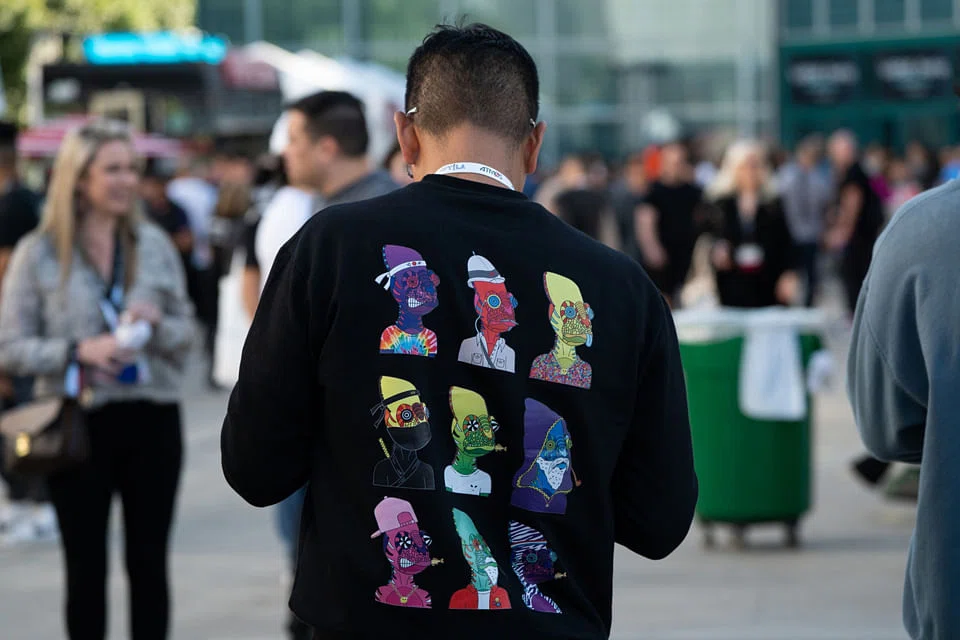
The pioneering NFT project that allowed its community to commercialise its artwork was the Bored Ape Yacht Club (BAYC), which states that "when you purchase an NFT, you own the underlying Bored Ape, the Art, completely".
The terms specifically allow the NFT-holders to create derivative works like T-shirts and earn revenue from them.
During the recent funding of Yuga Labs, valuing it at US$4 billion, the CEO spoke about this "new economy" that's possible because of the intellectual property for Apes, Punks and Meebits being owned by the community.
Another project, Doodles, has granted commercial rights to its community.
However, there's an upper limit of US$100,000 that the holder can make through the sale of physical merchandise or the use of a Doodle in a piece of art they may create.
World of Women, on the other hand, had its floor price rise by 400 per cent just a few days after it transferred all copyright associated with the artwork to its NFT holders.
The artist world is certainly divided on whether or not commercial rights should be granted alongside NFTs. Mike Shinoda of Linkin Park fame, who released the world's first generative NFT mixtape called Ziggurats, is of the view that giving away commercial rights takes from the artist.
This, to him, is the opposite of what NFTs started out to do, which is to give artists the ability to monetise. It comes as no surprise that his NFTs are then accompanied by the very-restrictive personal-use only licence.
Another fundamental question persists: does any of the underlying art or media really need to be in the form of NFTs if the licensing is a completely different contract?
One can surely imagine a situation in which the creator sells the NFT to a first buyer who then sub-licences out a commercial-use NFT to a third-party before going on to sell the NFT to a second buyer.
What is the value of the NFT in the hands of the second buyer who merely "owns" the NFT, but not the licensing rights?
While most project terms are silent on this, The Word of Women contract protects the rights of the sub-licensor thereby diminishing the rights in the hands of the second buyer.
While giving out commercial rights, certain projects like Doodles specifically prohibit creating other projects and NFTs which are derivatives of the original project. This is where a no-copyright structure helps.
No copyright
For certain projects like Cryptoadz, the creator waives all copyright and related or neighbouring rights to the piece. This is otherwise known as "Creative Commons" (CCO), which allows the artists or creators to waive those interests in their works and place them as completely as possible in the public domain.
This means that others can legally and freely build upon, enhance or reuse the works for any purposes without restriction under copyright or database law.
As a result, we've seen merchandise and products with Cryptoadz, as well as derivative NFT projects on different chains (for example, Soltoadz).
For such open projects, the more popular the artwork becomes, the higher the value of the original NFTs - so there is little point to restricting its use if the creator wants the artwork to spread far and wide.
Read the fine print
It is quite clear that all NFTs are not created equally and the varying nature of the terms of each project make it clear that it's critical to read the terms of each project and understand the scope of NFT ownership.
Creators of NFTs need to determine what they want their projects to be used for and consider what they are really offering to those buying into their project. Understanding the implications of each licensing option could impact an NFT buyer's ability to use the NFT and potentially, the value of the project.
- The writer is a partner at Saison Capital
READ MORE: NFTs: Are they art or artifice?