

Agri-food’s transition from a liability for sustainability into an asset
There are solutions to agriculture’s negative externalities, where investors and capital markets can help

THE agri-food industry is central to our daily lives and nutrition, but it also generates up to 30 per cent of global greenhouse-gas emissions, making it second only to fossil fuels as a human-made driver of climate change.
It also has a strong impact on natural capital.
At least 90 per cent of global deforestation is attributed to the agri-food industry, and it accounts for 70 per cent of global freshwater consumption.
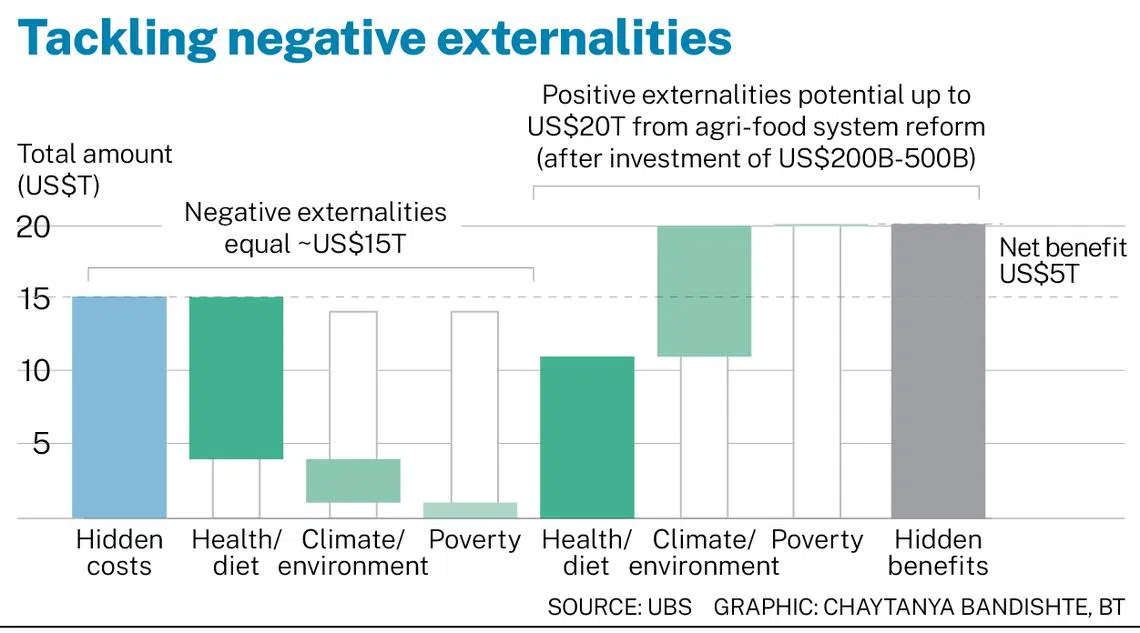
With reform, the sector could generate US$5 trillion in positive externalities.
A recent analysis estimated the industry generates net economic costs of US$15 trillion every year, the equivalent of 12 per cent of global gross domestic product.
It also gauged that a comparably smaller investment of between US$200 billion and US$500 billion is required to reverse these externalities, creating a potential economic windfall of US$5 trillion in net economic benefits.
Structural headwinds
Today, the agri-food industry is highly fragmented across different farms, traders, distributors and retailers.
It faces unique challenges that include cash flow cyclicality, intensely price-driven dynamics, and inherent uncertainty created by a weather-dependent production cycle.
These issues make it difficult to roll out new technologies.
The factors also brew a general reluctance to invest in more efficient productive assets, as well as research and development, which keeps innovation rates low.
This is reflected in venture capital holding periods that average nine years in the agriculture industry, compared to six years for others.
Solutions across grow, move, eat
A plausible path forward exists. Many solutions are available across the three stages of the value chain – “grow, move, eat” – that can both lower the industry’s emissions and reduce its impact on biodiversity.
Farmers and companies can position themselves ahead of trends by adopting and testing new solutions, capturing premiums in different forms, and putting themselves in an advantageous position as the industry transitions towards a net-zero, nature-positive state.
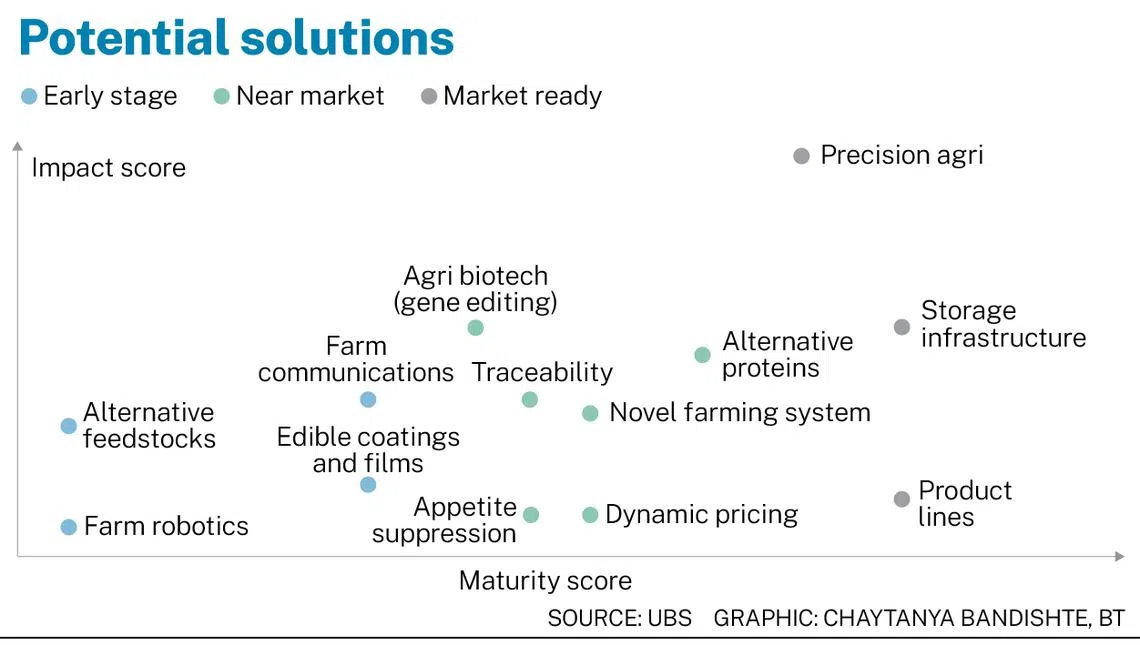
Solutions fall into three buckets. The first set is “market-ready” solutions which are mature and investable today and offer a high impact in the 2020s. One example is precision agriculture-technologies that can dramatically improve on-farm input efficiency and yields, such as drip-feed irrigation.
While results vary by farm, these solutions are often a “no brainer” for two reasons: Firstly, they reduce operational costs for farms while improving yields, particularly with recent spikes in the price of energy that puts pressure on farms to improve input efficiency.
Secondly, they lead to substantial sustainability benefits, as the “grow” stage of the value chain is targeted. That generates almost three-quarters of the industry’s emissions, and drives most of its biodiversity impacts via land-use change.
“Near market” technologies are close to scaling and offer medium-to-high impact, but they face barriers, ranging from technological readiness to public acceptability. This means, based on our research, we do not expect them to have a major sustainability impact until the 2030s.
A good example is alternative proteins. They offer sustainability benefits but also face barriers such as taste and texture issues, and higher shelf prices.
The third group, “early stage”, refers to nascent solutions which could generate substantial sustainability benefits as they mature, but are unlikely to have a noticeable impact any time soon. For instance, farm robotics can improve yields through automating farm processes, but they tend to be expensive for cash-strapped farms. Fully automating a farming process is also technologically difficult as each field and crop is unique.
The role of capital providers
The financial sector can help facilitate the agri-food transition by convening users of capital across the value chain and matching them with capital providers based on their risk-return preferences. For this, we propose a three-pronged framework:
- Finance: Offer an extensive menu of financing options, which reflects the fragmentation of the industry and supports their financing needs. Mature and high-impact solutions tend to be readily financeable through conventional instruments and have well-known risk-return profiles, thus appealing to institutional investors. For less mature solutions, capital providers with higher risk appetites – such as venture capital and specialist funds, as well as blended finance instruments – can enable these solutions to move down the cost curve.
- Convene: The financial sector can convene stakeholders to promote the deployment of sustainability solutions by connecting innovators with capital providers. In general, the upstream end of the agri-food value chain adopts innovations slowly. Strengthening knowledge sharing between stakeholders is also crucial. The FAIRR (Farm Animal Investment Risk and Return) Initiative, of which UBS is a member, is an example of effective convening in practice.
- Engage: The financial community cannot engage every single farmer, but it can target large food companies and commodity traders, who hold significant sway on the dynamics of food value chains through pricing and procurement.
While the financial sector is an enabler of progress, it cannot deliver system change alone. Public authorities need to be in the driving seat for the agri-food transition.
For instance, agricultural subsidies generally do not align with sustainability goals. The necessary changes to industry and consumer practices raise social and political questions which only the public authorities have the mandate to tackle.
The writer is ESG analyst, UBS Sustainability and Impact Institute. He authored the institute’s Grow, move, eat, repeat report.
TRENDING NOW
Three ex-employees of Envy group join Ng Yu Zhi in bankruptcy

He built the Vingroup empire. Now South-east Asia’s richest man is handing some key roles to his sons

Grab CEO’s wife Chloe Tong on life with Anthony Tan and finding her purpose

Incidence of civil servants buying property near unannounced MRT stations ‘a concern’, but may not establish misconduct: PSD

