

The big surprises of 2023 and what it means for 2024


INVESTORS have plenty to celebrate in 2023. As measured by the MSCI World Index, global equities grew over 20 per cent while long-term interest rates fell, leading to price gains for bonds. This is a pleasant surprise, as at the start of the year.
Many forecasters were expecting a recession in the United States due to the elevated inflation: 6.5 per cent for Consumer Price Index (CPI) and 5.7 per cent for core CPI against the Fed’s target of 2 per cent.
Several market pundits also expected inflation to be sticky due to a myriad of structural dynamics such as de-globalisation and energy transition.
Contrary to these predictions, inflation fell precipitously, with November’s CPI up only 3.1 per cent year on year, compared with a high of 9.1 per cent in the middle of 2022. While core CPI remained at a brisk 4 per cent, more recent data suggested that price levels would converge soon to the Fed’s inflation target of 2 per cent.
Unit labour costs, a proxy for wage inflation, rose by only 1.6 per cent despite a relatively tight labour market. Several economists premise the recession call on the historic high vacancy rate, or the number of job openings over the number of unemployed.
When the year started, the vacancy rate stood at 1.94, which means that for every 194 job openings, there were only 100 unemployed workers available. A paper published in the National Bureau of Economic Research by Alex Domash and Lawrence Summers in April 2022, argued that a tight labour market of the magnitude experienced in 2022 would likely result in a hard landing as the Fed will have to crush aggregate demand to reduce labour demand, to balance it with labour supply.
Indeed, the Fed executed one of the most aggressive monetary tightening in history, bringing the Fed funds target rate from zero to 5.375 per cent at midpoint while shrinking its balance sheet.
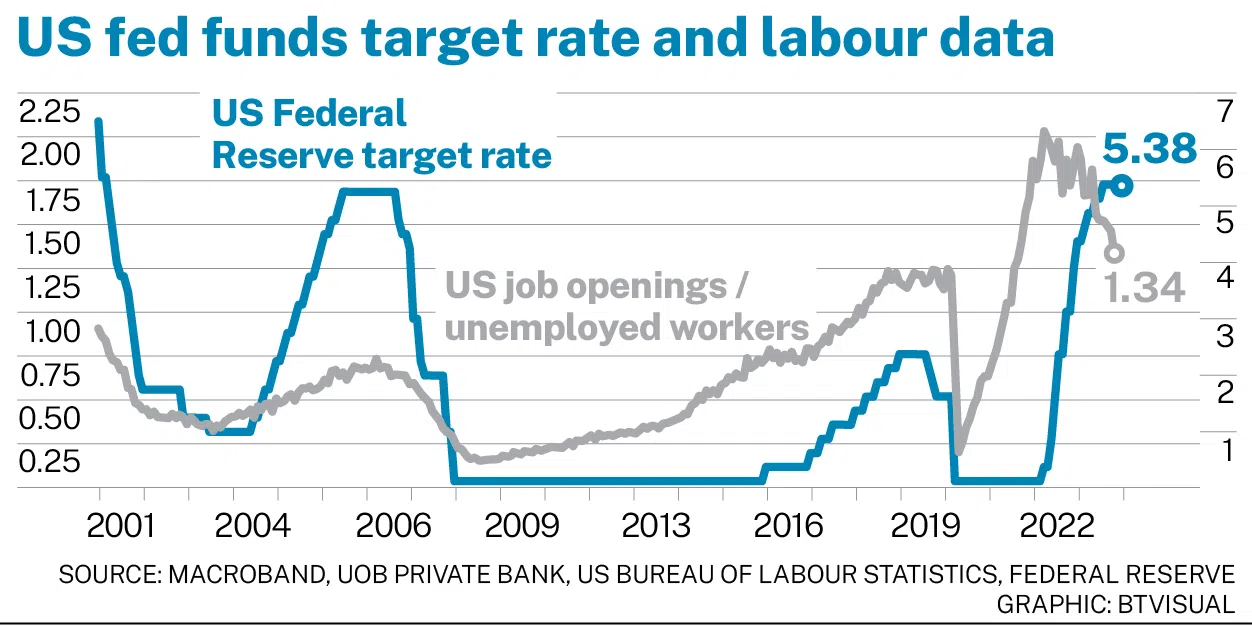
However, not only did the US economy not experience a hard landing, but there was also no recession. Stocks even rallied over 20 per cent. In addition, the economy expanded at an average rate of about 3 per cent while inflation trended lower. The labour market also softened without a concomitant surge in unemployment rate.
Why did the US economy surprise so many economists and investors?
The almost near “perfect” landing for the US economy is unprecedented and puzzling for many economists whose predictive toolkit comprises models that extrapolated from past data. This cycle, which started in 2020, has been so unique that the past 10 post-war cycles would not serve as a useful template to understand current dynamics.
The key difference is that the inflation surge in 2021 was predominantly supply driven, mainly due to the pandemic upending the supply chain. The Fed had an initial hypothesis that the surge in inflation was transitory, but capitulated to a more persistent inflation view when prices kept edging higher.
In retrospect, the Fed’s initial instinct was correct. As supply-chain disruptions were progressively resolved with production resuming post-lockdowns, the inflation rolled over.
The other driver was the role of fiscal policy. While the Fed was battling high inflation in the early parts of 2023, the US government ran a highly pro-cyclical fiscal policy to the tune of 6.5 per cent of gross domestic product.
The contribution of fiscal impulse may have given the impression that the high interest rates have limited impact on the economy. However, it is unlikely that such expansionary fiscal policy can be sustained in 2024. The ongoing drama surrounding the debt ceiling is likely to put a lid on government spending.
Implications for 2024 outlook
We have a constructive outlook in 2024 as inflation continues to decelerate with most economies growing moderately. With the Fed funds rate at 5.375 per cent, the Fed can afford to cut rates without a material slowdown in growth.
As the lagged effect of past monetary tightening will eventually pose as a drag on growth and positive fiscal impulse fades, the economy will slow down.
Having said that, we expect a soft patch rather than a deep recession as the recovery in the manufacturing sector and continued healthy labour income growth will support consumption activities.
In such an environment, corporate earnings can expand. As interest rates fall, the current price-to-earnings ratio of the S&P 500 is at 21 times. While this is expensive relative to history, it can be sustained with the 10-year bond yield between 3 and 4 per cent.
Cyclical sectors could continue to perform in this environment. The top 10 stocks by market capitalisation account for over 65 per cent of the returns in the S&P 500 in 2023. While these names will benefit from falling interest rates and the widespread adoption of artificial intelligence, investors could seek investment opportunities beyond the mega-caps. Sectors and stocks that benefit from declining interest rates will perform well in 2024.
Another surprise is that emerging markets, excluding China, have performed relatively well, largely because they were ahead of most developed markets in hiking interest rates to combat inflation and, correspondingly, in cutting rates as well.
In our view, Chinese equities are cheap, but await a meaningful catalyst due to the government’s general reluctance to deploy demand stimulus. However, there is a clear threshold of pain that is unacceptable as with the experience of the sudden abandonment of the zero-Covid policy.
Avoiding a catastrophe
For now, any incremental stimulus is likely to be just enough to avoid a catastrophe. Due to attractive valuations, downside risk is limited and there could be episodes of rallies such as the post-bubble Japanese stock market in the 1990s. A sustained bullish trend is unlikely to be established under the current policy framework.
Japan will continue to perform well although the yen could strengthen as the Fed, the European Central Bank and other central banks begin to ease monetary policies. Japanese equities will be supported on continued earnings growth, structural reforms and reasonable valuations. The currency is best left unhedged.
Fixed income will continue its fourth-quarter rebound in 2024 as rates continue to fall on the Fed’s easing. This asset class will likely outperform cash returns as duration contributes to price gains on top of the coupon income. Credit spreads are already tight but selective opportunities remain, notably in bank capital and private credits.
Finally, we continue to advocate an allocation to alternatives. Private assets will perform well on supportive macro factors, while alternative assets also generate diversification benefits.In 2024, there are numerous political events, with elections to be held in many parts of the world including Taiwan, Russia and the US.
While most of these events do not always have a material lasting effect on economies, they may induce episodes of rising volatility. The key to successful investing is constructing a resilient portfolio that can withstand unexpected shocks.
The writer is chief investment officer at UOB Private Bank
TRENDING NOW

Olivia Lum, ex-CFO not giving evidence in their Hyflux trial

Bank on AI-resilient Singapore property via deep-value listed property groups

Positive pivot or premature? Analysts split on Keppel Reit’s S$610.9 million buy

Once staunchly pro-China, Malaysian Chinese businesses are now distancing themselves from Beijing

