Singapore marks catastrophe bond milestone amid record issuance and returns
Nearly US$1 billion of renewals from three sponsors are in the pipeline

Genevieve Cua

SINGAPORE marks a fresh milestone in its ambition to become a hub for issuance of insurance-linked securities (ILS) in Asia.
This year in January, three renewals of catastrophe (cat) bonds by MS Amlin Asia Pacific – with a total value of US$35.24 million – were listed on the Singapore Exchange (SGX). The renewals are a first for Singapore, which has been active in inaugural issuances. Amlin’s tranches, however, are icing on the cake.
Over the next few weeks, some US$1 billion more in renewals is expected to launch and list on SGX. The renewals are by three insurers or sponsors to cover property risks in Japan, arising from natural calamities such as earthquakes and typhoons.
Simon Goh, Rajah & Tann’s (R&T) head of insurance and reinsurance, said renewals are significant as they signal the maturity and sustainability of Singapore as a base for ILS origination.
“To sustain the market, you must have bond renewals. It has been a bit of a learning curve for our team and for the sponsor. The next three renewals will make a big difference. It shows that we can go to market very quickly, and we have the infrastructure and depth of expertise to do a renewal,” said Goh.
R&T is among the largest law firms in Singapore. It is the legal counsel for virtually all cat bonds domiciled in Singapore so far.
Since 2018 there have been 25 issuances out of Singapore, including the January renewals, with a total volume of nearly US$5 billion. Singapore has captured around 33 per cent of Asian risk in terms of volume, and about 42 per cent in terms of number of issuances.
Globally, 2023 was a banner year for cat bonds in terms of issuance and investor returns. Swiss Re estimates the ILS market grew by more than 20 per cent to US$43.1 billion by end-2023, up from US$35.5 billion in 2022. New issuance surged by 63 per cent, reaching a record of US$15.4 billion.
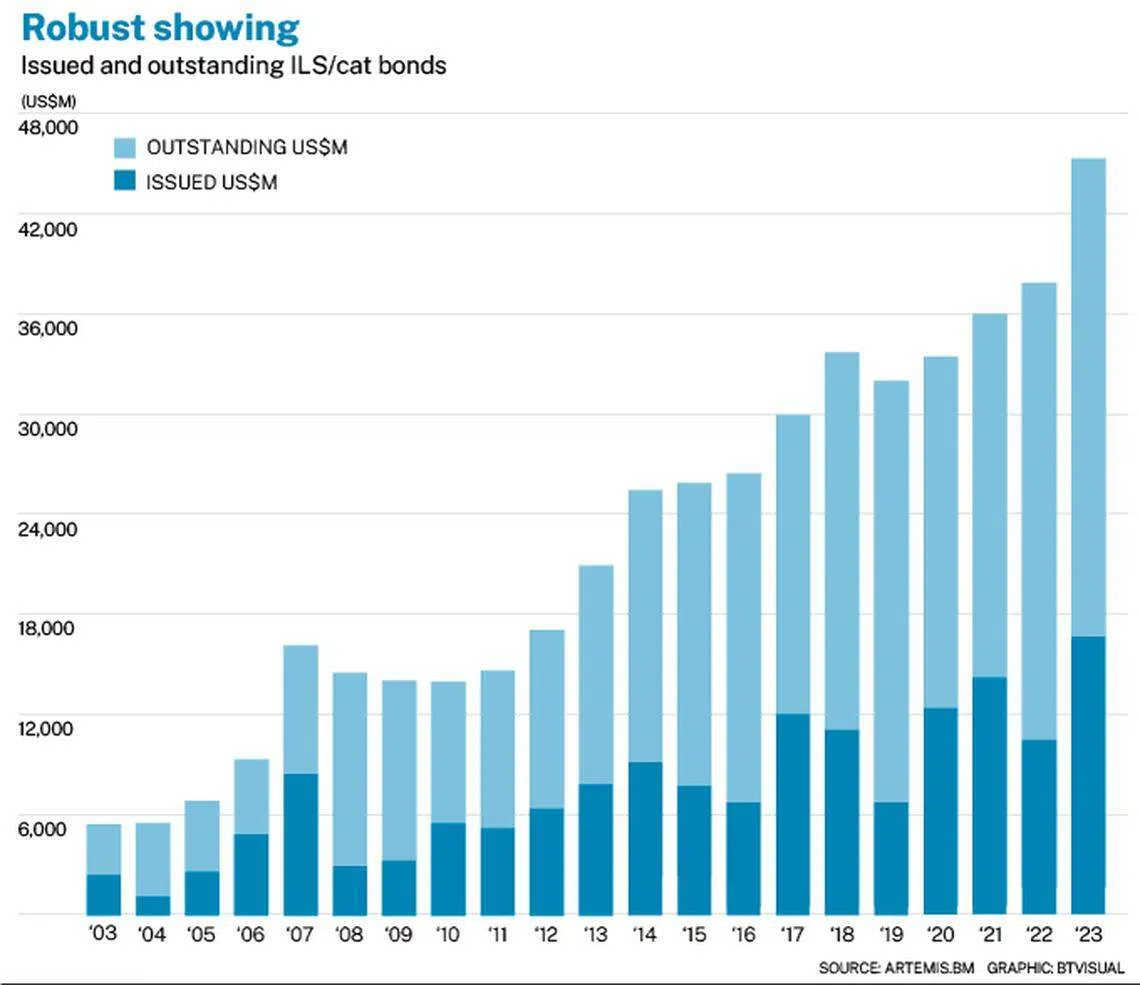
Last year also saw the launch of cat bonds to cover cyber risks for the first time. ILS data provider Artemis says some US$415 million of cyber cat bonds were issued, mostly towards year-end, “as the nascent cyber ILS market gained long-awaited traction”.
Returns were also stellar, thanks to a confluence of factors. The year 2023 was relatively muted in terms of large catastrophe events. This encouraged new capacity and helped spur a recovery in previously discounted cat bond prices.
Premiums also rose, reflecting the cost of insuring large-cat events. The Swiss Re Global Cat Bond Total Return Index posted a record 19.69 per cent return in 2023, the highest one-year return since 2002.
Based on Preqin data, ILS strategies generated returns of 14.4 per cent, the strongest returns of all hedge fund strategies in 2023.
Artemis data shows an average coupon of 9.2 per cent for Q4 2023 issuance, compared to Q3’s 8.38 per cent. The full year 2023 average coupon was 8.9 per cent.
Cat bonds, the dominant segment of ILS, are a type of securitised risk transfer by insurers or reinsurers in the form of a debt instrument. Cat bonds help to fill protection gaps in the marketplace for which traditional insurance or reinsurance may be scarce or too costly.
Climate change in particular has driven extreme weather events, exacerbating so-called “secondary” perils including wildfires, floods and landslides.
Aon estimates a global protection gap of US$262 billion from natural disasters; the gap is defined as the difference between total economic losses and losses covered by insurance.
In Asia, economic losses are estimated at US$65 billion against insurance losses of just US$6 billion. The gap is acute at 91 per cent.
For investors, cat bonds carry little or no correlation to stocks and bonds, giving them a place in portfolios as diversifiers. Investors benefit from an attractive yield, and receive coupon and principal if no disaster occurs.
If a disaster occurs, however, investors could lose some or all of their money, as proceeds are used to cover the cost of the disaster.
Cat bonds are mainly an institutional market, but R&T’s Goh hopes for take-up among family offices.
Matthew Song, SGX head of capital markets, said: “Singapore aims to be the leading ILS hub in Asia. As the SGX is the largest bond-listing venue in Asia-Pacific, we see a role that we can play in solidifying Singapore as a reinsurance and speciality insurance centre in Asia. The Asian institutional and accredited investor base continues to grow for ILS.” To date, there are 10 ILS listed on SGX by four issuers.
Song said SGX aims to support the growth of ILS and a wider range of ILS risks and instruments. “We will build on this momentum and anchor capabilities in ILS structuring, risk modelling, loss reserve adjustments, and fund management to better support corporate and sovereign cedants in the Asian time zone.
“As the leading fund and wealth management centre, Singapore is well positioned to promote the growth of ILS investment products, and grow a well-informed investor base.”
Singapore has had special purpose reinsurance regulation since 2008, but saw little action for a decade. The Monetary Authority of Singapore (MAS) formed the ILS working group in 2017, and a year later it built a tailored regulatory, tax and listing infrastructure to cater for ILS issuances. It also introduced a grant scheme with a focus on Asia-Pacific risks.
The MAS’ grant scheme has been extended until end-2025 and has been expanded beyond cat bonds, to include sidecar and collateralised reinsurance issuances. The grant also supports issuances covering longevity, mortality and cyber risks.
The first cat bond issuance out of Singapore was Orchard ILS in early 2019, sponsored by the Insurance Australia Group. That bond was triggered and “fully exhausted” by claims due to severe wildfires in Australia in 2020.