THIS TIME IS DIFFERENT

China nibbles at dollar dominance and US’ control over global money flows

The greenback currently accounts for about 70% of international currency usage, against the yuan’s 6%
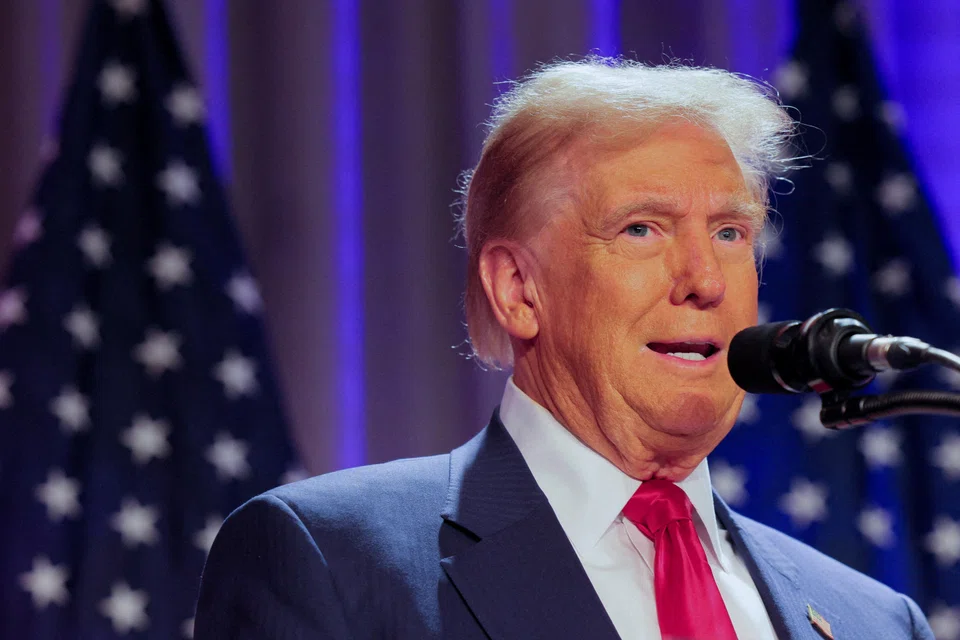
    • President-elect Donald Trump on Nov 30 said Brics countries could face 100 per cent tariffs if they created a new currency for the bloc.
    • President-elect Donald Trump on Nov 30 said Brics countries could face 100 per cent tariffs if they created a new currency for the bloc. PHOTO: REUTERS
    Published Mon, Dec 16, 2024 · 05:57 PM

    WHEN I wrote last month about the Brics conference held in Kazan, I was not expecting to touch on this topic again for another six to 12 months because the group would need to overcome large hurdles to achieve its target of building a new multipolar world order as an alternative to the petrodollar system that has been in place for decades.

    The stated targets in the Kazan conference were so grand in scope that they would be expected to take a long time to come to fruition, if ever – especially given the disparate goals of each government.

    Yet, last month brought a startling turn of events that left bond traders questioning the reality unfolding before them.

    China issued a government bond for US$2 billion. This by itself is routine; it would not have raised eyebrows. However, what did raise them was how the issuance was done and what happened afterwards.

    The bond was issued in Saudi Arabia, at a yield of only 0.01 per cent above equivalent US Treasuries. It was 20 times over-subscribed, and it was launched on the day the US experienced very weak demand for one of its regular bond auctions. Post-trading, the yield of this China bond fell below the yield of US Treasuries.

    So, at that point in time, China – a country that needs to earn US dollars to pay back its debt – could pay less interest than the US government on its dollar debt. This should not have happened since US Treasuries have been the global risk-free rate for the last 70 years.

    There are two possible explanations. The first is that this is a temporary anomaly, perhaps linked to Saudi Arabia having too many US dollars to invest at this point in time.

    The second is more intriguing – that this is the next step in a change in the US dollar’s influence as the global reserve currency.

    Why would China borrow US dollars, when it has an enormous annual trade surplus with the US? A possible answer is that this is the initial salvo by the Brics countries – comprising Brazil, Russia, India, China, South Africa, and their allies – to make a statement in bond markets:

    • They are concerned about the safety of US dollar-denominated assets, given sanctions and the freezing of Russian assets.
    • They are concerned about the path of US fiscal policy and rising deficits.
    • China has the ability to compete for dollars with the US government, making it more difficult to conduct successful Treasury auctions. 

    If the last point is repeated with future bond issuances, the petrodollar recycling system that the world has known for decades may be ending.

    Gavekal, an independent Asian investment research firm, wrote on a possible thought-provoking path forward.

    By having the ability to borrow in US dollars and selling this debt to other Brics countries, the net effect is that China could be helping countries that join its Belt and Road Initiative pay back debt owed to Western lenders via the dollar system.

    This debt could then be swapped into Chinese yuan, speeding up the global adoption of the currency as an alternative to the US dollar. Such a system would potentially help emerging-market (EM) countries with large dollar debt bypass the World Bank and other Western institutions.

    US dollars raised by China’s new bond issuance can be deposited in Hong Kong banks, and in turn, lent to other Asian institutions which have existing dollar debt to be refinanced. This system greatly weakens the US’ ability to control global money flows outside its own borders – as it has been doing.

    Gavekal calls this scenario outcome speculative, but one that investors should pay attention to.

    Currently, the US dollar accounts for about 70 per cent of international currency usage, against the yuan’s 6 per cent. The yuan’s global trading is even below the yen and the British pound.

    The Chinese currency’s recent percentage of China cross-border transactions has risen to 53 per cent this year, from 40 per cent in 2021. We can anticipate China’s import/export figures denominated in yuan to continue to rise in the coming years, though it will have an uphill battle to replace the US dollar.

    Should Gavekal’s scenario begin to take shape, it could lead to an Asian boom in credit – one in which Wall Street would not participate, as the US Treasury would have diminished control over external lending of US dollars.

    Such an event would potentially be bullish for EM bonds. EM equities performed poorly last month as US equities notched new all-time highs, due to concerns on Trump’s tariff policy. But EM sovereign bonds were a mirror image, outperforming US and European sovereigns.

    Gavekal argues that China has been establishing its 10-year government bond as the world’s reserve value since 2012.

    Global investors have scoffed at this idea in the last decade, but recent events suggest that this is no longer a far-fetched one.

    If countries with a US dollar trade surplus recycle their cash into China government bonds instead of US Treasuries, and they yield less than Treasuries, they will compete for global attention as the new risk-free asset.

    Or, said in another way, the time value of money would no longer be solely under control of the US.

    Further, if this leads to a money supply boom in Asia, while inflation in the US does not come down due to increasing deficit spending, it could also be a trigger for an end of Asian equity underperformance versus the US over the coming years.

    In response, president-elect Donald Trump on Nov 30 announced on his Truth Social platform: “The idea that the Brics countries are trying to move away from the US dollar while we stand by and watch is over. We require a commitment from these countries that they will neither create a new Brics currency, nor back any other currency to replace the mighty US dollar, or they will face 100 per cent tariffs, and should expect to say goodbye to selling into the wonderful US economy.”

    If the Brics initiative elicited such a response from the future US president, it suggests that change is underway.

    The writer is head of investments for Singapore at AlTi Tiedemann Global. The views are solely his, and do not reflect the views or positions of AlTi Tiedemann Global or its subsidiaries. This content should not be considered as financial advice.