Chipmakers heading for an epic rebound
Semiconductor sales expected to surge 40 per cent by 2025, thanks to structural rise in demand
CHIPMAKERS are once again on the cusp of a new revolution.
The semiconductor industry has been mired in a downturn since Q4 as chip sales plunged by nearly 10 per cent year on year, the first negative print since 2019. Fast forward to today, the slump in sales has worsened, coming in at minus 20 per cent as at Q2 of 2023. This comes as many chipmakers, including the likes of TSMC (Taiwan Semiconductor Manufacturing Co) continue to warn of falling demand and rising inventories, a trend that is likely to persist for the remainder of the year.
Despite the grim near-term outlook, we think the industry is headed for a rebound with the potential for semiconductor sales to rise 40 per cent year on year by Q2 of 2025. Underpinning this prediction is our belief that chipmakers will see a massive structural increase in demand as the world becomes increasingly digitalised, leading to (i) more semiconductor applications and (ii) higher silicon content in them.
Over the past few months, our conviction has become even stronger as the artificial intelligence (AI) frenzy took the world by storm following the launch of ChatGPT in late-2022. We believe the industry is once again on the cusp of a new revolution thanks to the rapid adoption of AI, which requires highly advanced processors that are capable of handling huge, complex workloads efficiently.
Just like previous revolutions such as personal computers and mobile, we expect the AI revolution to bring tremendous opportunities for chipmakers over the next decade and more.
Inventory cycle adjustments to result in higher sales growth
To give some colour on why we think 40 per cent year-on-year sales growth is achievable, we’ll have to revisit the inventory cycle. Semiconductor cycles are essentially driven by fluctuating sales growth numbers, which are caused by distortions to supply-and-demand dynamics. There are a few factors, but for the most part, these distortions can be explained by over and underestimations in production levels.
Given how dependent the world is on technology and the growing number of end-use products we have today, the overall demand for electronic products (and by extension semiconductors) tends to see a steady increase each year under normal conditions. This is represented by the grey line in the accompanying graphic, which depicts a simplified version of the inventory cycle.
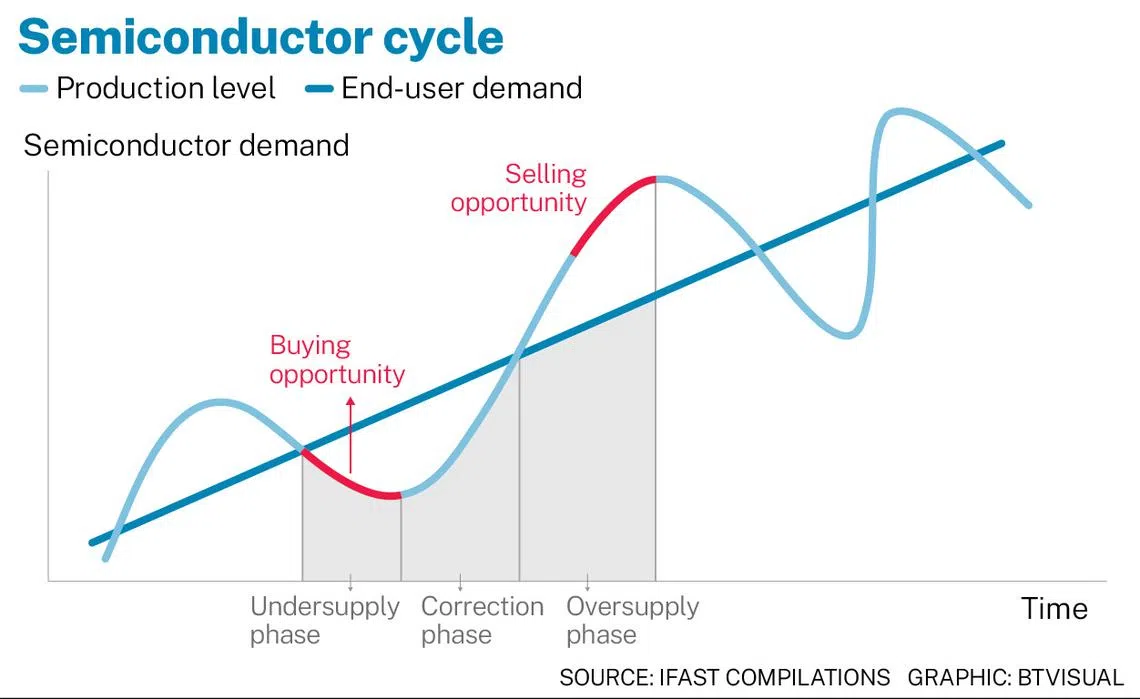
In contrast, the supply of semiconductors tends to vary a lot more. This is mainly due to adjustments in production levels by chipmakers. When times are good, chipmakers tend to overestimate demand, invest heavily in capacity, and produce more than what the market can absorb.
Over time, the high level of production eventually becomes unsustainable as inventory starts to build, leading to an oversupply. When this happens, chipmakers slash prices and cut down on production as they work through excess inventory, causing sales growth to fall – even as demand remains relatively stable.
But just like how chipmakers tend to over-produce when times are good, they also have the tendency to under-produce when times are bad. Put simply, it is the excessive adjustments in production levels that lead to fluctuating sales growth numbers, a characteristic that defines the cyclical nature of the semiconductor industry.
Looking back at the industry’s capex post-Covid, it is clear that chipmakers have gone too far. In 2021 and 2022, capex rose by a staggering 39 per cent and 20 per cent respectively, a rate that is significantly higher than the pre-Covid years.
Unsurprisingly, this sudden and sharp increase in capex resulted in a supply glut. Today, several chipmakers have made significant downward revisions to their capex budgets, citing bloated inventory channels as one of the key reasons. On an industry level, capex is projected to shrink by nearly 20 per cent this year as chipmakers continue to hold back spending.
While the near-term outlook certainly warrants a more cautious approach, we think that the market is underestimating the impact AI will have on chip demand in the long run; supply is currently inadequate at present. Once this downcycle blows over and clearer signs of a recovery emerge, chipmakers will likely have the confidence to bring more supply online, which should translate to higher sales growth in the long run.
Government incentives and base effects
Across the world, governments are handing out massive incentives to build fabs, adding to the total supply of semiconductors in years to come. In the US, we have the US$280 billion Chips and Science Act, designed to boost American semiconductor research and development as well as manufacturing.
Since the Act was passed in August 2022, several domestic companies such as Micron, Qualcomm and GlobalFoundries announced plans to increase their manufacturing capacity on US soil. Even foreign chipmakers are taking advantage of the Chips and Science Act. TSMC is building two leading-edge fabs in the state of Arizona, which it targets to be operational by 2025.
In Asia, China has made the development of its domestic semiconductor capabilities one of its biggest national priorities. Japan, whose chipmakers once dominated the industry in the 1970s to 1980s, is also looking to regain its lost status as a semiconductor powerhouse, with the government launching several initiatives geared towards attracting semiconductor investments on Japanese soil.
With the industry still in a steep downturn today, base effects as well as the massive incentives handed out by governments across the globe should help to drive higher sales growth once the recovery gets underway.
Think long term
Known as the building blocks of technology, semiconductors will forever have a place in the global economy. The current downturn is merely a temporary setback for chipmakers and does little to derail the industry’s long-term growth story.
Taking into consideration all the factors mentioned above, particularly the structural megatrends of AI and digitalisation, we are confident that semiconductors will be one of the best-performing sectors over the next decade. With a recovery of the chip cycle in sight, chipmakers are likely to see an increasingly positive earnings outlook, a catalyst for share prices to rise further.
Investors who can look beyond the near-term headwinds should see what we see – an industry that is set for explosive growth in the coming years.
The writer is a portfolio manager of the research and portfolio management team at FSMOne.com, the B2C division of iFAST Financial. The latter is the Singapore subsidiary of iFAST Corporation