

Considering a Trump re-election in 2024 – fiscal and geopolitical challenges
The prospect of Trump’s return as US president poses the greatest uncertainty in the investment landscape in 2024
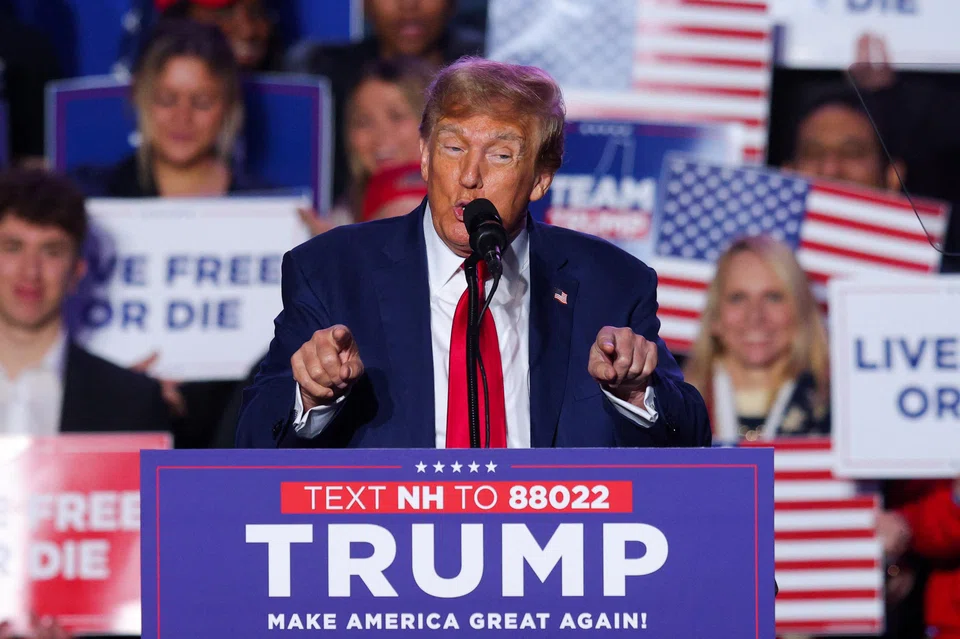
AS 2023 comes to a close, the debate over whether or not a recession is likely continues to capture investor attention. However, looming just over the horizon as the calendar turns to a new year is a prospect not yet incorporated into market expectations – the return of the 45th US president, Donald Trump, to office in 2025.
Indeed, a recent Wall Street Journal poll has the current president trailing the former president by four percentage points in a head-to-head match up. Introducing third party/independent candidates into the mix still leaves President Joe Biden trailing former president Donald Trump by 31 to 37 per cent, according to the same poll.
Perhaps more telling are polls in the six key states on which the November 2024 election is expected to hinge on – Arizona, Georgia, Michigan, Nevada, Pennsylvania and Wisconsin. According to the New York Times and Siena College, the presumed Republican challenger leads Biden by four to nine percentage points in all swing states other than Wisconsin.
With less than eleven months to go before polls open, the prospect of Trump’s return to office likely presents the greatest uncertainty over the investment landscape in the year ahead.
Fiscal policy
Should he return to office, especially with majorities in both houses of the US Congress, look for the returning president to deploy fiscal policy generously as he did in 2017.
However, in 2023, US fiscal deficits sit at 6 to 8 per cent of gross domestic product, the largest non-recession, non-wartime deficit in US history. This compares with the 2 to 3 per cent of GDP in 2016, closer to long-term averages ahead of Trump’s first term in office. Such potential fiscal largesse would make a 2017-style round of deficit spending in 2025 perilous.
Economically, a new round of unfunded fiscal spending risks a resurgence of US inflation. Indeed, recall the Trump tax cuts of 2017, which came as US core inflation was easing, troughing near 1.7 per cent in the summer of 2017. With the passage of the Tax Cut and Jobs Act later that year in December, core inflation rebounded to above the Federal Reserve’s 2 per cent target throughout 2018 to 2019, despite 150 basis points in interest rate hikes by the central bank to contain it.
Similar to 2017, core inflationary pressures in the US economy have been receding in 2023. However, year-on-year price growth remains elevated at 4 per cent through October 2023, well above the Fed target.
Thus, significant fiscal stimulus amid still-elevated inflationary pressures would leave the US central bank with the prospect of having to resume the inflation fight, by restarting the rate-hiking cycle paused in July 2023 – with the Fed funds rate already at 5.5 per cent, a level not seen since the turn of the century.
More troubling, even higher interest rates than seen in 2023 have the potential to raise concerns about US debt sustainability. Interest costs as a share of American tax revenues have risen to the highest levels since the early-1980s, just as the risk premium for long-dated US Treasuries has once again retreated to below zero in December 2023.
The alternative, we suspect, would be a Fed indirectly signalling that the era of central bank policy dominance and inflation targeting is coming to an end, ceding policy leadership to fiscal authorities and potentially kicking off an era of fiscal dominance and likely elevated inflation.
Under either scenario, long-dated bond investors would face as yet unpriced risks.
Should a second Trump presidency come without congressional control, the new Trump administration will likely focus on regulatory and foreign policy priorities, just as the first Trump administration did upon losing control of Congress in 2018.
The traditional energy sector is likely to get a boost as regulation potentially eases, following Biden’s policies constraining fossil fuel production. However, despite the rhetoric, Republican opposition to the green energy sector is likely to be more muted in 2024, with the Biden-led Inflation Reduction Act driving job growth and investment across many Republican-led states over the past year.
Instead, an interruption to the reshaping of the global geopolitical landscape likely emerges under a second Trump administration.
Undoing Biden’s multilateral approach
Where the Biden administration rebuilt fraying transatlantic ties and formalised alliances across East and South Asia, a new Trump administration is likely to slow down the multilateral approach of his predecessor.
Strains between the US and Europe as seen during the first Trump administration would likely return. With congressional Republicans already posing roadblocks for continued funding for the Ukraine war, financing and leadership of the war effort may be forced to shift to the UK and Europe, which are themselves encountering budgetary challenges domestically.
However, with Europe dependent on American energy exports following the 2022 sanctions on Russia, the continent may be in a weaker position than in 2017 to forge a path separate from the US.
The warmer relationships between the US, Israel and Saudi Arabia during the first Trump administration may serve as a foundation to ease the elevated tensions in the Middle East since October. However, this may only serve to allow the US to refocus its foreign policy efforts once again on East Asia.
Across the Pacific, with the first Trump administration initiating the reshaping of US-China ties with its 2018-19 trade war, and the Biden administration keeping it up with containment measures since 2021, a second Trump administration risks an expansion of restrictions on capital and intellectual property flows.
With China’s economy still struggling to recover following its 2022 pandemic reopening, additional restrictions on trade, capital, and intellectual property potentially invite direct retaliation from China not seen since the Trump trade wars. This places East Asian nations in a more challenging position, caught in an overt conflict between the two largest economies in the world.
On balance, for investors, a second Trump administration would expose the frailties of a global economy still in transition to its post-pandemic equilibrium. In particular, the new president has the potential to accelerate fiscal challenges facing global economies and catalyse nascent inflationary tendencies that central banks around the world have only begun to contain.
Geopolitically, a second Trump presidency may serve to accelerate the ongoing realignment of the global geopolitical order that is already taking shape much faster than most have anticipated, resulting in a shifting of power from historical to emerging powers, especially in Europe and Latin America.
For investors, such destabilising changes to the economic and geopolitical foundations may create an opportunity for gold to return as a long-term anchor of wealth preservation in investor portfolios.
The writer is group chief strategist at Union Bancaire Privee, a private bank and wealth management firm
TRENDING NOW

Grab CEO’s wife Chloe Tong on life with Anthony Tan and finding her purpose

He built the Vingroup empire. Now South-east Asia’s richest man is handing some key roles to his sons

HDB reviewing ‘jumbo’ flat scheme after Telok Blangah unit listed for sale at S$2.18m

What role can Japan play in Asean’s future?

