From stealing electricity to heat shielding: Why some go to great lengths to mine Bitcoin
In spite of its price swings, the digital currency remains attractive enough for some miners to break the law to obtain it


[SINGAPORE] Illegal Bitcoin mining is drawing renewed scrutiny across South-east Asia.
On Nov 18, Malaysia’s national power provider revealed that more than US$1.1 billion of electricity had been stolen by cryptocurrency miners between 2020 and August this year to power illegal crypto mining – mostly of Bitcoin.
Thai authorities also recently raided seven Bitcoin mines worth about 300 million baht (S$12.2 million) and seized 270 million baht in mining devices. The mines were believed to be run by Chinese transnational scam networks.
These cases highlight how, in spite of Bitcoin’s price swings, the digital currency remains attractive enough for some miners to break the law to obtain it.
The Business Times explains what Bitcoin mining involves, and why some operators go to such lengths to mine the cryptocurrency.
What is Bitcoin mining?
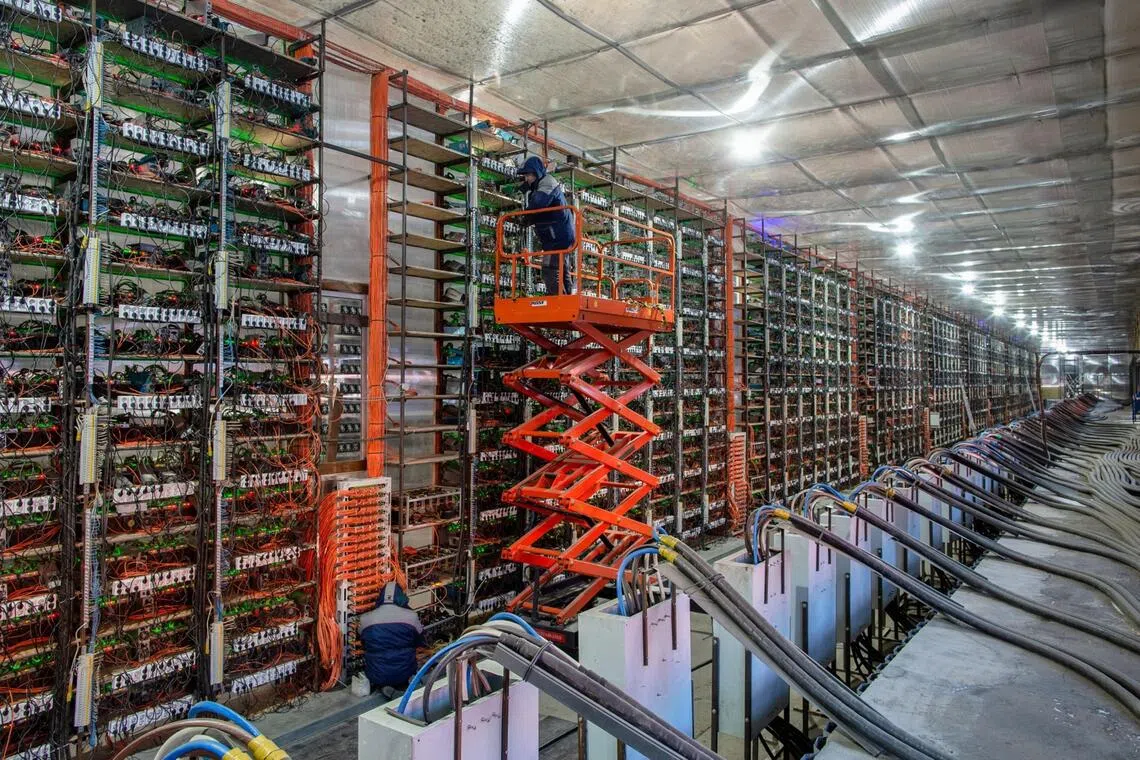
Bitcoin mining involves individuals or companies – the miners – using powerful computers to solve complex cryptographic puzzles to verify transactions on the Bitcoin blockchain, a digital ledger of all the currency’s transactions.
The first miner to solve a puzzle is rewarded with a newly minted Bitcoin.
While running more hardware helps a miner’s chances of earning Bitcoin, it also increases the amount of power used to generate the currency and maintain the blockchain.
Is Bitcoin mining profitable?
Bitcoin’s mining profitability peaked during its 2017 bull run, when its price rose to nearly S$20,000.


At the time, the currency’s hashprice – which is the amount of money a miner can earn per unit of computing power – was around US$3.39 per terahash per second, based on an article published on Nasdaq.
But Bitcoin miners are now facing a squeeze, with the profitability of mining recording historic lows. In November, Bitcoin’s hashprice fell to just US$0.035 per terahash.
A Dec 2 Bitcoin mining report by digital currency asset manager CoinShares indicated that “miners have faced a sharp deterioration in profitability as production costs climbed to levels not seen since… early last year”.
The average cost to produce one Bitcoin stood at around US$74,600 in the second quarter of 2025. When factoring in non-cash costs such as depreciation, the total average cost climbed to US$137,800, said CoinShares.
While actual costs may vary significantly across miners due to differences in mining machine efficiency and electricity expenses, energy is becoming increasingly expensive across the board.
The latest Bitcoin halving, which occurred in April 2024, also reduced the reward for mining new blocks by 50 per cent.
With the market price of Bitcoin constantly in flux and mining revenue structurally declining, it is increasingly difficult for less efficient mining companies to maintain profit growth.
Why some turn to crime
As profit margins compress with greater production costs, the industry has moved in different directions.
Publicly listed crypto mining giants such as Bitfarms and CleanSpark, for instance, are converting their mining farms to more profitable artificial intelligence data centres. Investors are also favouring firms with revenue streams beyond Bitcoin mining.
Meanwhile, other miners are turning to crime to reduce their mining costs. For example, stealing electricity to mine Bitcoin has become a compelling option because power makes up about 70 per cent of production costs.
To evade detection, some miners divert the electricity by installing “taps” that bypass official electricity meters and allow them to run high-wattage Bitcoin-mining rigs while registering zero or minimal power consumption.
Illegal miners also employ counter-surveillance techniques to evade the authorities in a cat-and-mouse chase. These include using heat shields to cloak the glow of their rigs and equipping entrances to their mining sites with closed-circuit television cameras, heavy-duty security and broken-glass deterrents, Bloomberg reported.
There are also “cryptojacking” schemes, where the crypto miner knowingly causes a computer to perform a function without authorisation. They often involve phishing or software bundling, in which attackers install mining codes on victims’ computers through pirated software.
Is Bitcoin mining a problem in Singapore?
While crypto mining is not specifically regulated in Singapore, there have been no reports of large-scale electricity theft for the activity, likely due to strict enforcement and grid monitoring.
In Singapore, it is a crime to dishonestly or fraudulently abstract, use, consume or divert electricity. It is also an offence to alter or tamper with any utility meter.
Penalties include a fine of up to S$50,000, imprisonment for up to three years, or both.
Cryptojacking here can lead to a fine of up to S$5,000, jail of up to two years, or both.
The tax treatment for crypto mining in Singapore depends on the nature of the mining activity.
If an individual mines cryptocurrencies as a hobby and not as a systematic or regular business activity, they will not be taxed on the earnings, as the Republic does not impose a capital gains tax.
However, if the activity is conducted systematically, regularly, and with an intention to profit – similar to how businesses are run – the profits are subject to income tax at the corporate tax rate of 17 per cent.
Decoding Asia newsletter: your guide to navigating Asia in a new global order. Sign up here to get Decoding Asia newsletter. Delivered to your inbox. Free.
Copyright SPH Media. All rights reserved.