Dementia cover: Need versus want
Dementia exacts a toll on the sufferer, families and society at large. Insurance can help to alleviate caregiving costs, but watch the fine print.


WHEN I was younger, I associated dementia simply with old age, loss of memory and childlike behaviour. How bad can it be? Now that I have a front-row seat to the debilitation caused by dementia, I know much better.
My mother-in-law was diagnosed with vascular dementia when she was about 81 years old. A brain scan revealed multiple strokes through the years. She passed away last year, more than 10 years after the diagnosis. While she was relatively mobile until the end, dementia caused a dramatic change in personality from her normal urbane and gregarious self. Caregiving was a challenge.
My own mother now also suffers from dementia since a stroke some six years ago.
As Singapore ages, dementia – an umbrella neurological condition that includes vascular dementia and Alzheimer’s, among others – emerges as a pressing concern, and with good reason. As at 2021, an estimated 91,000 people in Singapore live with dementia. This is currently one in 10 people above the age of 60. This is expected to grow to 152,000 by 2030.
According to the World Health Organization, dementia is a syndrome that can be caused by a number of diseases which can destroy brain cells and nerve functions, leading to a deterioration in cognitive functions “beyond what might be expected from the usual consequences of biological ageing”. It affects memory, orientation, calculation and language, among other things. At advanced stages, simple acts such as chewing and swallowing are increasingly difficult.
There are physical, psychological and economic impacts, not only for the dementia sufferers but also for their caregivers, families and society at large. A 2017 study here sought to quantify the cost of caregiving in Singapore. This was estimated at over S$13,000 a year for mild dementia to over S$47,000 a year for severe cases.
Disability arising from dementia may be a key risk to hedge, alongside chronic illnesses such as heart disease, cancer and hypertension.
Novel dementia protection
Recently, two insurers rolled out products with specific dementia benefits. Both are firsts in the market in a few aspects.
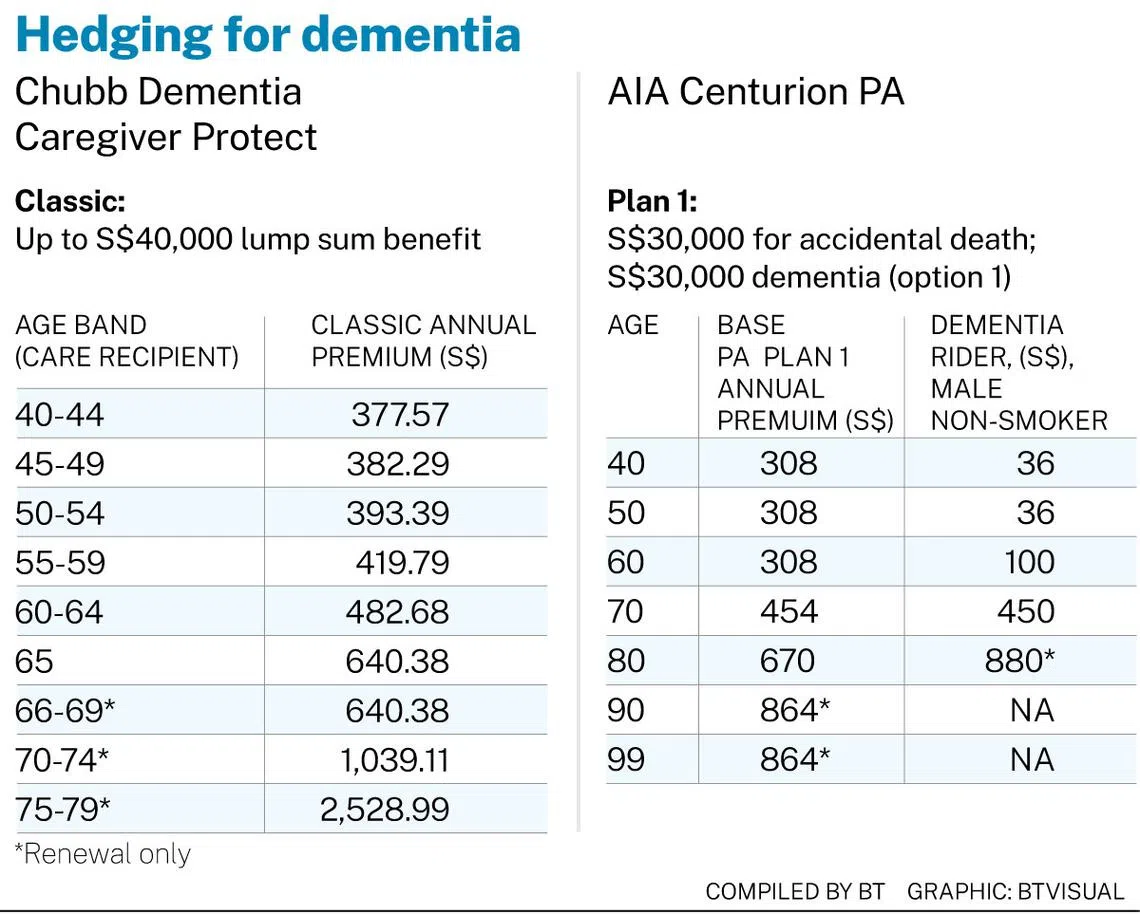
AIA introduced an optional rider for its Centurion personal accident (PA) plan to pay a benefit when one is diagnosed with neurological diseases such as Alzheimer’s, dementia and Parkinson’s. Depending on the level of cover, the rider pays a lump sum of up to S$100,000 upon diagnosis of early, intermediate and late stages of the diseases.
It can also pay a care reimbursement benefit of up to S$20,000. AIA has taken an interesting approach to bundle a dementia option with its PA plan. PA plans cover a sudden, unpredictable hazard such as accidental injury and death. In contrast, neurological diseases are chronic.
The Centurion plan, however, is designed for older ages, in recognition of Singapore’s rapidly ageing population. The maximum age of entry for the base plan is 80, and the plan covers up to 99. The dementia rider must be taken up by age 70, and cover is up to 85.
AIA found in a customer survey that 60 per cent of Singaporeans are concerned about dementia, and fewer than half hold policies which cover neurological diseases. By 2030, almost one in four Singaporeans will be over 65, and an increasing number is likely to be diagnosed with dementia. AIA said the Centurion PA, launched in August, “helps to holistically address the growing needs of this segment”, adding: “Traditional insurance plans may not adequately cover the long-term and specialised care required for dementia.”
Separately, DBS partnered Chubb Insurance to offer Dementia Caregiver Protect to pay a benefit for both the caregiver and the care recipient. This, too, is novel in its extension of cover to caregivers who suffer stress and burnout, and may need to cease working for a time. The plan can pay caregivers a monthly payout for voluntary loss of employment and utility bills for up to 12 months, and even reimburse their counselling expenses.
Evy Wee, head of financial planning and personal investing at DBS, said: “With a significant majority choosing to give up their jobs to become full or even part-time caregivers due to cost constraints, it’s imperative that we try to alleviate the financial and emotional stress that these family members face amid managing their loved ones’ health.”
If cover for neurological conditions is important to you, there are a few things to note. These new policies will not cover you for life. Hence, while welcome, there is a distinct possibility that a dementia diagnosis occurs after the policy has ceased.
• Exclusions apply. For both Chubb’s and AIA’s plans, pre-existing conditions are excluded. Chubb’s policy specifies that the exclusion applies to the “care recipient or a member of their immediate family having a history of dementia, Alzheimer’s disease or Parkinson’s disease”. An exclusion also applies if the insured has received, prior to the policy’s start date, medical treatment through examination or a medical check-up for dementia, Alzheimer’s disease, Parkinson’s disease, stroke, traumatic brain damage, amnesia or paralysis.
AIA’s optional rider states it differently – that it will not pay benefits for a loss caused by a pre-existing condition, unless a declaration is made in the application, and the application is “specifically accepted by us, and we have expressly agreed to insure the risks to which such pre-existing conditions declared relate”.
For Chubb, pre-existing conditions do not apply to the caregiver. The caregiver may be the policyholder, the care recipient’s partner, sibling or adult child.
• Limits of cover. For Chubb, the maximum age of application is 65. Renewal is up to age 79 only. AIA’s optional dementia rider covers up to age 85. In my family’s case, my mother-in-law was diagnosed at 81, and my mother’s stroke and subsequent dementia also occurred in mid-80s.
• Low-hanging fruit in CareShield Life. I believe disability is a key risk to hedge. There are other types of policies that cover for neurological illnesses. Critical illness (CI) cover is one, and you will have to scrutinise policy documents for the definitions to qualify for a payout for Alzheimer’s and advanced dementia. There are also multi-stage CI plans that will cover for early, intermediate and advanced stages of dementia. AIA, for example, has five plans for multi-stage dementia cover including the Centurion PA.
And, of course, there are the disability plans under the CPF umbrella. These are the Careshield Life and Eldershield. Eldershield was rolled out in 2002 for severe disability especially in old age. In its first iteration, it provided a monthly benefit of S$300 for five years; this was enhanced in 2007 to pay out S$400 a month for six years.
From October 2020, Singapore citizens and PRs who turn 30 are enrolled into CareShield Life. CareShield Life is a significant step-up from ElderShield in a few respects: Monthly payouts are potentially for life, as long as you are unable to perform at least three out of six Activities of Daily Living (ADLs).
From 2020 to 2025, payouts will increase at 2 per cent per year. Thereafter, payout increases and corresponding premium adjustments will be recommended by an independent CareShield Life Council.
There are also CareShield Supplement plans from Singlife, Great Eastern and Income if you desire additional payouts.