

Equities vs ‘guaranteed’ fixed deposits
When interest rates were 5% or higher in the past, global equities consistently performed better than US Treasury bills by a significant margin

DINNER conversations have changed quite a bit this year. Friends, who two years ago would not stop talking about hot stocks, coins and NFTs (non-fungible tokens), are now talking about the amazingly high “guaranteed” fixed deposit rates they are getting at their banks.
Indeed, fixed deposit rates are high – higher than they have been for a while. But should we park our money accordingly, just because rates are high?
Year to date, global equities are up 18 per cent (represented by the MSCI World Index in USD as at Nov 30). Those sitting in fixed deposits have been comfortable but have missed out, and history does not paint too different a picture.
How stocks fared in high-rate periods
When interest rates were around or higher than 5 per cent in the past, global equities consistently performed better by a significant margin. From 1973 to 1991, interest rates were above 5 per cent and reached 15 per cent, as the US battled inflation in the teens, an oil embargo, and a great recession. In that time, stocks endured much volatility including Black Monday, when US stocks dropped by over 20 per cent in a single day.
Yes, fixed deposits in this period would have shielded you from this volatility and earned you a healthy return. US Treasury bills, an asset the market considers to be “risk free” and a good gauge for where fixed deposits would have been, returned 326 per cent. But despite the high rates, you would have left a lot of money on the table with equities returning 579 per cent in the same period.
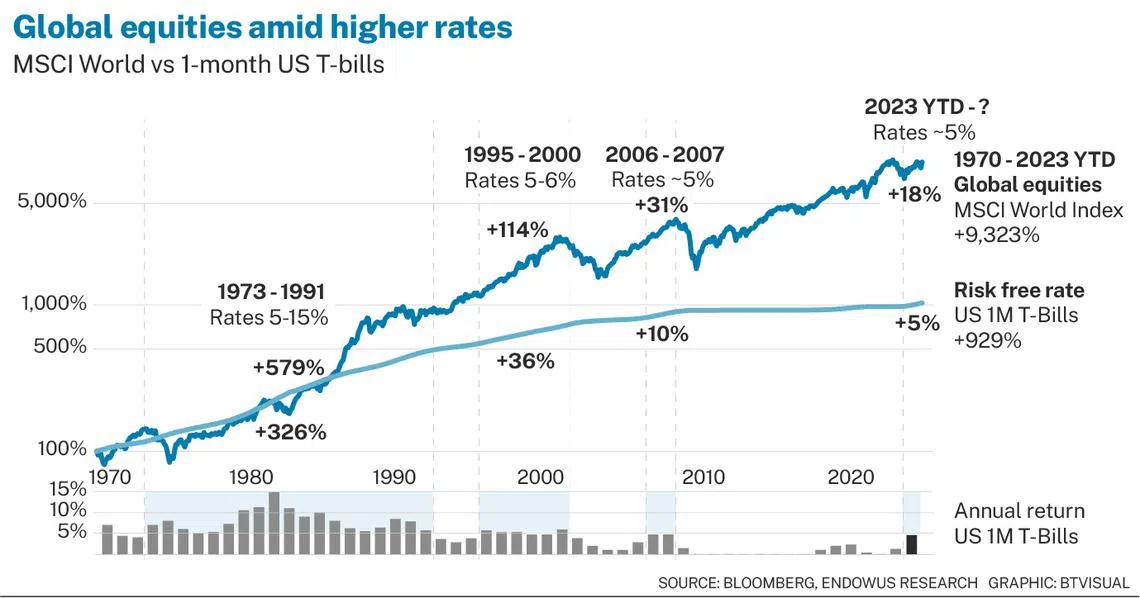
History certainly does rhyme, and the same concept can be observed from 1995 to 2000, 2006 to 2007, and what we are experiencing in 2023. To understand this phenomenon, we need to remember the fundamental mechanics of how markets work.
Understanding the equity-risk premium
The risks associated with owning or benefiting from something are relative to everything else, and prices are determined on this basis. It applies to owning one car versus another, buying fruit from one stall versus another, or staying in one hotel versus another.
The same concept applies to stocks, bonds and fixed deposits. When fixed deposits become more attractive with higher rates, stocks and bonds get beaten down to a price where their expected returns are still worthwhile relative to fixed deposits. The finance industry calls this re-rating, and we witnessed this in 2022 as interest rates were rising. Stocks and bonds went down to a price where the market believed they provided the appropriate higher expected relative returns.
If your investment goal has time before you need to use the money, you will be rewarded. But you need patience to harvest the equity-risk premium, discipline to stay diversified and manage your cost, and the stomach to tolerate more volatility. Since 1970, global equities have risen by more than 9,000 per cent, during which a risk-free return rose by just over 900 per cent.
When fixed deposits may make sense
Fixed deposits may have a place in your portfolio, but my opinion is that they should only be used for a clear goal in the short term, and with money that can be locked up by your bank.
For short-term goals or emergency money, you can also explore safe and smart cash management options like money market funds. They offer similar yields to fixed deposits, are more diversified, accrue interest daily, and are redeemable without penalty for many platforms.
Foreigners and citizens should take advantage of the Supplementary Retirement Scheme (SRS). The deadline to top up your SRS account is around the corner on Dec 31. SRS is a gem that everyone should look into, helping all of us save for tomorrow, and save on tax today.
Singaporeans and permanent residents can save up to S$3,366 in taxes by contributing up to S$15,300 to SRS. Foreigners can save up to S$7,854 in taxes, by contributing up to S$35,700 to SRS.
The beauty is that once you top up, you can avail of many fund choices that enable you to take advantage of the equity-risk premium to build your long-term savings – well above what is “guaranteed”.
The writer is the CEO of Endowus, an independent and holistic wealth platform advising over S$5 billion in individual and family client assets across public and private markets
TRENDING NOW

Olivia Lum, ex-CFO not giving evidence in their Hyflux trial

Bank on AI-resilient Singapore property via deep-value listed property groups

Positive pivot or premature? Analysts split on Keppel Reit’s S$610.9 million buy

Once staunchly pro-China, Malaysian Chinese businesses are now distancing themselves from Beijing

