Five in seven insurers to jack up private hospital premiums under Integrated Shield Plans - some by double digits
AIA, Income Insurance, Singlife, Great Eastern, Prudential will raise premiums with end of 2-year moratorium; there’re 7 insurers that offer IPs

FIVE of the seven insurers with Integrated Shield Plans (IPs) will raise the premiums of private hospital plans, following the end of the two-year moratorium on premium hikes at end-August.
They are AIA, Income Insurance, Singlife, Great Eastern and Prudential; AIA and Singlife – are focused only on private hospital plans. Singlife is understood to be reducing premiums for some age bands, and raising for others.
Income, however, will raise IP premiums across all its IP ward types – as a “strategic measure” to maintain the long-term sustainability of its IP portfolio, it said. For restructured hospital plans, this is the first increase in nine years. For Class A and private hospital plans and riders, it has enhanced cancer cover for multiple cancers.
The average premium increase for Income’s restructured hospital base plans is 14 per cent, and 23 per cent when riders are included. For private hospital base plans, the average increase is 21 per cent. The average increase when riders are included is around 35 per cent.
“Policyholders with most costly private hospital IPs may face lifetime premiums approaching or even exceeding S$800,000: Havend”
Increases by two other insurers – AIA and Singlife – are focused only on private hospital plans. Singlife is understood to be reducing premiums for some age bands, and raising for others.
The exception to this rising trend is HSBC Life, which reduced premiums of its private hospital base plans by up to 23 per cent. Rider premiums, however, were raised.
Manu Tandon, chief health officer of HSBC Life Singapore, said the overall impact for those with private hospital IP plus rider ranges from a reduction of 9 per cent in total premium to a rise of 30 per cent. “Our aim is to offer our customers benefits they need at sustainable premiums, and we continuously work closely with the MOH (Ministry of Health) in doing so.”
Great Eastern Life (GE) and Prudential will raise the premiums of their private hospital base plans in October. Both have already raised premiums of the corresponding riders in April. The hikes are expected to be substantial and in double digits.
Concern over IP profitability and rising premiums has been simmering for years, but Health Minister Ong Ye Kung recently sounded an alarm over the long-term sustainability of IPs. Intense competition among insurance companies, he said, risks “a race to the bottom”.
The proportion of policyholders with private hospital IPs has declined from 40 per cent in 2021 to around 38 per cent in 2023. About 2.9 million people hold IPs.
IP insurers’ underwriting results deteriorated in 2023. Claims rose as policyholders resumed elective procedures which were halted when Covid-19 was prevalent. Five IP insurers incurred underwriting losses. Even Prudential, historically the most profitable, posted substantially lower underwriting profits. Income was an exception – its underwriting profits were steady at S$16 million in 2022 and 2023. It has become the most profitable IP insurer in 2023.
Insurance advisory Havend has compiled the lifetime premiums of the seven insurers, including various classes of riders. MOH’s compilation of lifetime premiums published in July was for base plans only. The accompanying graphic reflects private hospital IPs and only the higher value riders. The data takes into account those that have raised premiums in September. The October adjustments by Prudential and GE are not included, and may change the rankings.
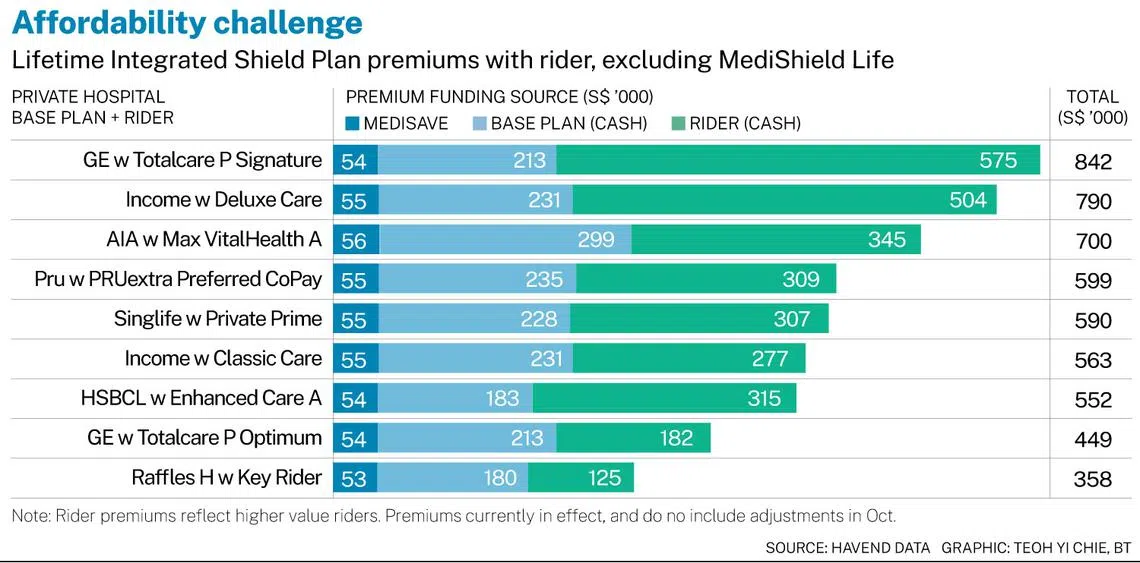
Based on Havend’s data, there are two stark conclusions. One, policyholders of the most costly private hospital IPs may need to be prepared to pay lifetime premiums approaching or even exceeding S$800,000. Great Eastern’s total lifetime premiums – including the TotalCare P Signature rider – comes to S$842,000.
Two, the cost of riders may well exceed the cost of the base plan.
GE has rolled out a new private rider, the Great TotalCare P Optimum, which offers private hospital cover “at more sustainable premiums without claims-adjusted pricing”. This rider does not cover the S$3,500 deductible at private hospitals, but it caps the out-of-pocket expense at S$6,500, “thus protecting customers from large bills”, said a GE spokesperson. The new rider is “well received” and comprises more than 90 per cent of private IP rider sales, said GE.
Based on lifetime premiums, GE’s private plan plus the TotalCare P Optimum comes to around S$449,000. This is just over half of the lifetime premium for customers holding the TotalCare P Signature rider.
Income already offers an alternative private hospital rider called Classic Care with 10 per cent co-insurance, compared to Deluxe Care (5 per cent), both subject to a cap of S$3,000 per policy year. Income said the average premium increase, assuming base plan plus Classic Care rider, is 29 per cent, “commensurate with Income’s overall IP claims experience”.
Raffles Health Insurance (RHI) has maintained the premium rates for its private hospital base plan since it entered the IP market in 2018. It raised premiums in 2023 for both key and premier riders only.
“In view of an ageing population, increased medical utilisation and compounding medical inflation, we may have no choice but to review our premium rates. We will however do so thoughtfully and balance that with the need to ensure equitable access of care,” it said.
“Adjusting premiums alone will also not mitigate underwriting losses in the long run. More effort must be taken to cut down wastage and optimise efficiencies in care delivery. RHI’s expenses ratio has significantly improved. Whilst it is admittedly still high, this is due to capital investment in the initial years. As our business grows, this expenses ratio is expected to improve.”
Havend chief executive Eddy Cheong said that there are a few options for policyholders who wish to save on premiums. One is to clarify the ward type desired and get a base plan that covers most of one’s medical exposure. Another is to select a provider that matches one’s expectations in terms of costs and benefits.
Downgrading the rider is also an option. He added: “Get a rider if you want to reduce out-of-pocket expenses and also additional cancer coverage to supplement the base plan. But with rising rider (premiums), you have to weigh if that is affordable in the long term. If not, you may downgrade to a lower rider plan... If you are on a private hospital plan, I strongly recommend getting at least a small rider for the cancer cover, because the cancer treatment, for severe illnesses, can exceed significantly the cancer benefit under IP.”