

History’s lessons: Back to basics
More than 100 years of market data show investors can’t ignore the US stock market, but concerns over concentration risk are rising

Genevieve Cua

HOW much does the past inform the present and future in terms of investment experience and portfolios?
Academics Paul Marsh, Mike Staunton and Elroy Dimson have published the 2024 edition of the Global Investment Returns Yearbook, which captures more than 100 years of capital market returns.
The latest edition, the first in collaboration with UBS since its merger with Credit Suisse, throws up some trends that have time and again confounded investors, particularly over the past year.
Let’s dive into it.
US equity dominance and concentration risk
It perhaps shouldn’t surprise anyone that the US has been by far the most dominant of stock markets over more than a century, only briefly overtaken by Japan in the mid-1990s. As at end-February, US equities’ share of the MSCI World index was nearly 71 per cent. But what has caused much hand wringing was the outsized weighting of the Magnificent Seven stocks not just in the S&P 500, but also in the MSCI World index. Both indices are weighted by market capitalisation.
Bloomberg’s total return index for the Magnificent Seven (Apple, Amazon, Alphabet, Meta Platforms, Microsoft, Nvidia, and Tesla) rose 82 per cent over 12 months, and 14 per cent year-to-date to Mar 8. Those stocks accounted for nearly 20 per cent of the MSCI World at end-February.
What the yearbook shows is that over-concentration has been typical of the 12 largest equity markets. Professor Paul Marsh of the London Business School pointed out that the US is actually one of the world’s least concentrated markets over the long term. Only Japan is less concentrated than the US.
But what has raised concern of late is the outsized contribution of a few stocks. In the past, the 10 largest stocks in the US accounted for a quarter of the market. This share grew to two-thirds of the market in 2023.
“This is a very unusual phenomenon of the very largest stocks making up such a huge proportion of the market’s return. It will not always be the case, but it would be a brave person to call the turn,” said Prof Marsh.
Long drawdowns, even for bonds
The surge in US stocks over the past year obscures the long drawdowns that have been typical historically. The authors contend that even with the latest run, US stocks have yet to beat inflation since the high achieved in November 2021.
“We don’t really have a name for the 2021 bear market, which hasn’t ended yet. If you invested in November 2021, you still haven’t recovered your money.
“Yet everyone’s talking about new highs on the S&P 500. That’s because they look at it in capital gains terms; we’re looking at total returns. And more importantly, we’re looking at real returns. Despite the great performance of US stocks, investors have not yet recovered their purchasing power since November 2021.”
Bonds have the deserved reputation of serving as a ballast to stabilise portfolios. But historically, drawdowns in bond values have been almost as deep as equities. The “golden age” in bonds was between 1982 and 2014, when bonds delivered real returns after inflation of 7.2 per cent a year, comparable to equities.
The yearbook says bond performance was admirable for almost 40 years since the 1980s. “They produced equity-like performance, but with much lower volatility in an apparent violation of the law of risk and return. However, these high returns arose from factors that could not continue indefinitely.”
From 2015 onwards the real returns on the world bond index has been minus 1.7 per cent, followed by poor returns in 2021 and a “dire” showing in 2022.
Says the yearbook: “Future real bond returns are clearly likely to be far lower than during the golden age of bonds… This is another example of the importance of looking at very long periods of history to understand markets. Even periods as long as three or four decades can be quite misleading if naively extrapolated.”
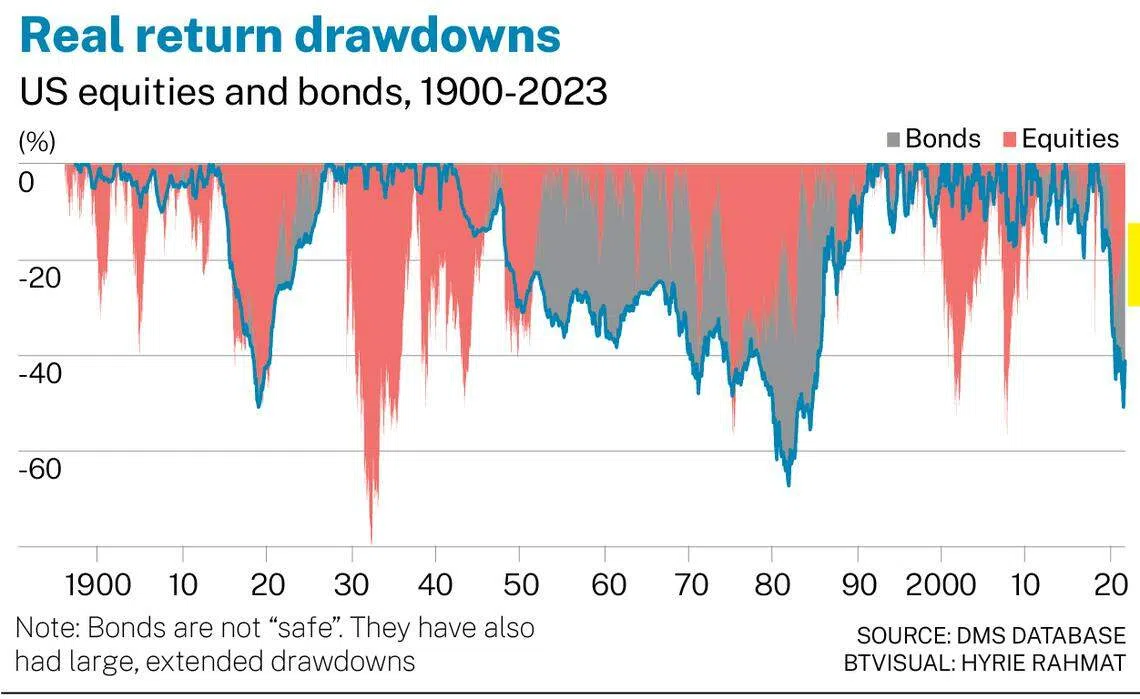
There were three major bear markets in bonds. The worst began from a peak in 1940 to the 1980s. The fall in value was 67 per cent and lasted 50 years until recovery in 1991. We are in the middle of the third bear market. Marsh said: “We’re still 46 per cent underwater in bonds, following the worst year on record in 2022. It’s going to take a very long time to get back to zero from that… So, bonds are not safe. They’ve had large, extended drawdowns.”
Factor returns
Factor investing – where portfolios are tilted towards or away from factors such as size, value, income and momentum – is an established approach to fund management. There is a proliferation of “smart beta” funds where factor choices overlay a broad index. This is typically seen as a lower-cost alternative to active fund management.
What the yearbook shows is that over the long run of more than 100 years, factors do reflect a positive premium, ranging from 1.4 per cent for income to as much as 7.6 per cent for momentum. But in the recent decade (2010 to 2023), only momentum remains positive at 7.2 per cent. The premium was zero for size, and negative for income, low volatility and value.
What you need to note is that the premium from specific factors can remain negative for very long periods. For US stocks, the premium for value investing has been negative for 37 years since around 1984.
The research shows that “factor effects” exist, defined as the tendency for stocks with certain attributes to move together. But whether factors would generate a premium in the future is an open question, said Marsh.
The authors write in the yearbook: “The theory for why such premiums should exist or what types of risk they are rewarding is admittedly weak. Furthermore, if they are generated by behavioural traits, behaviour can change, especially as awareness of these factors and their popularity increase.”
The bottomline
What does all this mean for portfolios today? Not surprisingly, stick to basic principles like diversification. Marsh brings up two pointers:
“First, try to ignore the short-term ‘noise’, be patient and stay focused on the long-term. As Charlie Munger said, ‘The big money is not in the buying and selling, but in the waiting’.
“Second, without an appreciable allocation to equities, you are unlikely to do well over the long run, but you should mitigate the risk of equities by diversifying across stocks, industries, countries and asset classes.”
It would appear that you can’t do without large-cap US stocks. But investors are understandably wary of valuation risks, despite the widespread optimism. Hartmut Issel, UBS Wealth Management head of Apac equities and credit, says investors may consider phased investments on a “disciplined schedule while accelerating during market sell-offs”.
He believes generative AI will be the growth theme of the decade, with revenues expected to grow by 70 per cent a year until 2027.
“Generative AI is unusual in history because right from its onset, many companies in the industry are already present across multiple stages of its value chain, from the cloud and connected hardware to large language model development and applications. These companies are almost exclusively giants in the US technology sector. With such an advantage, we believe the largest players today are poised to grow larger still.”
TRENDING NOW

Grab CEO’s wife Chloe Tong on life with Anthony Tan and finding her purpose

What role can Japan play in Asean’s future?

He built the Vingroup empire. Now South-east Asia’s richest man is handing some key roles to his sons

Asean’s challenge is to become resilient against global geopolitics: former Indonesia trade minister

