

Honing in is what matters amid market volatility
Investors should focus on longer-term outcomes rather than react to short-term dislocations

AUGUST kicked off with a perfect storm that sparked the great unwind of some of the most crowded, popular trades.
After a strong first-half performance, this recent bout of market volatility is a timely wake-up call for investors, a reminder that the best-laid plans can be derailed by short-term factors.
Crowded trades are positions where investors may have factored in some level of consensus and elevated expectations of certain outcomes. Some examples: That earnings growth justifies higher valuations for generative artificial intelligence (gen AI)-related stocks; or that higher inflation and a stronger US economy correlate with higher bond yields; or that a weak Japanese yen correlates with borrowing the currency to fund trades, in addition to buoying the prospects of Japanese exporters.
When any such expectations appear misplaced, a sell-off of “long” positions can trigger a sharp reversal. The pace of corrections is exacerbated by the unwinding of hedges, derivative positions or quantitative trading strategies, as well as the sell-off in leveraged exchange-traded funds.
The key question for investors is this: Are these issues anomalous, or harbingers of more enduring trends that we should prepare for?
What do we see as the areas of concern?
1) Is the US economy about to enter a recession?
Against the backdrop of a strong stock market performance in 2024, softer-than-expected July jobs and ISM data sparked fears that a US recession is imminent. This implied that the Federal Reserve might have to cut rates more quickly than anticipated and the “higher-for-longer” narrative might have been misplaced. This risk aversion led to a reduction in US Treasury yields from more than 4 per cent to a low of 3.79 per cent, before settling at 3.94 per cent as at Aug 10.
We think the Fed is unlikely to react to one month’s data before its September meeting. July’s soft jobs data (which only rose 114,000) and unemployment (up from 4.1 per cent to 4.3 per cent) includes one-off factors which may not be repeated. The Fed will likely stick to two rate cuts of 25 basis points this year, starting in September. Hence, we prefer short-dated bonds which will benefit from upcoming Fed rate cuts, and avoid longer-duration ones given uncertainties over the US presidential election.
2) US presidential election to drive short-term volatility
With the prospects of a close presidential race between Vice-President Kamala Harris and former president Donald Trump, we saw a reversal of the “Trump trades” which foreshadowed greater inflation and Treasury yields, and a higher US dollar.
While Harris’ stance will likely be an extension of President Joe Biden’s in clean energy and regulatory policies, a second Trump presidency could propel fossil fuel demand and consumption, with reduced incentives for electric vehicles. Trump may also expand tax cuts, raise government spending, impose punitive tariffs on US imports and curb immigration. This would spur inflation and support long-dated US Treasuries (UST) yields and the US dollar.
US sectors that are sensitive to election outcomes include traditional and clean energy sectors, financials, pharmaceuticals and companies exposed to Affordable Care Act exchanges, as well as US companies with high international revenues.
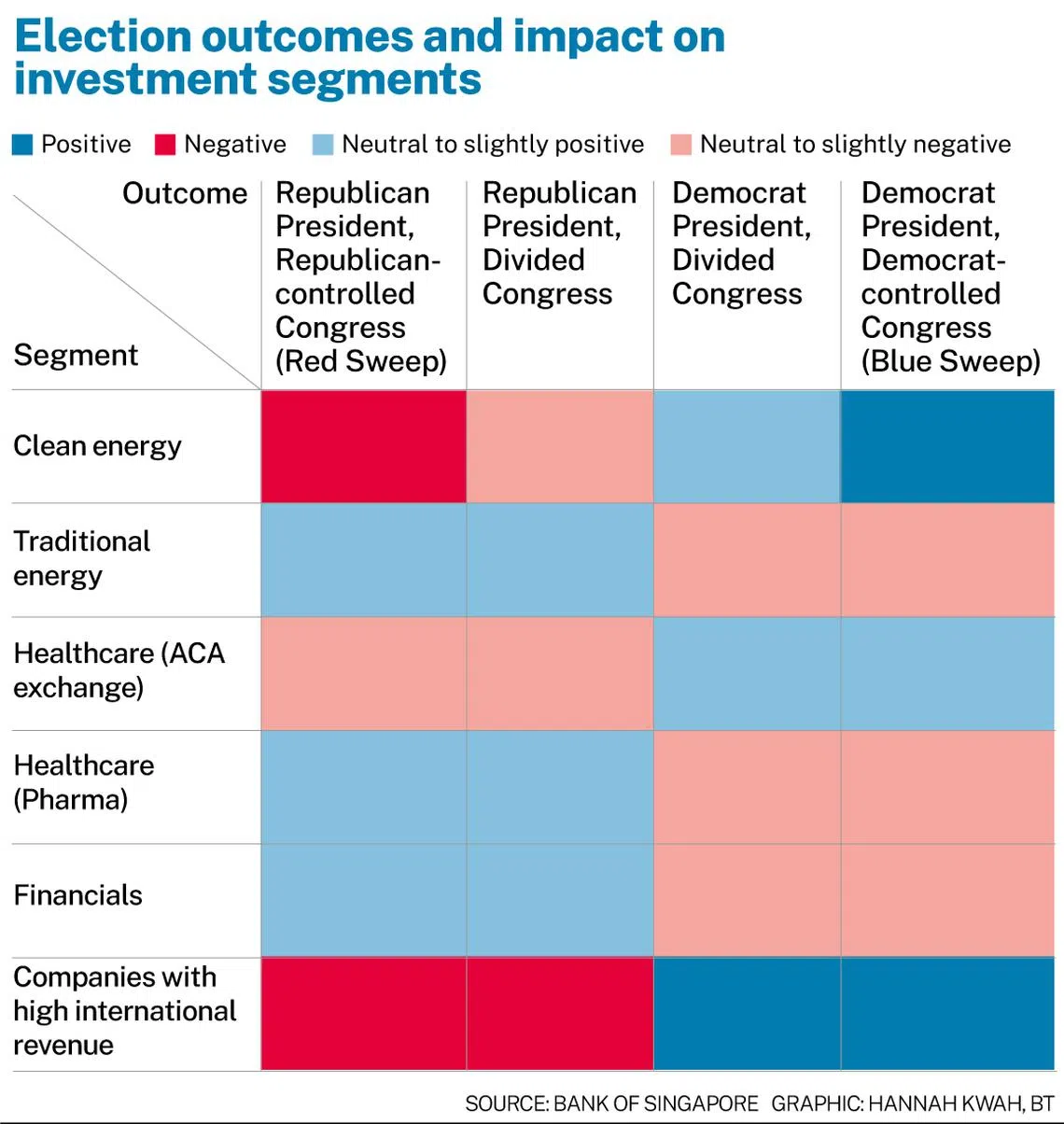
In the run-up to the presidential race, the perceived beneficiaries and affected sectors, UST and the US dollar could experience volatility depending on the market’s perception of the odds for either candidate’s victory.
3) Will yen strength derail the Japanese economy and markets?
Though well-telegraphed and gradual, the Bank of Japan’s rate hike sparked a rebound in the yen from record lows which caused a steep correction in Japanese equities.
With the recent rebound in yen strength, investors need to be cautious about the potential currency impact on individual companies’ margins based on their cost base and hedging strategies. The steep correction in technology and industrials sectors also provides an opportunity to accumulate high-quality companies within this space, especially those that provide exposure to secular growth trends such as gen AI and industrial automation.
4) Is the gen AI euphoria overdone?
The technology sector was caught up in the global unwind of popular trades, exacerbated by speculation over US export restrictions, mixed mega-cap results as well as concerns over potential delays in chip shipments.
Going into the Q2 earnings season, elevated valuations for technology stocks meant that the bar for mega-cap stocks was set high. While cloud growth and capital expenditure were trending in the right direction, we observed headwinds for advertising and retail revenues. Moreover, there were also concerns about the elevated levels of AI-related capital spending and the subsequent pace of returns on these investments.
Near-term challenges could persist especially as recessionary fears build, though investors could gradually reconsider exposure to technology names with favourable fundamentals and valuations in light of the current price dislocation. We remain selectively positive on cloud and AI names, quality semiconductor capital equipment and foundry plays, as well as software companies that can weather the ongoing macro challenges.
Time for prudence, not panic
We reduced the overall risk exposure of our tactical asset allocation in July, but hold a moderately risk-on stance given our base case of a US soft landing and impending Fed rate cuts. In fixed income, we maintain a “Neutral” stance on duration against the elevated rate uncertainty and favour the short end and belly of the yield curve. In equities, our asset allocation strategy reflects an overall “Overweight” stance in the asset class via an “Overweight” position in Asia ex-Japan.
Notwithstanding our view that a US soft landing, favourable disinflation trends and resilient corporate earnings will support a longer-term bull market, we acknowledge that near-term volatility will remain high in the run-up to the US presidential election for both developed and emerging markets.
Hence, the need to diversify portfolios across asset classes, regions and industries remains front and centre. Appropriate cash buffers and allocation to gold, alternatives, certain derivative strategies, funds by diversified investment-style managers and other low-correlation investments can also help buffer some of the volatility.
As investors, we focus on longer-term investment outcomes rather than react to short-term dislocations. Benjamin Graham, widely known as the “father of value investing”, once said: “In the short run, the market is a voting machine but in the long run, it is a weighing machine.” We heed his advice on long-term value as we build investment portfolios to generate resilient risk-adjusted returns in the long run.
The writer is global chief investment officer, Bank of Singapore






