How a ‘Cash++’ portfolio with Asian bonds puts you in good stead
There are some types of investments that offer above-inflation returns, but without too much risk

AT A time when bank deposit rates are still considerably higher than during the pre-Covid era, it is tempting to conclude that cash remains king. The last time the Singapore Overnight Rate Average (Sora) was close to the current 3 to 4 per cent rate was in 2006.
Hence, it is not surprising that one of the most common questions I get from clients is: why bother chasing yields?
Sub-zero inflation a thing of the past
My answer is typically two-fold. The first reason is that while it is true savers have not had it so good for almost two decades, we also think Singaporeans’ cost of living will remain structurally elevated. Although current inflation and interest rates will ease somewhat, we do not expect to see a return to pre-Covid levels anytime soon.
The prospect of a “higher-for-longer” trend is not a Singapore-only phenomenon. Many global economists highlight the impact of increased geopolitical unrest, higher trade barriers, supply-chain dislocations, government debt and climate disasters.
Whatever the cause or combination of causes, these structural challenges cannot be easily resolved, and could in fact deteriorate. Both the Monetary Authority of Singapore and Asian Development Bank expect Singapore’s core inflation to average around 3 per cent in 2024 and 2 per cent in 2025. Economists expect this range to remain for the rest of the decade.
Assuming this is the case, it is important that individuals and businesses achieve yields above 3 per cent if they want to achieve real (net of inflation) returns.
Start of rate-cut cycle
The second reason is that yields higher than 3 per cent will become increasingly difficult to achieve once countries start to ease their monetary policies. Europe and most of Asia, including Singapore, are taking their cue from the US.
Recent data shows that US manufacturing activity is slowing, unemployment is rising and overall, deflationary pressures are starting to take over from inflation. As a result, there are high expectations that the US Fed will cut its rates in September, with more to come in 2024 and 2025.
In anticipation, bond markets and financial institutions around the world are already dialling back their policy expectations and bond yields have fallen from their 2023 highs. This has led Singapore banks to bring down their deposit rates to below 3 per cent. Over the longer term, we expect the Singapore cash rate (one-month Sora) to average around 2.7 per cent – that is, close to Singapore’s long term inflation rate.
‘Cash++’ portfolio building blocks
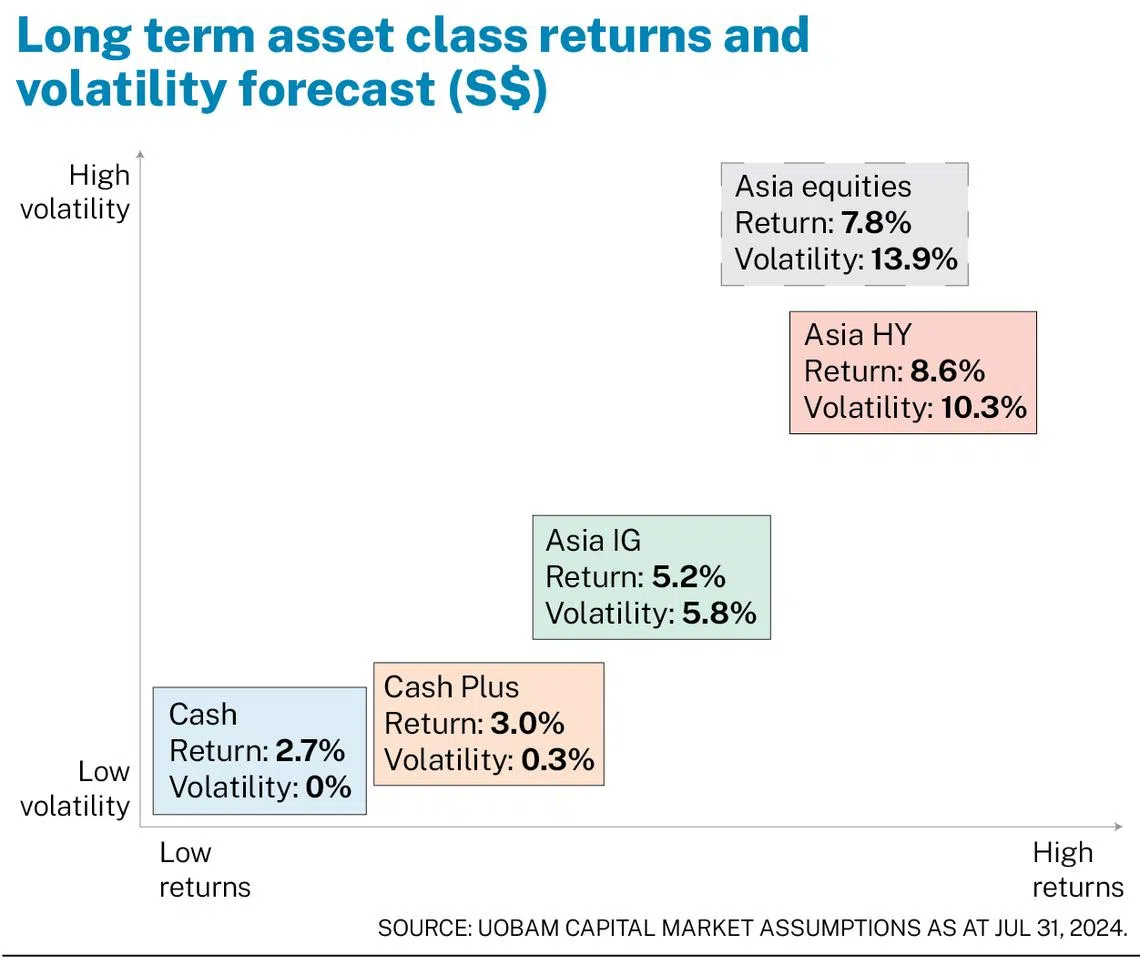
Given these trends, what types of investments offer above-inflation returns, but without too much risk? Here are three bond solutions that offer a gradual step-up in income, returns potential and risk. As shown below, they are also less volatile than equities.
• Cash-plus solutions
These offer on average an additional 0.2 to 1.5 percentage points of return compared to cash rates, but are still very low risk. They typically hold high-quality money market instruments such as Treasury bills (T-bills), and very short duration (less than one year) bonds. There is very little risk of negative returns and many also offer the added benefit of daily liquidity.
• Asian investment grade (IG) bond solutions
These solutions are able to add 2 to 3 percentage points to cash rates but are still considered low risk because they only hold high quality corporate and government bonds. Short maturity (one to three years) solutions are even less volatile, although they have less capital gains potential when rates ease.
• Asian high yield bond (HY) solutions
These invest in bonds with credit ratings below BBB-. Due to their lower credit quality, such solutions can potentially add as much as 5 to 7 percentage points to income compared to cash rates. They offer the potential for capital gains but also capital losses. Nevertheless, over the long term, this asset tends to see higher returns and lower volatility than Asian equities.
Constructing a Cash++ portfolio
A gradual increase in yield and risk can help build confidence if you are a novice investor. But you can also consider having all three building blocks in a Cash++ portfolio. This is because you are likely to have multiple requirements, all at the same time. Typically, you still want some of your savings to be free from any risk and readily available for near-term expenses and unforeseen events. But you also want to add a little extra to your annual spending power. Finally, you may be willing to take greater risk for the potential to boost your long-term savings.
Another reason to consider a portfolio is that each bond solution will react differently to different circumstances during the course of an economic cycle. Therefore, over such a cycle, the volatility affecting a portfolio as a whole is generally less than the sum of its parts.
Here is an illustration to give you an idea of what such a portfolio can offer. We assume that you have S$100,000 savings. Of this, S$40,000 (40 per cent) is kept in cash and cash-plus instruments for capital preservation and liquidity. Of the remainder, S$50,000 is invested in an Asian investment-grade bond solution for a steady income stream, and another S$10,000 is invested in an Asian high-yield bond solution for potential capital gains.
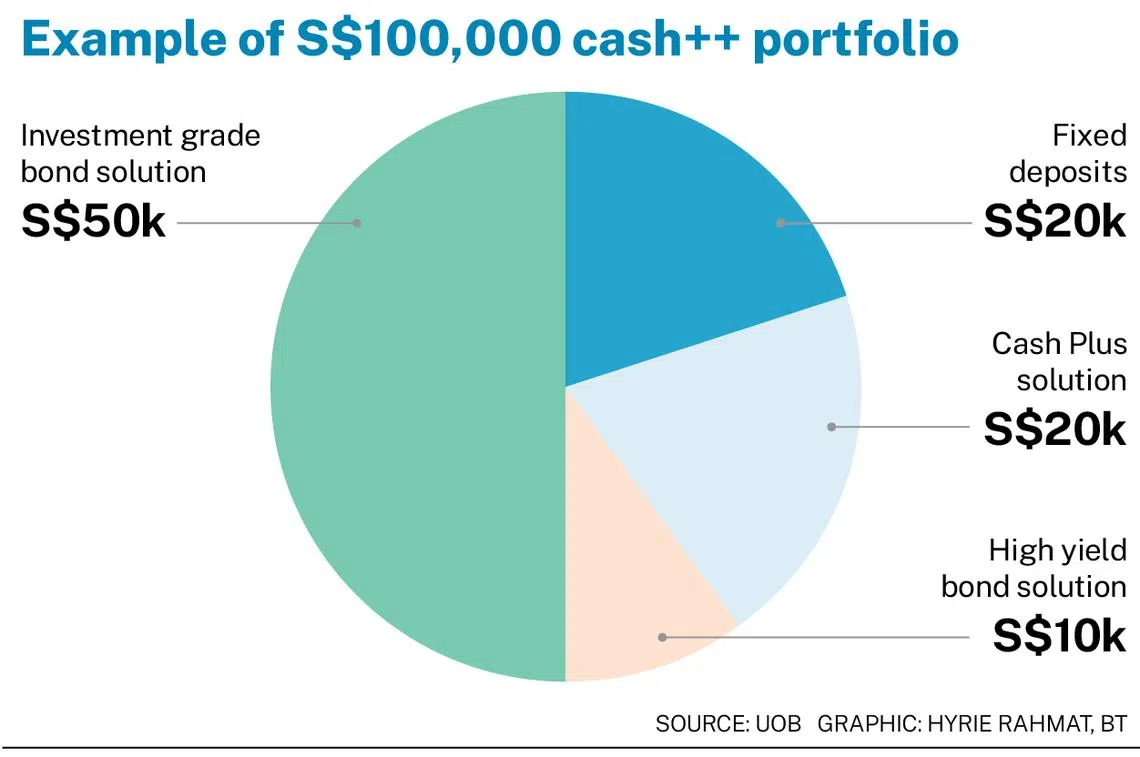
Based on our long-term capital market assumptions, this portfolio can be expected to deliver roughly S$4,600 per annum. This includes both the capital gains and income payments and excludes any relevant fees and charges. Based on our calculations, this portfolio would have a relatively low standard deviation of 3.64 per cent, meaning the expected return can be plus or minus S$167.
Bonds or equities
The above portfolio comprises entirely of deposits and bonds, but is in no way reflective of a negative view on equities. In fact, over the past 12 months, global equities have gained around 18 per cent. We are currently watchful but are unconvinced the US is facing a near-term recession. We are even more optimistic about Asia’s prospects. Against this backdrop, we believe that Asian equities will rise further.
However, for those who prefer not to take equity risks, Asian bonds present a viable investment alternative. Yields are higher than US and European peers, and as a result, Asian bond solutions are enjoying strong international fund flows.
Looking ahead, this sector has the potential to benefit from the region’s falling interest rates, stable inflation and good economic growth. This gives us good reason to believe that, for more risk-averse investors, Asian bond solutions offer enough diversity and yield to build a solid portfolio.
The writer is group chief investment officer, UOB Asset Management