Insurance par funds return to the black but no bonus uplift from 2023
Insurers maintain annual bonus rates despite improved 2023 results; three-year average returns remain negative for some


POLICYHOLDERS with traditional or participating insurance plans can breathe a sigh of relief. Virtually all insurers’ par funds returned to the black at end-2023, after posting losses – some in double digits – in 2022.
But even with the improved performance, most have chosen to hold their annual bonus rates steady.
The exception is AIA, which has raised the bonus and dividends rates for a block of policies, “while maintaining the rates for the majority of policies at the same scale as the previous year”. AIA said the increase in bonus and dividends is “part of our annual review” and does not comprise a special dividend.
The three-year average return of some par funds remains negative, which explains why bonuses have not been raised. Prudential has reduced terminal bonus rates for some endowment policies.
To recap, steep interest rate hikes by the US Federal Reserve and soaring inflation sent bond and equity markets into a tailspin in 2022. Both assets fell in tandem by double digits.
All insurance par funds generated negative returns in 2022. For five funds, the losses were between 13 and 14 per cent. As a result, some companies – including Great Eastern Life, AIA and Singlife – reduced the annual or terminal bonuses on a selective basis in 2023.
Manulife, Income and Prudential maintained their annual bonuses last year.
In this latest compilation of par fund results for 2023, the strongest returns were generated by Manulife at 9.08 per cent. Returns from bond and equity holdings, along with policyholder premiums, helped to boost its par fund assets under management by 22 per cent, from S$17.8 billion to S$21.7 billion in 2023. Manulife is maintaining its annual bonus rates for 2023.
At the same time, Manulife’s par fund expense ratio dropped from 2.35 per cent in 2022 to 1.52 per cent. “The reduction in our expense ratio can largely be attributed to decreased acquisition expenses, which correspond with a shift in customer preference away from par products in a rising interest rate environment. This led to us writing fewer new par policies, thereby increasing the proportion of in-force policies relative to new ones, contributing to the reduction in the expense ratio,” it said.
Prudential said in its update that its returns were positive in 2023. “However the average return over the last 10 years has not met the required level to sustain current bonus rates. As a result, some endowment policies will experience a reduction in terminal bonus rates for financial year 2023. Terminal bonus rates will be maintained for all whole life policies and for most endowment policies.”
Surge in non-par new business
Par policies are a staple among Singaporean savers for their partially guaranteed returns. In this type of policy, premiums are pooled by the insurer and invested collectively. Policyholders share in the experience of the life fund. A smoothing mechanism is applied which shields policyholders from market volatility. In a good year, some surplus may be retained as a cushion for future distribution in years when the market performance is poor. The result is a steady, positive return over the long term.
Returns are distributed in the form of annual bonuses, which become guaranteed once they are declared. There is also a terminal bonus component which is paid after a specified number of years or on maturity.
While par plans remain favoured, macro factors including higher interest rates and strong equity markets may have driven a shift in preferences – for now.
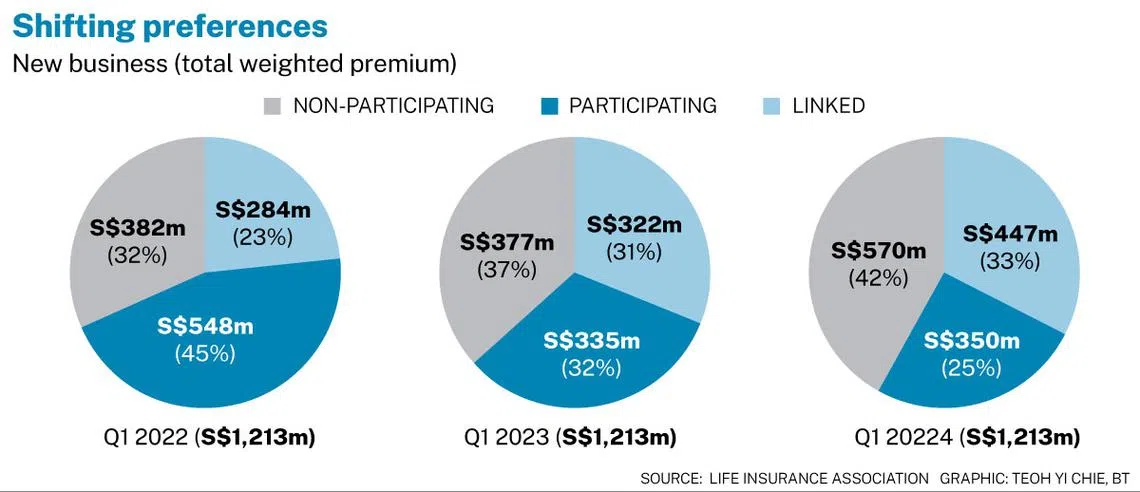
In the Life Insurance Association’s latest statistics for the first quarter, par policies’ share of new business declined to 25 per cent, compared to 32 per cent in Q1 2023 and 45 per cent in Q1 2022.
Non-par policies have taken up the slack; their share of new business has risen from 32 per cent in 2022 to 42 per cent this year. Non-par policies do not share in the insurers’ investment returns. These include health policies and some types of single premium endowments. Sales of non-par policies rose 51 per cent to S$570 million.
In an environment of higher rates, short-term endowments of two to three years’ tenor are regarded as comparable to fixed deposits, and marketed with guaranteed returns. For such endowments, the insurer invests in bonds which match the promised return. The marketing period is typically short and there is a cap on the funds that can be raised.
Investment-linked policies’ share of new business also rose to 33 per cent, from 23 per cent in 2022. Take-up of linked policies typically rises when markets are on an uptrend as they have been since mid-2023. Sales of linked policies rose 39 per cent to S$447 million.
Par funds are generally invested conservatively with a view to ensure that policy benefits and projections are fulfilled. The largest allocation is into fixed income assets to the tune of over 50 or 60 per cent. Equities’ share ranges from less than a quarter to more than 30 per cent.
What’s important for policyholders in long-term par contracts isn’t the return in any single year, but the insurer’s long-term track record and ability to deliver benefits as promised. Frequent bonus cuts could compromise the promised return, and could cause disappointment especially if the par contract supports critical illness benefits or is intended to meet a retirement goal.
What are insurers doing in the current year for their par funds? At the margin, some have slightly reduced their allocation into bonds, and raised their equity exposures.
Expectations for a rate cut by the Fed have been dialled back to one to two cuts later this year. A rate cut is positive for bonds’ capital values, but as bond prices rise, yields decline. Equities are expected to benefit, although this is likely already priced into markets given the strong returns so far. Year to date up to Jul 5, the S&P 500 has returned more than 16 per cent and the MSCI World, nearly 13 per cent.
Tailwind from higher rates
The silver lining is that rates are not expected to return to an era of ultra-low levels similar to the post-2008 decade. Very low bond yields pose a significant challenge to insurers who need to remain conservative but still be able to deliver the long-term promised returns.
Swiss Re cites higher rates as a significant tailwind for insurers. Jerome Jean Haegeli, Swiss Re’s group chief economist, said: “Savings products are attractive again as a direct consequence of normalising interest rates. Higher investment yields also benefit long-duration protection products.”
The Swiss Re Institute forcasts an additional US$1.5 trillion in global insurance savings premiums over the next decade as consumers buy products to secure higher retirement incomes. It expects total global premiums to hit US$4 trillion by 2034. In contrast, premiums grew by US$300 billion in the low-rate decade of 2010 to 2019.
Income Insurance chief investment officer David Chua said: “Since the latter part of last year, we are in a market environment where there is a tactical skew towards risk-on assets including equities, and we have positioned our fund accordingly. Notwithstanding, we are mindful of the risk scenarios including a decelerating US economy that may turn into a mild recession.
“As we navigate these near-term market dynamics, we maintain our longer-term perspective on market structure and return opportunities.”
Singlife said in its par fund update that it expected economic growth and corporate earnings to slow. Inflation is also expected to slow but remain above central bank targets.
“We believe the risk/reward outlook generally favours fixed income over equities in 2024. Risk factors which could upset the current inflation downtrend include a broad expansion of war in the Middle East and related supply chain disruptions and energy shocks, or populist outcomes in 2024 political elections, with an increase in onshoring, tariffs and protectionism,” it said.
Eddy Lim, GE’s head of products and propositions, said: “The market outlook will depend on the persistence of inflation, which will then have a corresponding impact on central bank policies. The participating fund takes a prudent, well-diversified approach to seek a stable medium-to-long-term return for our clients. Bonus allocated are typically smoothed over a period of time to lower volatility from market conditions.”