‘Learning to play mahjong at 70 is not an easy feat’: healthcare experts say make early investments to extend healthspan
These investments go beyond medical to include lifestyle choices and hobbies

[SINGAPORE] More people around the world are now living longer, and the numbers paint a clearer picture.
The global lifespan has been increasing over the past few decades, with the average life expectancy rising from 64.6 years in 1990 to 73.8 years in 2023.
It is even higher in Singapore, where the life expectancy at birth for residents was 83.9 years in 2025.
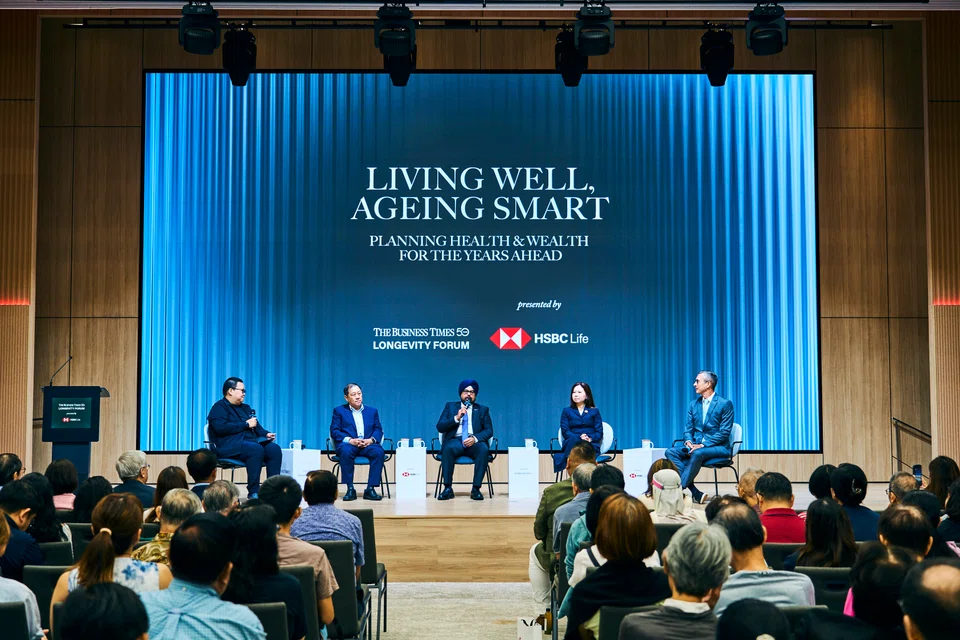
And yet, life expectancy only tracks how long people live, and not how well they live, said a group of panellists at The Business Times Longevity Forum presented by HSBC Life on Saturday (Jul 25).
“We have one of the highest life expectancies in the world, but the last decade is spent in ill health,” said Dr Sue-Anne Toh, CEO and co-founder of Novi Health, a specialist medical clinic and health tech company.
She was joined by Professor Chin Jin Jih, deputy CEO for clinical and academic development at NHG Health and senior consultant in geriatric medicine at Tan Tock Seng Hospital; Dr Naras Lapsys, chief clinical officer and senior dietitian at Chi Longevity; and HSBC Life CEO Harpreet Bindra.
In Singapore, there is currently a gap of about 10 years between a person’s lifespan (which measures how long a person lives) and healthspan (which measures how long a person can live in good health and with a good functional quality of life).
Closing that lifespan and healthspan gap has been a major focus in Singapore. At the national level, the government has initiatives such as Healthy 365 – a programme that incentivises residents to lead more active lifestyles. The private sector is also increasingly adding more offerings aimed at preventive healthcare.
But increasing one’s healthspan is still very much driven by the actions of the individual. Panellists urged people to start investing in themselves earlier, both in terms of financial planning and lifestyle choices and habits.

“Learning to play mahjong at 70 is not an easy feat,” said Prof Chin. He advised individuals to start adopting both indoor and outdoor hobbies that can positively affect both physical and mental health at an earlier age.
“The evidence (shows) that you have got to invest earlier. You don’t, suddenly at 60 (or) at retirement, decide that (you) now want to go to the gym (or) want to run. Yes, there’s a lot of repair and maintenance work (to be done), but the investment has to start earlier, and that’s where I think the underestimation is,” he said.
Prof Chin advised that beyond taking up indoor and outdoor hobbies, one should also find some activities that allow for human interaction. He explained that people often underestimate the importance of human interaction, and that loneliness could eventually lead to poor nutrition or a lack of motivation to exercise.
The panellists also acknowledged that there will still be chronic diseases that are unavoidable. Nonetheless, they urged individuals to set their own targets and find ways to “thrive”, regardless of the medical circumstance an individual finds himself or herself in.
The importance of investing in one’s healthspan was highlighted by Dr Lapsys who noted that residents in Singapore are in the top five globally of economies where people are going to live the longest.
“Our life is a bit like climbing a mountain and trying to reach the summit. If you’ve made 65 years of age… the likelihood that you are going to live up to 87-plus is a reality. We are going to live longer, and we need to think about it,” he said.
He added that the city-state has a good environment that supports longevity such as easy access to clean water, good healthcare and green spaces.
While an individual can adopt many health and lifestyle choices in the pursuit of a longer healthspan, Bindra also explained that one should not think of health and wealth as two separate conversations as they are “deeply interconnected”.
Poor health can negatively affect one’s financial situation, which in turn affects one’s confidence and well-being. Conversely, having one’s finances in good order can also help provide better access to healthcare, which in turn allows one to lead a healthier life.
“We encourage our customers to think about these as two... interconnected topics, not divergent,” Bindra said.
That includes retirement planning as well. He explained that individuals should go beyond the idea of having a fixed financial milestone to achieve by 65 as there are still about two decades from 65 to the end of the average lifespan.
Individuals may want to pursue different lifestyle options post-retirement or may also have different responsibilities post-retirement that require money. It is important to factor these into retirement planning as well.
He advised individuals to check if their financial solutions are flexible and also called on financial institutions, banks and asset managers to develop more long-term solutions that give customers flexibility in retirement.
Bindra pointed out that a “first of its kind” inflation indexed retirement income solution that HSBC Life launched in Singapore in January has been very well received by customers.
“It solves two challenges. It solves for longevity as it offers guaranteed payouts till age 120, and it also solves for inflation because inflation can massively erode your life savings,” Bindra said.

Decoding Asia newsletter: your guide to navigating Asia in a new global order. Sign up here to get Decoding Asia newsletter. Delivered to your inbox. Free.
Copyright SPH Media. All rights reserved.