Investing lessons for 2023
The best takeaways are learnt over years and decades, and not from the past 12 months
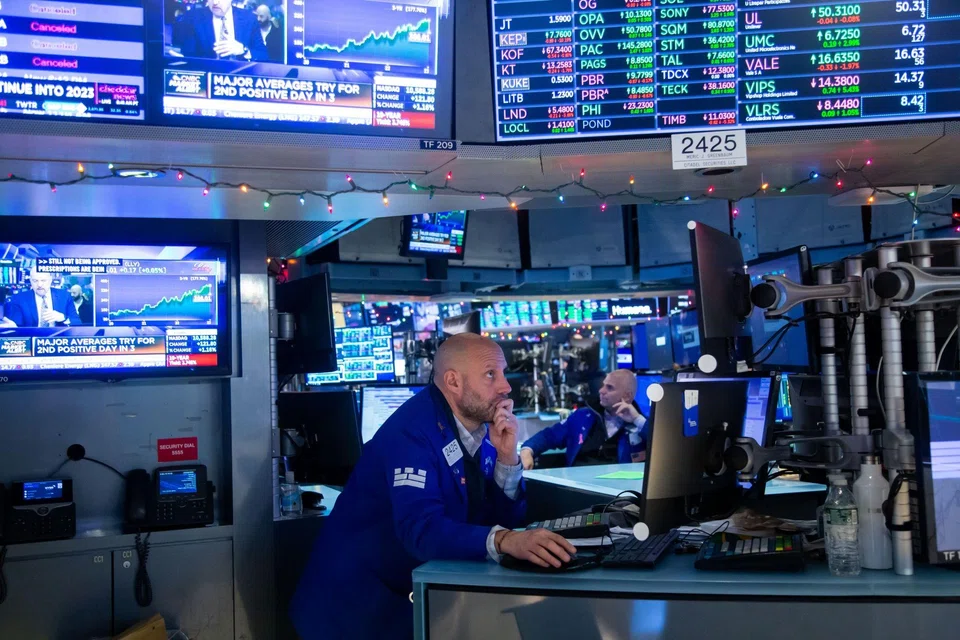
IT has been either a terrible time or a great time to be owning stocks. A lot depends on when you started investing.
Last year, the S&P 500 index sank 19.4 per cent, marking its worst performance since 2008. Investors who put in their money at the start of 2022 would be understandably distraught.
Yet, if you lengthen your time horizon, the returns look vastly different.
Between 2018 and 2022, the S&P 500 rose by a compounded annual growth rate (CAGR) of 9.5 per cent per year, fairly close to the index’s long-term average return of 10 per cent a year.
Similarly, the lessons you learn from the past 12 months are very different from the conclusions you draw from events that happened years or decades ago. The best lessons, I would argue, come from the latter, and not the former.
Living on the edge
When confronted with unfamiliar situations, humans have a tendency to dwell on the extremes. For instance, visits to Singapore’s shopping malls were severely curtailed during the 2020 “circuit breaker”. During that time, Frasers Centrepoint Trust, one of Singapore’s largest mall owners, reported that foot traffic fell below 40 per cent of its 2019 pre-Covid average, causing it to lose 60 per cent of tenant sales.
Worryingly, at around the same time, online sales as a percentage of Singapore’s total retail more than quadrupled from 5.8 per cent in January to 24.5 per cent in May. This sharp shift in consumer spending prompted analysts and commentators to suggest that the offline retail landscape had forever been altered and will face a long road to recovery, if at all.
Yet, today, 30 months later, those scenarios have been revealed to be overly pessimistic. While it’s true that the percentage of online sales within Singapore has remained at over two times pre-pandemic levels, it is nowhere near the doomsday scenarios where shopping malls are rendered completely irrelevant. In fact, tenant sales at Frasers Centrepoint Trust’s malls had already exceeded 2019 levels by November 2021, and have remained above the benchmark since then.
Likewise, the onset of the pandemic normalised the idea of working from home – in the process, raising questions over the role of physical offices in the future. There is some merit to these concerns, but it depends on where you work.
As recently as September 2022, physical occupancy rates in North America were still at half of pre-pandemic levels, said the World Economic Forum. The same cannot be said for Singapore offices. According to JLL research, monthly gross rentals on our island-nation are close to the pre-pandemic peak and are expected to be sustained at higher levels over the medium term.
The two examples above are a reminder that we have just lived through a period of extremes. As investors, we should recognise that the huge shift online in 2020 followed by the massive move back offline in 2022 are abnormalities and unlikely to recur every year. Considering these two extremes as the norm for the future would be a mistake, in my view.
Learn the right lessons
If there was a single villain that caused the 2022 market crash, most would point their finger at rising interest rates. But not everyone may be learning the right lesson here.
In particular, the market crash last year may have persuaded some investors to equate rising interest rates to falling stock prices. This way of thinking may cause them to sell at the next sign of a US Federal Reserve rate hike.
However, such a conclusion ignores how unusual last year’s interest rate increases have been. According to data compiled by the Visual Capitalist, the effective federal funds rate rose past the two-percentage mark within six months in 2022, its fastest increase in more than three decades. That’s abnormal, to say the least. In comparison, the US central bank took 36 months to reach the same rate level in its previous rate hike cycle between December 2015 and December 2018.
Furthermore, avoiding stocks within this three-year period would be a mistake. For example, shares of Amazon and iFAST Corporation would have netted investors returns of 164 per cent and 349 per cent, respectively, if both counters had been held from the start of 2016 till the end of 2022.
Missing out on the basis of misguided beliefs would be detrimental to investors.
Thinking in probabilities
Finally, investors tend to put too much weight on recent events. This bias could be especially egregious after last year’s market crash. Given the beating that investors have taken while holding stocks, some may end up waiting on the sidelines.
Instead of holding back, investors may wish to consider the odds of a market downturn.
For context, wealth manager Ben Carlson pointed out that the 2022 performance of the S&P 500 was among its worst ever in history. Last year’s decline of nearly 20 per cent was only exceeded by the major market crashes in the past, such as the Great Depression in the 1930s, 2002 dot-com crash, and the 2008 global financial crisis.
That, in my eyes, is the definition of an abnormality. To be clear, it’s not to say that another 20 per cent decline is completely out of the question. But what we can say is with every passing year, the odds of a positive outcome increase, based on historical data stretching back to the 1920s.
Considering the probabilities, I would argue, would be a better way to think about the future, compared to reacting to the stock market’s performance over the past 12 months.
Get smart: Life-long learning
As the saying goes, the stock market is the Great Humiliator. Investors who were over-optimistic two years ago have been left with egg on their faces when 2022 came along. By the same token, I suspect that investors who are overly pessimistic today will also be proven wrong.
We can’t prove it now, but given time, we may come to see these two contrasting periods for what they are: two extreme periods by historical standards.
For investors, it’s best not to come to any conclusions too early. As a life-long student of investing, I submit that your interest is best served by exercising patience in holding your stocks and learning the right investment lessons.
The writer owns shares of Amazon and iFAST. He is co-founder of The Smart Investor (https://thesmartinvestor.com.sg), a website that aims to help people invest smartly by providing investor education, stock commentary and market coverage