Investment opportunities and risks beckon in 2023
The outlook for next year looks bumpy at the start – before becoming more promising as the year progresses

IT HAS been said that there is seldom a dull moment in the financial markets. And 2022 has indeed had its fair share of surprises.
First, we had the pandemic turning endemic, and then the Russia-Ukraine war that till now shows no signs of ending.
But the most pivotal development was the sharp rise in inflation globally, which jolted central banks – many of whom were behind the curve – to tighten rapidly.
This represented a sharp reversal from the post-1990 disinflation era that led many central banks in the developed world to pursue an ultra-easy monetary policy that included quantitative easing and negative interest rates.
This year, the US Federal Reserve has raised interest rates by 425 basis points – the largest hike since the early 1980s – with the corresponding impact to the economy yet to be fully felt.
However, certain areas in financial markets that were addicted to ultra-low rates, such as profitless growth stocks and cryptocurrencies, came under severe pressure.
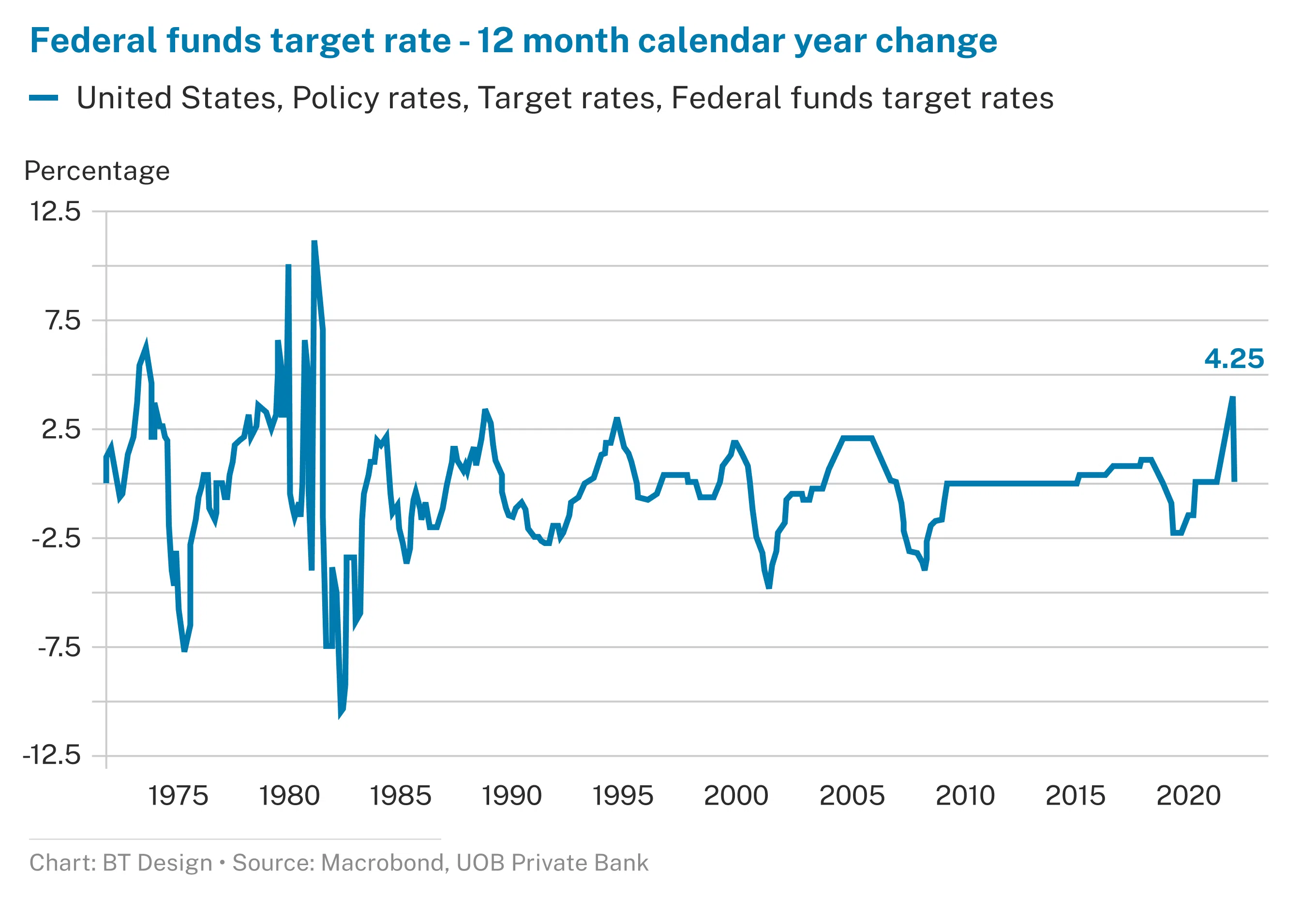
In our view, the crucial issue for the coming year is the trajectory of the Fed’s policy.
On a more positive note, US inflation peaked around the middle of this year and is on track to fall gradually in the coming months.
Key drivers such as rental rates, commodities and auto prices are pointing to lower inflation ahead.
However, as Fed chairman Jerome Powell highlighted in his Jackson Hole speech in August this year, the experience from the 1970s suggests that rising inflation can raise expectations of more price increases, which could eventually percolate into pricing and wage decisions.
While long-term inflationary expectations have been well-anchored so far, the risk of letting the inflation genie out of the bottle outweighs the risk of over-tightening, even if it means causing a recession.
The US labour market remains very tight, and the Fed has no choice but to slow down demand to cool the labour market.
Don’t fight the Fed
The recent rally in US stocks, falling credit spreads and a decline in the US dollar have loosened financial conditions and partially reversed the tightening by the Fed.
But any rally in financial assets in the near term is likely to be short-lived as the Fed is likely to counteract it with a hawkish response via an adjustment to its monetary policy, which will again translate to tighter financial conditions.
With inflation expected to trend lower in 2023, leading to a concomitant downshift in economic momentum, we anticipate that the Fed will pause its rate hike and is likely to even cut rates towards the end of next year.
The big ‘R’
Historically, declines in inflation, even from high levels, have been associated with rising asset prices – ostensibly due to anticipation of a less hawkish Fed.
However, should a recession ensue, asset prices might decline further as the Fed is expected to maintain a restrictive policy stance to generate sufficient slack in order to cool the labour market.
The risk of a recession is material. Using Powell’s favourite yield curve measure – the 18-month forward three-month government bond yield – the risk of a recession in the coming year is rising.
However, the debate among investors is less on whether we will face a recession, and more on its potential duration and depth.
One unique feature of the current cycle is that a recession seems to have become a consensus expectation, and has arguably been partially priced in.
In our view, there is a higher likelihood of a milder recession than a hard landing like the 1970s, where the real Fed Funds rate rose by over 10 per cent.
Moreover, there are few signs of financial imbalances and associated instability now, compared to 2008.
The balanced portfolio, which refers to a mixed asset portfolio of roughly equal weight between bonds and equities, suffered a drawdown of 20 per cent this year – a level not too far from the global financial crisis of 2008.
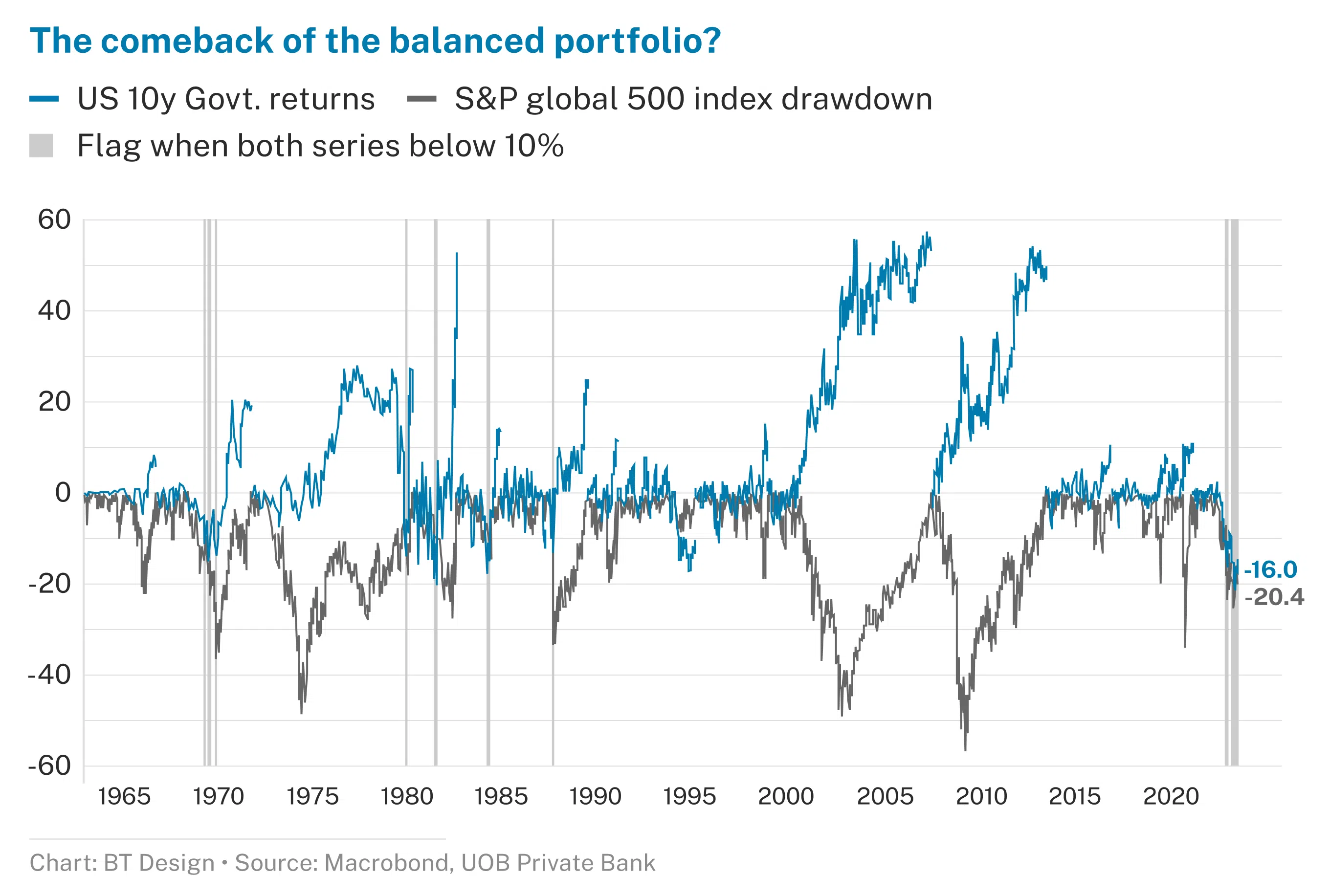
In 2008, bonds rallied and mitigated losses from equities; whereas in 2022, value for both bonds and equities fell.
Heading into 2023, with expectations of terminal funds rate at around 5-5.25 per cent, any further rate hikes are unlikely to be as impactful as the preceding 425 basis points.
Moreover, with the economy already slowing from the cumulative impact of previous rate hikes, long-term interest rates are not expected to rise in tandem.
Additionally, with higher starting yields, further negative mark-to-market risk will be limited.
High-quality investment grade bonds are attractive as all-in yields are moving towards 5 per cent for the intermediate duration sector.
Should there be a deeper slowdown and rates fall, these bonds could act as a portfolio stabiliser as investors will enjoy capital gains on top of a higher yield.
Non-synchronised growth: the emerging market potential?
While cycles in the US and Europe are broadly synchronised, the emerging markets have a different cyclical profile.
China, in particular, may see a decoupling from developed markets as a result of a gradual reopening following a pivot away from its zero-Covid policy and a recommitment to the growth agenda following its 20th Party Congress.
With both equity and credit markets valued at recession lows, there is potential for the financial market to decouple from the rest of the world.
Post-pandemic experiences across the globe suggest that the initial phase of reopening could lead to a slowing economy as the healthcare system attempts to cope with a surge in cases and people reduce mobility to avoid infection.
However, countries eventually cross this hurdle and successfully transition towards endemicity.
As markets undergo regime changes, it is important to stay diversified.
The start of 2023 could be bumpy but the outlook for the full year looks more promising.
With higher interest rates, there are ample opportunities for investors to achieve better returns.
The writer is chief investment officer at UOB Private Bank.