

Is it time to load up on S-Reits? Caution is warranted in higher-rate environment
Investors should be selective when investing in them as it is an interest rate-sensitive sector

AS THE forward price-to-book ratio of the FTSE ST REIT Index hit 0.84 times as at Jun 30, close to two standard deviations below its 10-year average, investors may see this as an opportune moment to enter the Singapore Reit (S-Reit) market.
However, we caution investors against hasty decisions and advise prudence before entering.
Stress testing: a higher cap rate
We do not expect any rate cuts by the Federal Reserve this year, which may suggest further downside risks for S-Reits. Our view arises from the resilient US economy and the uncertainties surrounding the Red Sea which could potentially drive up shipping and freight costs, and in turn, contribute to sustained inflationary pressures.
In the longer term, we expect rates to remain higher for longer; the era of cheap borrowing rates may have already ended.
Given this landscape, we conducted a stress test on the top 10 S-Reits by market capitalisation. We first looked into the impact of a 1 per cent increase in capitalisation rates on property values. We found that a 1 per cent expansion in cap rates will result in property valuations falling by an average of 19 per cent.
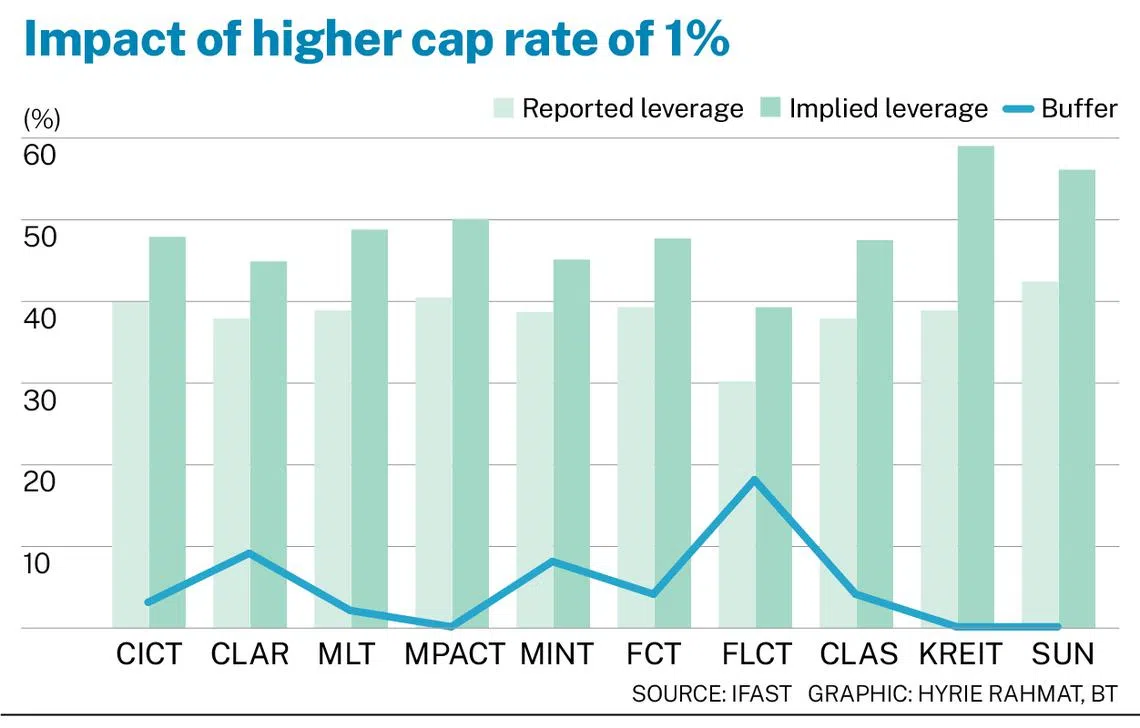
We note that Mapletree Industrial Trust and CapitaLand Ascendas Reit are less vulnerable to cap-rate expansion. On the other hand, a greater impact on property valuations was seen in Keppel Reit due to its lower existing implied cap rate.
A lower asset value will automatically increase a Reit’s leverage. Thus, we computed the adjusted property values and then calculated the amount of buffer available for the Reits before they exceed their regulatory gearing limit.
We note that the average available buffer stands at 5 per cent. Frasers Logistics & Commercial Trust has the largest buffer of 18 per cent, largely attributed to the fact that it has the lowest reported leverage of 30.2 per cent (as at FY2023) relative to the average peer gearing ratio of 38.5 per cent.
On the flip side, Mapletree Pan Asia Commercial Trust, Keppel Reit and Suntec Reit would have no buffer due to their high gearing ratio of 40.5 per cent, 38.9 per cent and 42 per cent as at FY2023, respectively. Moreover, Suntec Reit is currently subjected to a gearing limit of 45 per cent instead of 50 per cent, due to its interest coverage ratio being less than 2.5 times.
In the next layer of our stress test, we look to capture the downside potential involving refinancing risks.
Refinancing risks persist
In this layer of stress test, we estimate S-Reits’ new cost of debt in accordance with the prevailing high interest rate environment. We compute the cost of debt after refinancing in 2025, with interest rates based on a credit spread over the Monetary Authority of Singapore’s (MAS) Singapore Overnight Rate (Sora).
As at Jun 30, 2024, Sora was at 3.43 per cent, lower than last year’s average of 3.71 per cent but still about two standard deviations above its 10-year average of 1.26 per cent. With rates now in a much higher territory compared to historical levels and our expectations that rates would stay higher for longer, we expect S-Reits to still face refinancing risks for its near-term debt.
In our analysis, we find that some S-Reits which locked in a low cost of debt a few years ago face the greatest refinancing risks, as a huge proportion of their debt matures in the next two years. These include Frasers Logistics & Commercial Trust, CapitaLand Ascott Trust and Keppel Reit, whose cost of debt is expected to rise by more than 30 per cent.
We also estimate the higher interest expense that will be incurred, assuming that no new debt would be taken on. It is worth highlighting that higher interest expense lowers the interest coverage ratio (ICR).
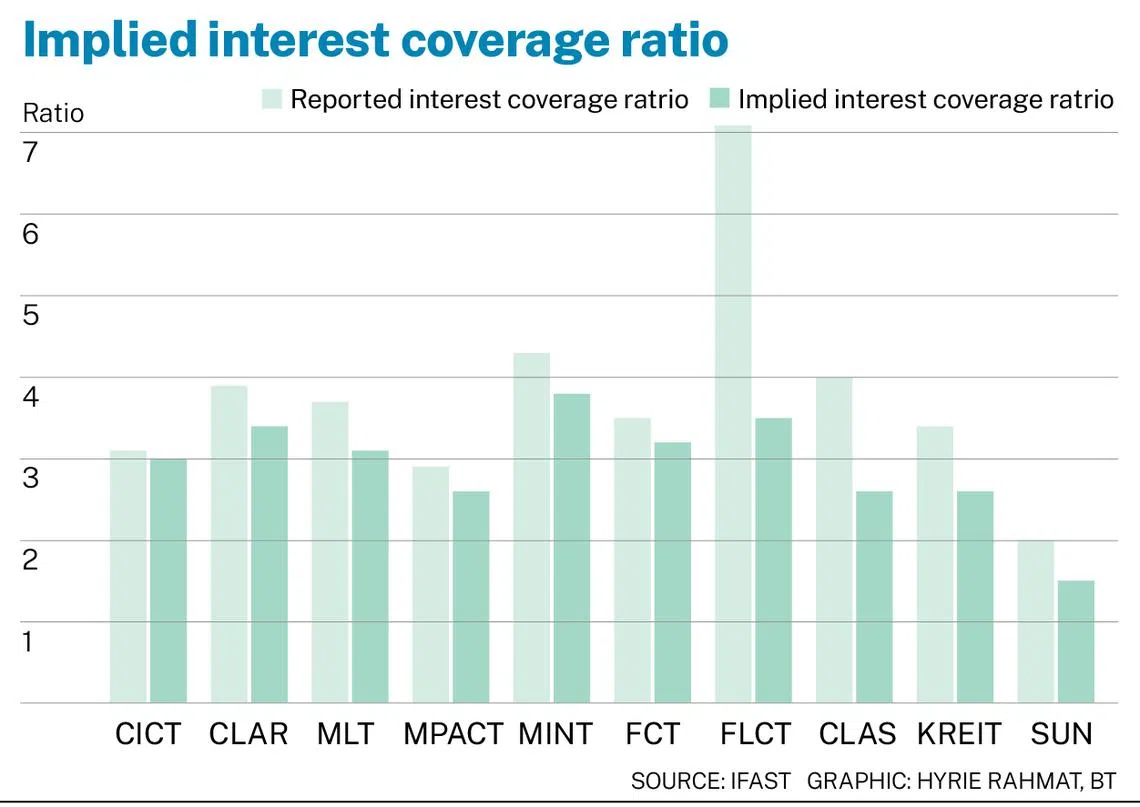
It is crucial to look into the ICR as it determines which leverage threshold a Reit would be subjected to. On Apr 16, 2020, MAS announced that it would raise with immediate effect the leverage limit for S-Reits from 45 to 50 per cent, to provide S-Reits greater flexibility to manage their capital structure amid the challenging environment created by the Covid-19 pandemic.
MAS also proposed to require S-Reits to have a minimum ICR of 2.5 times before they are allowed to increase their leverage beyond the prevailing 45 per cent limit (up to 50 per cent).
As previously mentioned, we note that Suntec Reit is currently subjected to a limit of 45 per cent due to its ICR of 2 times (as at FY2023). Based on our research, some S-Reits’ ICR would fall near the threshold of 2.5 times because of higher interest expenses. They are Mapletree Pan Asia Commercial Trust, CapitaLand Ascott Trust and Keppel Reit.
Investors should be selective when investing in S-Reits as it is an interest rate-sensitive sector. Based on our stress test of the 10 S-Reits by market capitalisation, CapitaLand Ascendas Reit and Mapletree Industrial Trust exhibit greater resilience against the backdrop of higher-for-longer rates.
The writer is a research analyst with the research and portfolio management team of FSMOne.com, a Singapore subsidiary of iFast Corporation
TRENDING NOW

World’s largest offshore wind platform by Seatrium consortium on track to be completed by 2028

Is stamp collecting enjoying an analogue revival or are its best days over?

GovTech retrenches another 38 staff in second round of layoffs

MBS adjusted property Ebitda falls 20.6% in Q3 with fewer high-roller visits, weaker hold

