Is it time to return to Asian high-yield? Here’s what we are watching
China’s property will remain a significant drag on Asian HY performance, but India is set to play a larger role, thanks to its renewable energy sector

THE rally in Asian high-yield (HY) bonds has lost its steam. The bond market, as gauged by the Bloomberg Asia USD High Yield Bond Index, has retraced some gains from November 2022 and is at one of its lowest levels of the year.
China a driver of Asian HY
Since its 2021 property crisis, China has become a major underperformer within the Asian HY bond market. Prior to the crisis, the China corporate HY bond market – dominated by bonds from property developers – made up over half of the Asian HY universe. This highlights the idiosyncratic risks associated with one single sector.
Today, Asian HY is becoming more diversified in terms of market composition. China’s weight has shrunk drastically from over 50 per cent in 2021 to 28 per cent in June 2023. Meanwhile, the weightage of its smaller counterparts – India, Hong Kong, and Macau – rose significantly.
But we observe that the performance of Asian HY remains highly correlated with the China corporate HY segment. Over the past year, the correlation between the two markets was 0.98, slightly higher than the five-year correlation of 0.91. As such, the recovery trajectory of the China’s property sector is key to the near-term outlook of the Asian HY bond market.
China property woes
We believe it is premature to call for a quick turnaround in the China property sector.
First, while home sales and prices were encouraging at the start of the year, we note that it was artificially helped by last year’s extremely low base and pent-up demand after the exit from the zero-Covid policy. Pent-up demand is already starting to fade as suggested by the recent new home prices and contracted sales growth, which were significantly lower than previous months.
As the global economy slows, China’s economic prospects are at risk. An increasing jobless rate also affects prospective homebuyers’ financial situation and their willingness to purchase big-ticket items such as homes.
Second, liquidity worries surrounding property developers have resurfaced after the recent default of KWG Group. This has reignited fears of more defaults in the property sector, particularly among peers with poor liquidity.
Meanwhile, restructuring plans of developers who have already defaulted are not always smooth-sailing. For instance, China Evergrande has yet to win enough support from creditors for its overseas debt restructuring plan. Fantasia, which defaulted in 2021, is facing resistance to its restructuring plan from a major shareholder.
Looking ahead, a shrinking land bank and sluggish property demand are expected to hold back developers’ debt restructuring plans. Poor liquidity profiles, as well as the disappointing progress of debt restructuring plans, suggest that China’s property market remains affected by a confidence crisis. Homebuyers also have continued concerns over the developers’ ability to deliver homes that have been pre-sold.
Lastly, policymakers have expressed a continued desire to prevent “disorderly expansion” by developers. This suggests that deleveraging and tighter scrutiny on fundamentals will remain the overall emphasis, even amid recent market speculation of more stimulus for the property sector.
Long-term potential in India
In the longer term, we expect India – currently the second-largest market in Asian HY – to play a larger role in driving the market performance. India has been a relatively resilient player within the bond market, underpinned by renewable energy, its largest sector.
The renewable energy sector has structural growth potential. The Indian government has rolled out continued support for the sector, which has been identified as one of seven key priorities in the Union Budget. At present, India’s installed renewable energy capacity is the fourth-largest in the world. Through large-scale energy transition projects, the country aims to achieve net zero by 2070.
Furthermore, from the perspective of credit fundamentals which are measured in terms of net debt to Ebitda (earnings before interest, taxes, depreciation, and amortisation) and interest coverage ratio, India HY issuers are largely on a stronger footing compared to issuers in the China property sector.
Cautious on Asian HY
China’s property woes will remain as a significant drag on the overall performance of Asian HY. In our view, the China property sector is unlikely to experience a quick turnaround as a result of poor liquidity profiles and a lack of confidence. Restoration of confidence could depend on a steady completion of uncompleted projects and well-received restructuring plans, which take time to materialise.
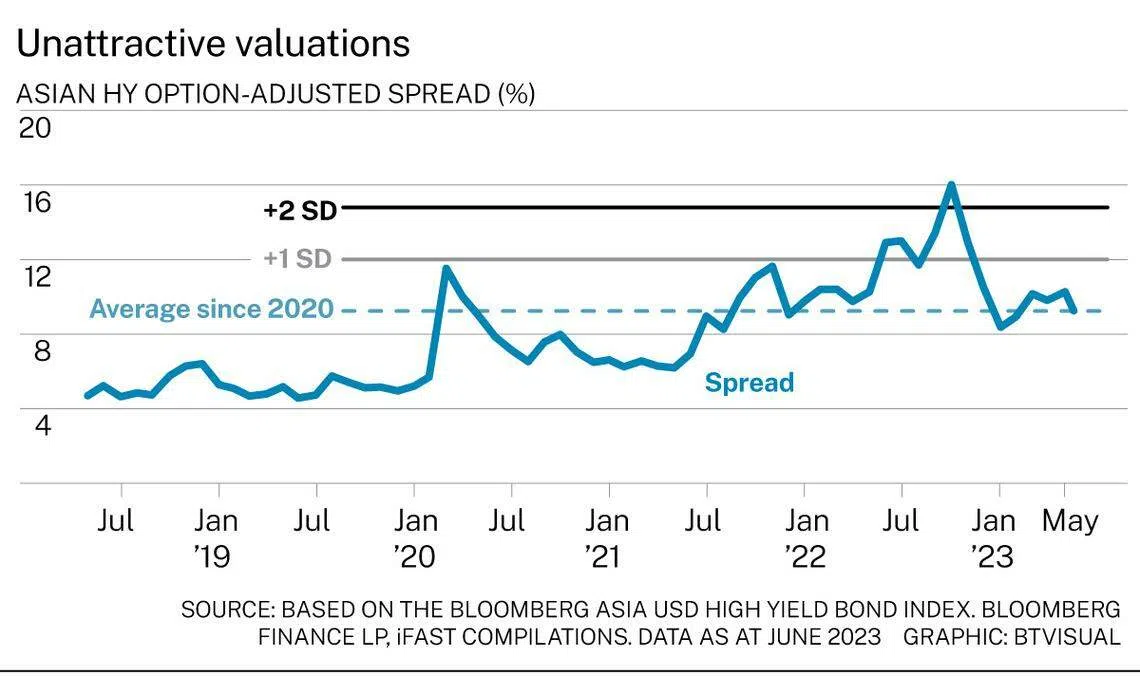
While valuations have come down since the start of the year, they remain unattractive. Until we see greater certainty about the recovery trajectory of the China property sector, we believe that investors should demand a greater margin of safety from Asian HY. A spread level of 1,500 basis points, which is two standard deviations above the average since 2020, could indicate a more attractive entry point for investors.
In the longer term, we expect India to play a larger role in driving the Asian HY returns. India HY benefits from structural tailwinds, and is on a stronger footing compared to the China property sector.
Investors who wish to retain exposure to Asian HY may consider the iShares Barclays Capital USD Asia High Yield Bond Index ETF (SGX.O9P) for a passive strategy.
For an active strategy, there is the Blackrock Asian High Yield Bond A8 SGD-H. Active security selection could help to identify higher quality names with robust balance sheets. The fund holds a sizeable position in the Indian HY space.
The writer is an assistant manager with the research & portfolio management team at FSMOne.com, the B2C division of iFAST Financial. The latter is a subsidiary of mainboard-listed iFAST Corporation Ltd