Mitigating the deep damage of market-timing errors
Timing mistakes take a huge toll on returns, particularly in thematic funds. Investors now face the tricky question of when to exit cash

Genevieve Cua

WE ARE our own worst enemy in investing. But in some types of funds, the tendency to buy high and sell low inflicts deeper damage than in others.
Morningstar’s report on investor returns in thematic funds starkly illustrates this. Published last week, the study reached the same bleak, albeit unsurprising, conclusion as another recently published study: Poorly timed investment decisions are a significant drag on wealth.
Over a five-year period until end-June, thematic funds generated an annualised total return of 7.3 per cent. Investors, however, earned only 2.4 per cent when the impact of cash outflows and inflows is considered. This means investors suffered a performance gap of 4.9 percentage points (ppts) a year. In contrast, the average gap in non-thematic all-equity funds was just 0.5 ppts.
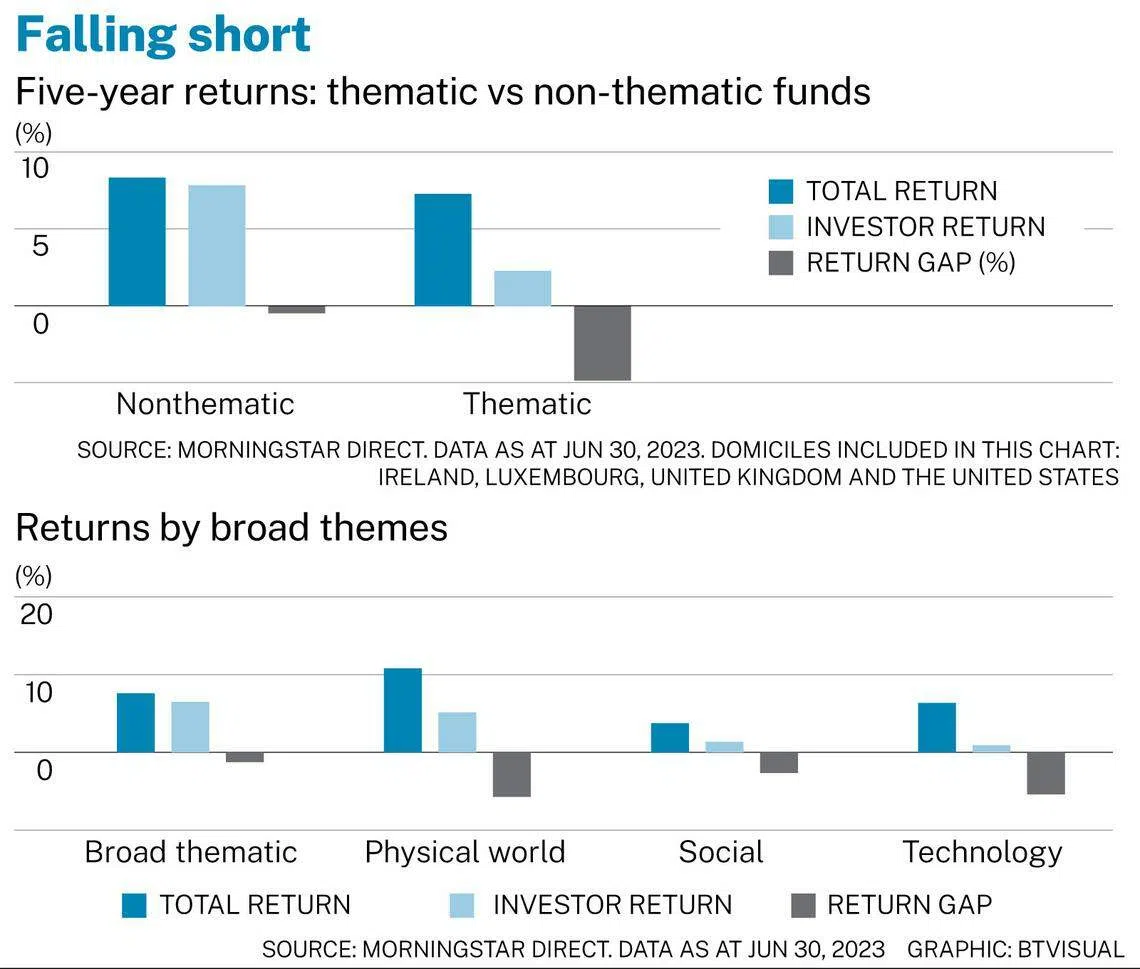
The return gap is worse in some sub-themes: It was 5.7 ppts in the Physical World funds, and 5.5 ppts in Technology funds. The worst was the Energy Transition segment, where returns lagged a buy-and-hold strategy by a whopping 11.9 ppts. Investors in Broad Thematic funds suffered a smaller gap of 1.1 ppts.
Separately, a broader and longer-term study by Morningstar published in July examined average US investor returns from 10 fund categories over 10 years, including asset allocation, international equity and US equity funds. It found that the average total return of the funds was 7.7 per cent annually, compared to investor returns of 6 per cent. This makes for a shortfall of 1.7 ppts a year.
That the returns gap in thematic funds far surpassed that of broader vanilla funds should not be surprising. Thematic funds tend to be more concentrated – sub-themes may have 50 underlying holdings – and are more volatile. “More volatile funds seem to induce more frequent trading and a tendency to buy high and sell low,” Morningstar noted.
Investors, it said, are collectively poor market-timers and would fare better using a “patient buy-and-hold approach”. “They particularly struggle in more volatile and exotic funds compared with more diversified core building blocks,” it added.
A caveat of the thematic funds analysis is that the five-year period for returns is relatively short. Morningstar said the period captures the exceptional growth in the global thematic funds market, followed by a significant tumble. “A significant rally for tech and growth stocks would likely shrink the return gaps going forward.”
Assets in thematic funds have doubled since 2018. As at end-September, global thematic funds had over US$1.25 trillion in assets.
Morningstar’s findings echo those of US-based Dalbar, which has been tracking the impact of investor behaviour on returns for decades. Over 30 years between 1993 and 2022, the average investor earned just 4.1 per cent annualised, compared to 9.6 per cent generated by the S&P 500; 7.5 per cent for a 50/50 stock/bond holding; and 4.6 per cent for bonds.
When to exit cash?
These studies are resonant in today’s environment. In 2022, stocks and bonds suffered as the US Federal Reserve hiked interest rates aggressively, causing their values to fall in tandem. Globally, investors have flocked to money market funds that offered safety plus a gratifyingly attractive interest rate, after scraping bottom for much of the past decade.
This played out in Singapore as well. Low-risk investment options, including fixed deposits, six-month Treasury bills and the Singapore Savings Bond, have attracted billions since 2022.
Savers, however, will grapple with the question of the right time to exit cash. Markets have rallied since the US’ tamer-than-expected inflation data, which came in at 3.2 per cent for October. In the year to date, the S&P 500 has returned 18.56 per cent, and bonds 0.56 per cent based on the Bloomberg Global Aggregate Total Return Index.
Many strategists now believe a soft landing is in sight for the US economy, and that the Fed will pause rate hikes and perhaps cut rates at least once in 2024.
Stocks have likely run up in anticipation of this. But for retail investors – I count myself among them – timing the market is a fool’s errand. You may get it right a couple of times, but you’re unlikely to succeed consistently.
Thematic funds enable investors to make a tactical bet. The danger is that retail investors tend to invest when markets are toppish, making them vulnerable to losses in a correction. A fund whose value drops by 50 per cent will need to double for you to break even. It will need to appreciate even more if you paid a sales charge.
For background, Morningstar uses time-weighted data to arrive at funds’ total returns. This assumes a lump sum investment at the start of the period. Investor returns, on the other hand, are asset-weighted. This means the periods when investors have more dollars invested are given heavier weight. This can make a substantial difference to returns.
What should investors do? The most sensible thing is to always keep in mind your risk profile and investment horizon. A 60-year-old who is near or in retirement would still have a fairly long horizon of around 25 years, depending on health and life expectancy. But because a retiree no longer receives a salary, he may be withdrawing from his portfolio for life needs, and hence a degree of asset preservation is important.
Younger investors can afford more concentrated bets. Even so, thematic funds belong firmly in the satellite portion of a portfolio. This allocation should be modest; it is the play money that you should be prepared to lose.
Late to the party
In thematic funds, even a long holding period may not do much to mitigate losses, said Matias Mottola, Morningstar’s director of manager research.
“It’s not always possible for investors to minimise the gap by investing as long-term as possible, as they may not have the assets available at the start of the period. What often happens is that the theme (and thus the funds) only become better known after a return run-up,” he said.
“Investors have to be mindful and aware of this fact – that as a non-professional investor you often come late to the party, and therefore it’s sensible to keep such positions small in the context of the portfolio.”
What of the mode of investment? Dollar-cost averaging by investing an amount at regular intervals is supposed to help to mitigate the timing risk incurred in a lump-sum investment. But in a rising market, when you buy shares or funds at progressively higher prices, dollar-cost averaging can yield worse returns than a simple buy-and-hold strategy.
Mottola said dollar-cost averaging is not optimal, but it makes a good starting point. “The issue does not seem to have been that investors use dollar-cost averaging too much, but rather that they (invested) in trendy funds in the periods when the asset’s price was close to its top.”
In any case, the robust appreciation of the Magnificent Seven stocks – comprising Alphabet, Amazon, Apple, Meta, Microsoft, Nvidia and Tesla – has skewed the composition of even a global index such as the MSCI World. The stocks account for nearly 30 per cent of the S&P 500 and roughly 19 per cent of the MSCI World. Hence, it’s imprudent to take even more concentrated bets in themes such as technology.
Capital Group chief executive Michael Gitlin proffers sensible advice: “Don’t try to trade the waves. It’s impossible to do well… At this stage of the cycle, as central banks begin to cut rates, cash becomes a decaying asset. To individual investors, I’d say get invested and stay invested.”