Portfolio yield: a ballast for volatile times and stable source of returns
Analysts see potential for growth in income and dividends, but keep a few key principles in mind when investing


SINGAPORE investors’ appetite for income or yield is almost never in question. But with the strong bull market of the past two years – when capital gains, especially in US stocks, trumped dividends resoundingly – you might be tempted to take larger bets on growth.
To be sure, whether you prefer to invest for growth versus for income is a personal decision and hinges on factors including age, risk appetite and investment horizon.
My joint portfolio with my husband is predominantly lower-risk, in keeping with our age and risk profile. Recently, I sat down to figure out how much in income the portfolio earned. It was gratifying that income was a five-figure sum from dividends and bond coupons – roughly 6 per cent in yield from the few corporate bonds that we hold, and slightly higher than that from a relatively modest equities allocation, comprising stocks and real estate investment trusts.
We didn’t have holdings directly exposed to US stocks or technology, and, hence, missed out on the robust showing of the S&P 500.
Still, the income earned, which doesn’t include interest from cash in fixed deposits, was a large component of the total returns. Better still, the portfolio has returned to the black after dipping in mid-2021. Income helped in that respect.
Yield’s evergreen appeal
Yield is likely to be resurgent this year, and there are a couple of reasons for this.
One, dividends and income serve as a portfolio ballast amid continuing uncertainty over the impact of tariffs and market volatility. Two, over the long term, even using S&P 500 as a reference, dividend-growers outperform.
In a January strategy note, Citi pointed out that the S&P 500 has generated a total return of 57 per cent in 2023 to 2024, thanks to the strong showing of a few large-cap US stocks, corporate profits and monetary easing.
The composition of returns from a medium-risk global portfolio was 80 per cent from asset price appreciation and 20 per cent from portfolio income. But this isn’t the norm; the historical average return composition over the past 10 years was 57 per cent and 43 per cent, respectively.
Citi concluded that the much higher ratio of capital appreciation of late is “only the norm of a strong bull market”.
It cautions investors not to expect a repeat of the S&P 500’s robust performance going forward. Asset price appreciation is “the more volatile and less certain component of portfolio returns”.
“We are not looking to de-emphasise seeking growth and asset price appreciation. But, as we may be shifting from the ‘rapid appreciation’ phase for US equities to something more modest, income in portfolios mathematically increases in importance.
“While bullish, we would simply have more conservative expectations for S&P 500 returns than the 26 per cent average of the past two years. A steady valuation on our 2026 estimate for the S&P 500 would generate a roughly 9 per cent total return this year. Yet a wide range of more positive or negative outcomes is possible.”
Strategists are watching bond yields closely. The 10-year Treasury yield currently stands at around 4.5 per cent. But should it rise to 5 per cent, it may decisively tilt the investment equation in favour of bonds at equities’ expense. This suggests a correction in the S&P 500.
By Citi’s compilation, “dividend aristocrats” in the S&P 500 have outperformed the vanilla index, delivering higher returns at lower volatility, resulting in a higher information ratio. The latter is a measure of risk-adjusted returns relative to an index.
Asian dividends’ potential
Meanwhile Schroders’ Lee King Fuei, co-head of Asian equity alternative investments, makes a strong case for dividends from Asia-Pacific ex-Japan equities. In a February note, he wrote that dividends are a “reliable anchor” at a time of geopolitical flash points and trade tensions which have implications for Asian companies’ earnings and valuations.
“Historically, yield-focused strategies have delivered strong performance during times of market stress, as companies that prioritise shareholder payouts often possess strong balance sheets, consistent earnings, and defensive qualities that appeal to stability-focused investors.”
Lee wrote that the most compelling case for investing in Asian dividend stocks is the potential for “dividend surprises”, defined as companies that “exceed market expectations by significantly raising their payouts”.
“Historically, such stocks have delivered strong outperformance in both rising and falling markets, making them valuable additions to portfolios. However, these opportunities are rare, often arising from strategic shifts, improved capital management, or enhanced corporate governance – factors that cannot be artificially created.”
A good example of this is Singapore banks, whose capital management strategies – including share buybacks and higher dividend payout ratios – are expected to underpin continued upward re-rating.
Lee pointed out that Asian dividends have trebled over the past two decades, but the region still has among the lowest payout ratios. This suggests “ample room” for companies to allocate a greater share of earnings to shareholders. He saw two critical catalysts for this trend: one is improvements in corporate governance; the second is government policies for a “dividend-friendly environment”.
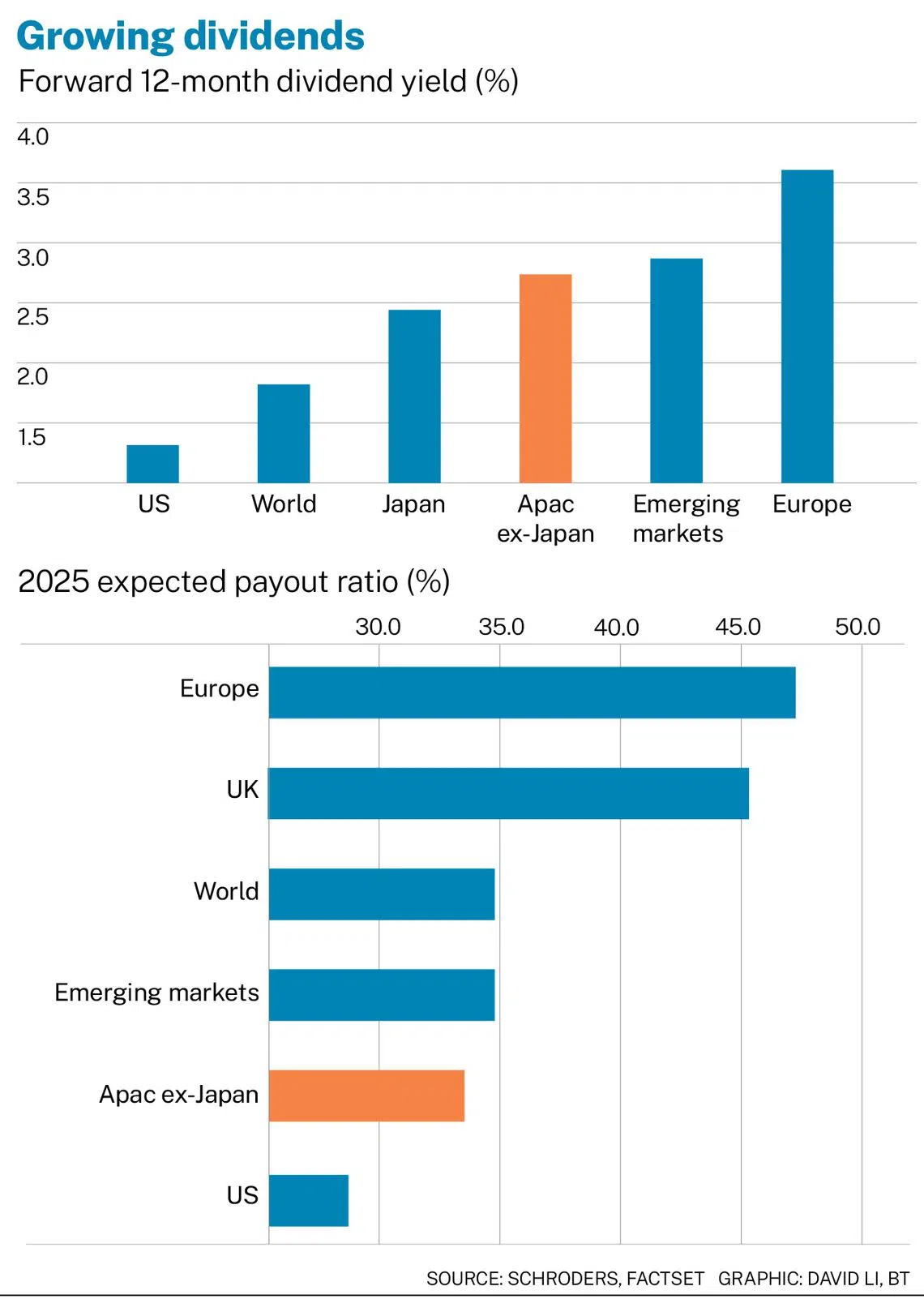
“These reforms and favourable market dynamics are creating the ideal conditions for a surge in dividend surprises across Asia. For investors, this represents a rare opportunity to capitalise on the region’s transformation. Dividend-paying stocks in Asia offer a compelling combination of growth, stability, and superior returns, making them a cornerstone for forward-looking portfolios.”
Meanwhile, it’s important that retail investors like myself do not fall prey to the Fomo (fear of missing out) syndrome. After all, I myself was burnt in the tech bust of 2000, when my global tech fund, which I bought at a high, fell by more than 80 per cent and, several years later, was merged with another fund.
There are some key principles that I find helpful. One is to avoid watching too much news, especially those that purport to help viewers make sense of market direction. In many programmes, talking heads fight to be heard and ultimately say little about long-term trends.
Second, stick to a strategic asset allocation which helps to mitigate the urge to sell on market dips and buy at the top. I do regret not buying a US equities fund decades ago. Now I take vicarious satisfaction in the fact that my son, who has been working for less than two years, has begun to invest regularly in a global equities exchange-traded fund.
Third, of course, is diversification and avoiding leverage. By diversifying, you won’t reap the best of market returns. But on the flip side, neither will you suffer the worst hits, especially on single stock exposures.
As for leverage, the downside could be far more than the capital you’ve put in. That raises the risk of permanent capital loss, which no one should be willing to take.