Quiet luxury brands ring in greater returns
Brands which eschew flashy logos and imaging outperform in terms of operating margins, revenue growth and return on equity
IF A tree falls in the forest and no one is around to hear it, does it make a sound? In the same vein, if a luxury good is worn by an individual and no one recognises it, does it still have value?
The answer is a resounding yes.
Late 2023, the DBS Chief Investment Office identified “quiet luxury” as a key investment theme. Quiet luxury stands apart from the broader luxury industry in that it does not draw attention to itself. Unlike the flashy branding of some luxury brands – think, for instance, conspicuous monograms and loud logos – quiet luxury prefers subtlety.
Quiet luxury, in short, speaks only to a group of insiders, encapsulating the Gen-Z slang: “If you know, you know.”
A bag plastered with brand logos is easy to identify, but The Row’s Margaux Bag will only be spotted by the discerning eye.
Beloved by consumers and investors
To construct a Quiet Luxury Index, we broke down the Bloomberg Global Luxury Goods Index into its constituents and looked for companies with understated elegance, a commitment to quality, and that maintain exclusivity in their offerings.
Seven out of 30 companies demonstrated those traits:
- Hermès
- Moncler
- LVMH Moët Hennessy Louis Vuitton
- Compagnie Financière Richemont
- Swatch Group
- Brunello Cucinelli
- Ermenegildo Zegna
Our call for this sector has panned out well this year. The products of quiet luxury companies may eschew the limelight, but their share performance is undeniably eye-catching. The Quiet Luxury Index has outstripped both the Nasdaq Composite and global equities by around seven and nine percentage points respectively, year to date.
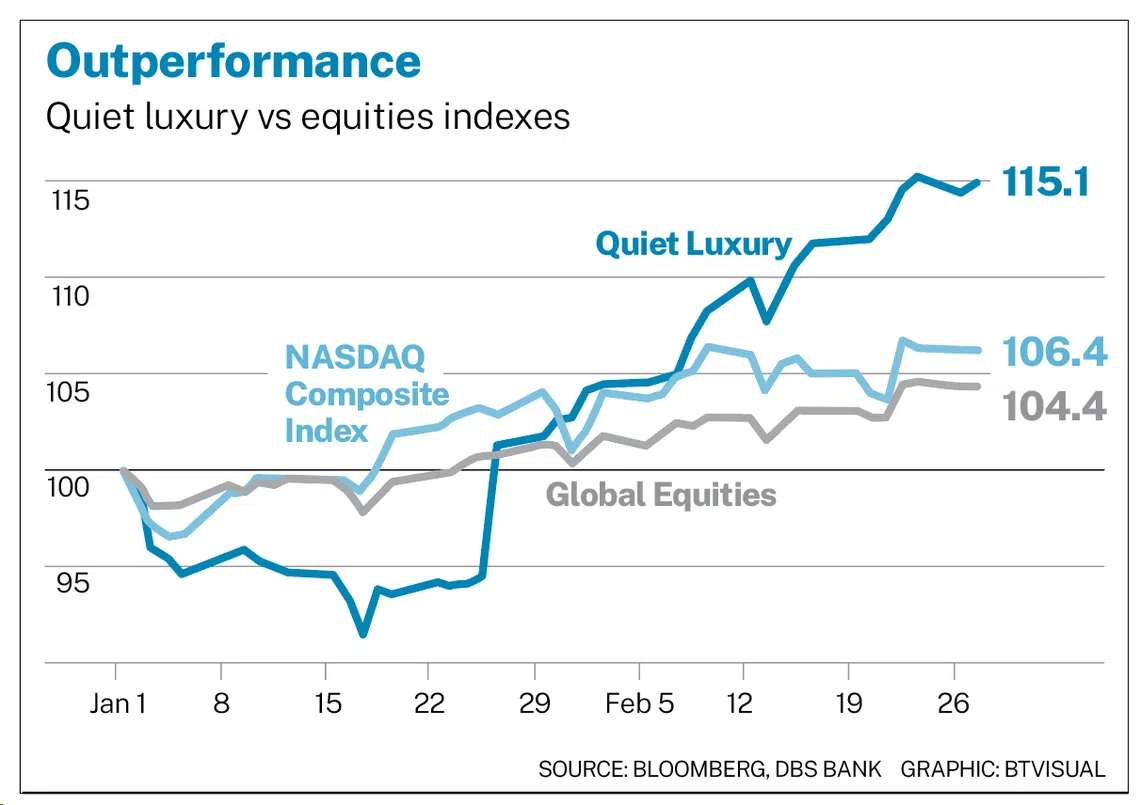
Such a statistic is more impressive when we consider how the Nasdaq soared 43 per cent in 2023 to make it the best-performing index in the US, thanks to investor excitement over artificial intelligence.
That the Quiet Luxury Index is outperforming the Nasdaq so far suggests that quiet luxury has enduring appeal, even when pitted against the next shiny investing trend.
The index’s strong showing is lifted by quiet luxury companies’ buoyant bottom lines.
In FY2022, quiet luxury companies boasted operating margins of 22.7 per cent. This means they made an operating profit of 22.7 cents for every dollar in revenue they raked in, far surpassing a margin of 13.6 per cent for global equities and more than triple the 7.2 per cent for the broader luxury industry.
With quiet luxury companies’ revenue growth of approximately 9.8 per cent for FY2023 and FY2024 – compared with 8 per cent for the broader luxury market – profits look set to keep rolling in.
Return on equity (ROE) is likewise dominated by quiet luxury companies, which had ROE of 18.5 per cent, compared with global equities’ 14.7 per cent and the broader luxury industry’s 9.8 per cent. The efficiency of quiet luxury companies in utilising shareholders’ equity to generate profits makes it clear why quiet luxury is beloved not just by consumers, but investors as well.
Conscious consumption
Quiet luxury may seem antithetical to the purpose of a luxury item, which, by definition, is a non-essential good meant to signal the bearer’s socio-economic status. Three trends underpin the rise of quiet luxury.
First, changing demographics. Millennials are projected to comprise the bulk of the luxury market by 2025. Growing up in an era dominated by concerns over social issues and climate change, millennials are conscious consumers.
Ernst & Young’s Future Consumer Index study found that over half of respondents surveyed paid increasing attention to the environmental and social impact of their purchases.
Furthermore, not only do millennials expect brands to produce desirable goods, they also want brands to reflect their commitment to causes they care about. Quiet luxury brands that honour craftsmanship, with handmade and durable goods, are hence growing in appeal to millennials.
Second, a desire for exclusivity. The widespread appearance of luxury goods on social media diminishes their rarefied aura, while reputable resellers such as Farfetch and Vestiaire Collective have made owning luxury goods more accessible than ever.
That is by no means a bad thing. The basic premise of economics, after all, is to allocate the maximum number of goods to the maximum number of people. However, in response to growing accessibility, some consumers are turning to exclusivity in the form of quiet luxury brands that shun the limelight and focus on producing quality products in a limited quantity.
Last, the emergence of uneasy affluence. The pandemic and inflation shock of recent years have highlighted growing income disparity in many countries, to the extent that simmering discontent towards the ultra-rich has crystalised as physical outbreaks.
French workers, for instance, stormed luxury titan LVMH’s Paris headquarters in April 2023 to protest pension reforms, just as the group celebrated its status as Europe’s most valuable company.
Backlash against the upper echelons of society has prompted many to avoid ostentatious displays of wealth. Instead, understatement, craftsmanship and discreet branding are back in vogue.
Time will tell
Consider the price of Rolex watches in the secondary market. According to WatchCharts, a research platform for watches, the price of Rolex watches – traditionally known for their eye-catching opulence – fell 3.6 per cent in the past 180 days.
In contrast, less mainstream brands such as Jaeger-LeCoultre and Cartier enjoyed price increases.
Since their invention in the 15th century, watches have been used to tell the time. But if we look beyond the movement of their hands and focus on the swings in their prices, these watches may be able to portend the future of the luxury industry as well – one where the quiet luxury segment continues to ring in returns, loudly.
The writer is chief investment officer, DBS