Retirement investing: Go for simplicity, low costs and risk control

OVER more than a year, an inverted US Treasuries yield curve has been interpreted as a harbinger of a US recession. However, in the past few weeks, the yield curve “un-inverted” to its normal shape, where short rates were lower than the long end.
A Wall Street Journal (WSJ) column raised this conundrum: A normal yield curve, it said, can also be “a sure-fire sign of recession”.
The column is symptomatic of today’s puzzling times, when mixed signals abound. The United States Federal Reserve raised interest rates at a rapid clip from mid-2022 to around 2023, in efforts to dampen soaring inflation. Conventional wisdom says that such an aggressive rate trajectory would induce a recession as the cost of debt and capital for businesses rise.
Yet here we are, at a turning point in the rate cycle. The Fed is widely expected to begin to reduce rates in September. The US economy remains resilient, and inflation has fallen from its peak. The big question is the magnitude and number of cuts. As the WSJ article pointed out, for most of modern history, deep rate cuts were a sign of an impending recession.
Do such prognostications matter if you are investing for retirement? There is a slew of concerns today – inflation, economic growth, market valuations, wars and, of course, the US election.
For savers, what matters most is that their portfolios grow consistently and are able to sufficiently fund their senior years. With rising longevity and the prospect of more than two decades in retirement, that’s a tall order.
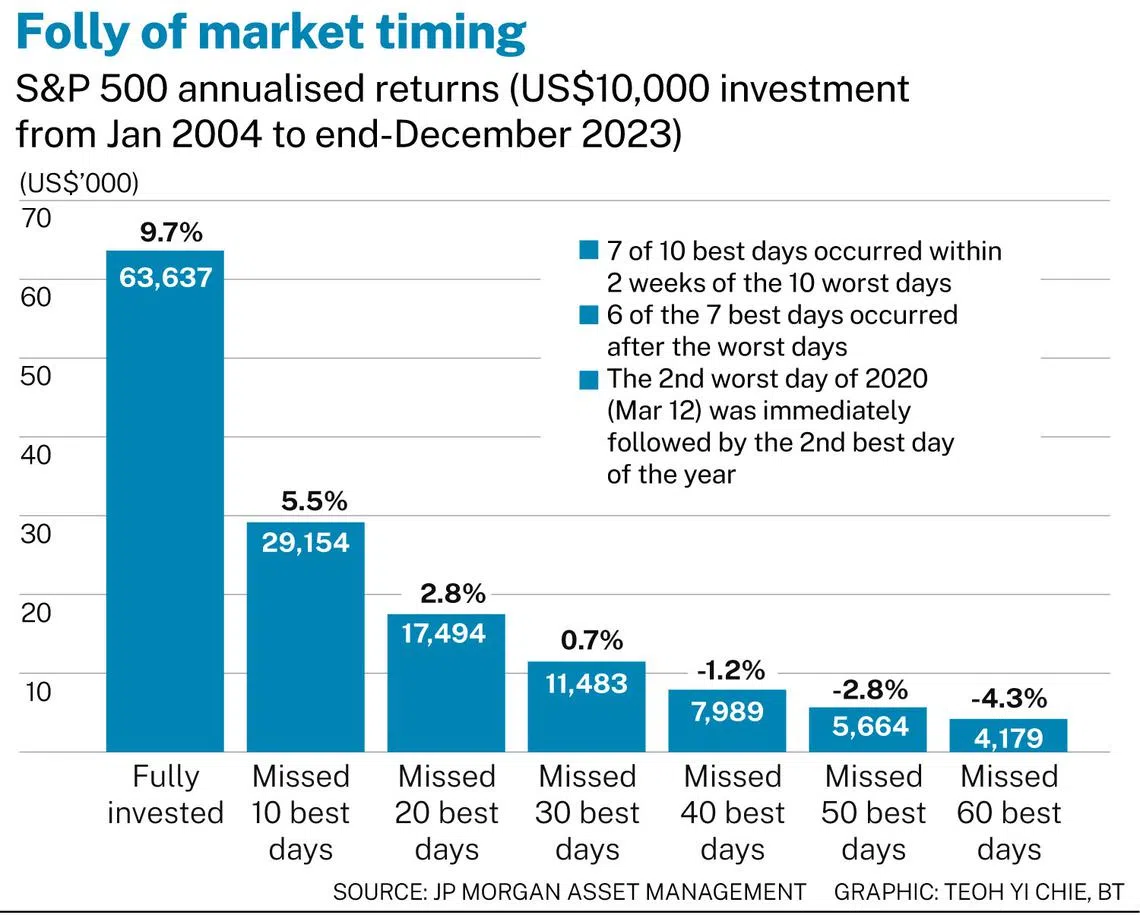
In all this, trying to predict economic and market outcomes, and, worse still, to invest based on those forecasts is a fool’s game. How can individuals time markets consistently when even professionals have a spotty record at best? As a New York Times column pointed out recently, the median Wall Street forecast between 2000 and 2023 missed its target by an average of 13.8 percentage points annually.
For long-term portfolios, I believe simplicity is key – that is, investing in a vehicle or vehicles that take the guesswork out of investing – plus the ability to stay invested to reap the benefits of compounding returns.
Here are some key principles.
Have a plan
By far, the most important aspect of saving for retirement is to have a plan by which you can map out your long and short-term goals. This sounds simple – and it is. The rule of thumb is: the longer your investment horizon and the larger your personal investable net worth, the more risk you can take. But due to sheer inertia, most people fail to even get started. Overlay your plan and corresponding strategic asset allocation – how much to put into equities, fixed income and cash – with a commitment to diversification.
You then have your guideposts which should keep you from taking excessive risk in any single asset. A plan doesn’t mean you have no leeway for tactical or “passion” bets – but this should be done only at the margin, and always avoiding leverage. Leverage is a gamble; you could make outsized returns, but your loss on the downside could exceed your capital. Avoiding permanent loss of capital is paramount.
Cash isn’t king in retirement portfolios
Higher rates in the past 12 months made it worth your while to park some amount in secure deposits or Treasury bills. But the tide is turning, and it’s time to reallocate some amounts into higher-risk assets if you haven’t done so yet. In Singapore, the most recent six-month T-bill auction in September fetched 3.1 per cent, compared with 3.4 per cent in August. But it’s an uphill climb to get Singaporeans to rethink the role of cash in their investments.
Fidelity’s latest survey, which touched on pre- and post-retirement issues, found that Singaporeans expected a return of 6 per cent post-retirement. It also found that the most popular financial product was fixed deposits, which clearly made a 6 per cent return expectation unrealistic.
Simple works, and low costs too
Much has been said about passive exchange-traded funds, which offer exposure to broad indexes at low cost. But there are also what I’d call “index funds-plus” funds, specifically those offered by Dimensional Fund Advisors (DFA). DFA funds have been available in Singapore for some time now through financial advisers and robos such as Endowus. Recently three funds were included in the Central Provident Fund Investment Scheme – the Global Core Equity III Fund, Emerging Markets Large Cap Core Equity, and the Global Core Fixed Income III Fund.
Unlike most passive funds which hug a capitalisation-weighted index, DFA funds tilt indexes towards factors that are proved to outperform. These are size, value and profitability. DFA’s approach is formed through research by academics Eugene Fama and Kenneth French, who designed a three-factor model to explain the risks and returns of stocks. Fama is a Nobel laureate and DFA director.
DFA co-founder David Booth described the approach as “a click away from passive” in an interview I did with him in 2017. “We’re basically passive in that we don’t think we can find value that isn’t already reflected in securities prices. But we think by making some adjustments on trading, we can add some value.” In all this, there is no room for market forecasts or timing.
Morningstar gives DFA’s Global Core Equity Fund a “silver” rating. It says DFA’s systematic process of excluding the most-expensive and least-profitable companies, and then weighting the remaining stocks, results in a portfolio of the desired factor exposures. Performance, it said, has been “solid” consistently in the second quartile of its category over several time periods. It also has higher Sharpe ratios.
But a weakness is that historical factor premiums may not persist, noted Morningstar. “The fund may underperform when its targeted factors are out of favour and (it) has limited flexibility to adapt to changing market conditions… Despite these challenges, the (fund’s) systematic approach, broad diversification, factor tilts, and competitive fee structure position it well to continue delivering superior risk-adjusted returns relative to its peers over the long term.” Fund fees comprise an annual management fee of 0.22 per cent, and an ongoing charge of 0.26 per cent.
Taking the measure of risk
Singaporeans’ love for fixed deposits and products with a guaranteed element such as insurance endowments arises from risk-aversion. Risk, as Oaktree Capital Management co-chairman Howard Marks expounds in his first video tutorial, isn’t volatility which is a technical measure of how much assets bounce around. Instead, risk is the possibility of loss. This, I think, is very true. It’s an established cognitive bias among individuals that the pain of loss is twice as powerful as the pleasure of gains.
In his talk, Marks tackles various conceptions of risk and how investors can practically view risk. Risk, for instance, isn’t a function of asset quality. “There’s a belief that high-quality assets are safe and low-quality assets are risky. I believe quite the opposite. A high-quality asset can be priced so high that it’s risky. Investment success doesn’t come from buying good things but from buying things well… There are no assets that are so good that they can’t become overpriced and dangerous.”
Risk, as Marks says, is “something to be managed and controlled, but not avoided”. “I think, and my experience tells me from watching others, that risk-avoidance equates to return-avoidance. Intelligent bearing of risk should be able to enable us to make good returns with the risk under control.”
My takeaway from all this is that asset diversification is a must. It may occasionally fail, but there is no other alternative if we seek long-term returns greater than cash.