

Robust outlook for Singapore’s three biggest banks
iFast Financial particularly favours DBS for its strongest earning potential for continued shareholder rewards
SHARE prices of Singapore’s three largest banks – DBS, OCBC and UOB – reached record highs in November, driven by strong third-quarter 2024 earnings, which bolstered investor confidence in the local banking sector.
Their share prices were further supported by Donald Trump’s victory in the US presidential polls, with Singapore poised to benefit in the ongoing competition with Hong Kong to become Asia’s top financial hub. Amid rising geopolitical tensions between the US and China, Singapore is increasingly seen as a safe haven for foreign capital from both the West and China looking to invest and grow in Asia.
Even though the valuations of Singapore’s banks remain high, they continue to be a good investment, offering stability and serving as a refuge amid global market uncertainties heading into 2025.
Strong earnings
For Q3, UOB posted the strongest net profit growth at 16.5 per cent year on year, followed by DBS at 15 per cent, and OCBC at 9.1 per cent. This growth was primarily driven by a significant increase in non-interest income and lower provisions for loan allowances.
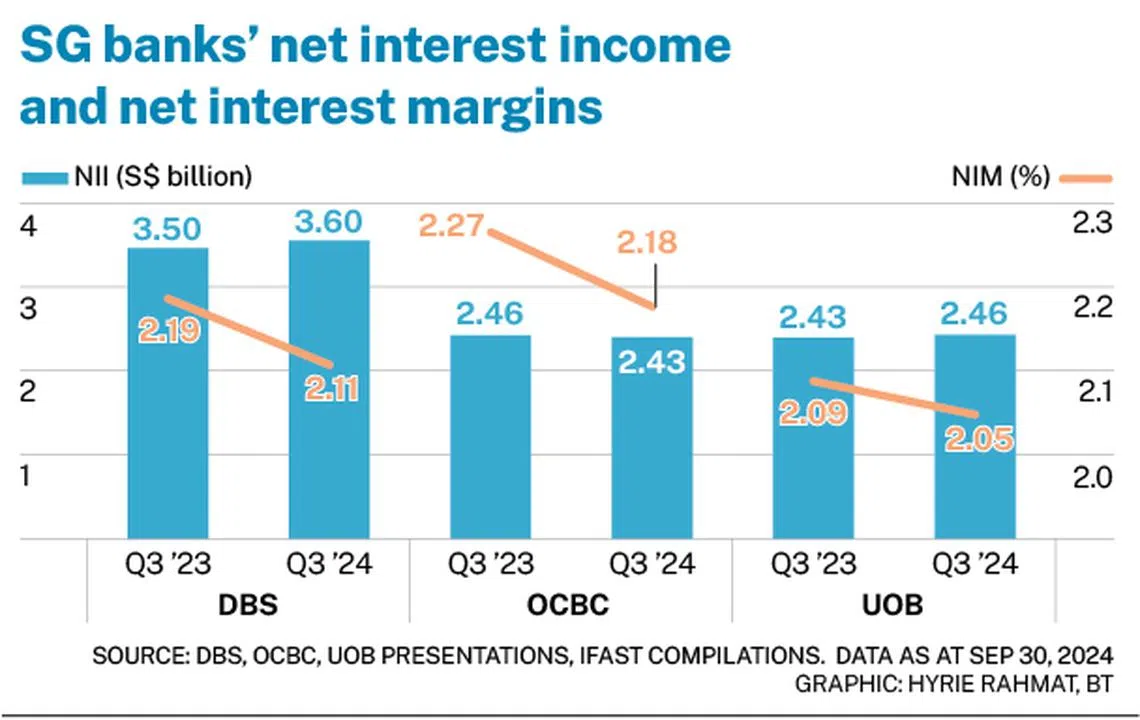
The high interest rate environment continues to pressure the banks’ net interest margins (NIM), but DBS and UOB achieved modest growth in net interest income (NII), with year-on-year increases of 2.7 and 1.3 per cent, respectively. Although OCBC saw a slight dip of 0.9 per cent year on year in NII for the third quarter, it still posted a 1.6 per cent increase for the first nine months of the year.
Non-interest income continued to show robust double-digit growth across all three banks in Q3. DBS reported the strongest wealth-management income growth, surging 55 per cent year on year to S$609 million. This growth was driven by strong inflows into assets under management and the bank’s success in converting cash into investments. OCBC and UOB also posted impressive gains in treasury sales and trading income, supported by strong demand for hedging.
For the year ahead, Singapore banks are expected to maintain a robust net-income outlook, with limited downside risks. NIM squeezes are likely to be cushioned by the banks’ strong management of deposit costs, strategies to reduce balance sheet sensitivity to interest rate fluctuations, and continued loan growth momentum. We also anticipate slower interest rate cuts, especially with Trump’s return to the political stage, supporting stable net interest income.
The most promising growth drivers will continue to be the fee income segments, particularly amid rising geopolitical tensions. Singapore’s political stability and favourable policies for family-office establishments have made it an attractive destination for offshore wealth. Growing economic uncertainties will also bolster trading and treasury income, further strengthening the banks’ non-interest income streams.
Resilient balance sheets
The banks maintain resilient balance sheets.
The non-performing assets (NPA) of both DBS and OCBC declined on a year-on-year basis, hitting historically low levels as repayments, upgrades and write-offs more than offset new NPA formations.
Consequently, both banks’ non-performing loan (NPL) ratios improved: DBS’ fell from 1.2 per cent in Q3 2023 to 1 per cent in Q3 2024; OCBC’s fell from 1 per cent to 0.9 per cent over the same period.
These underscore the two banks’ disciplined underwriting practices and the resilience of their consumer and corporate bases, positioning them for healthy growth – even in a prolonged high-interest-rate environment. UOB’s NPAs rose slightly – by 0.9 per cent year on year in Q3 2024, from a rise in individual NPA formations. But its NPL ratio was stable at 1.5 per cent.
Both DBS and OCBC have strengthened their provision coverage ratios to 135 and 164 per cent, respectively, providing a solid buffer against potential losses from impairment risks, whether stemming from domestic or global economic challenges. UOB’s coverage ratio stood at 99 per cent, down 3 basis points from the year before, but still at a healthy level.
Increased capital rewards
The year 2024 has been a rewarding one for bank shareholders. DBS led with the largest dividend increase, raising its payout to 162 cents a share, a 28.6 per cent increase year on year. The bank’s deputy chief executive, Tan Su Shan, confirmed that this shareholder-friendly approach will continue under her leadership when she assumes the CEO role in 2025.
OCBC and UOB also raised their interim dividends by four and three cents a share, respectively, a reflection of their confidence in their ongoing capital generation; their moves also boost their appeal to investors seeking consistent returns.
In addition to rising dividends, DBS announced a S$3 billion share-buyback programme. Under this, DBS will repurchase shares from the open market and cancel them, boosting earnings per share. As of Q3, DBS maintained a strong CET1 capital ratio of 15.2 per cent, well above the regulatory requirement, plus a capital conservation buffer of 9 per cent. Even with the buyback, the CET1 ratio is expected to fall by only 0.8 per cent, and remains at a robust level.
Long-term rewards
With all three banks’ current share prices hitting record highs, their price-to-book ratios appear stretched. Hence, it may be reasonable for investors focused on capital appreciation to take some profits off the table.
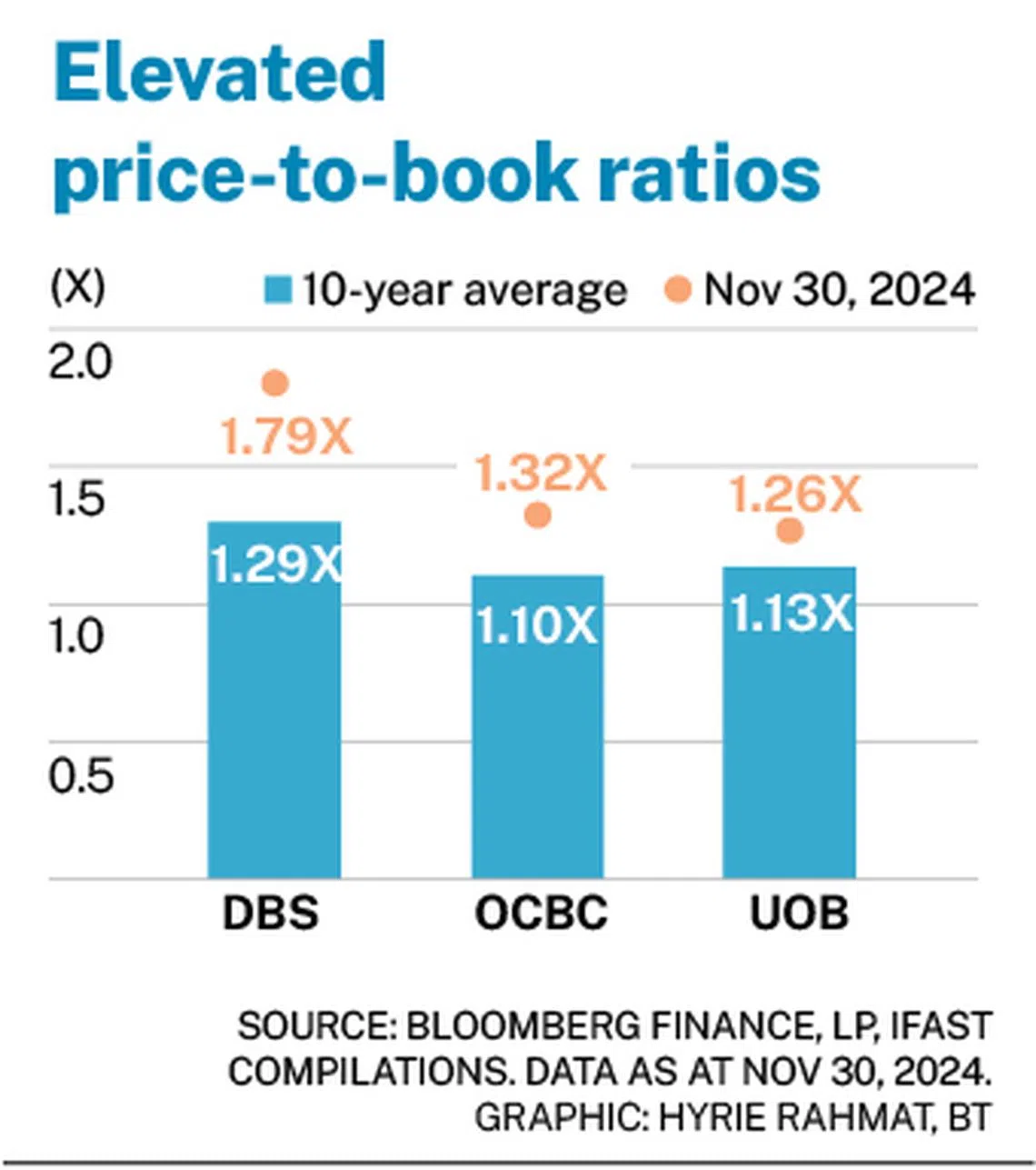
Still, we continue to view these banks as strong long-term holdings. Their solid fundamentals, backed by robust earnings and resilient balance sheets, are expected to sustain a forward dividend yield of over 5 per cent, providing a reliable income stream in an increasingly uncertain global market environment. We particularly favour DBS, given its highest return on equity of 18.8 per cent, signalling the strongest earning potential for continued shareholder rewards. DBS’ management has shown a clear commitment to capital returns, with initiatives such as share buybacks and the one-for-10 bonus issue announced in February. Both moves could significantly benefit long-term investors.
The writer is a research analyst with the research and portfolio management team of FSMOne.com, the B2C division of iFast Financial, the Singapore subsidiary of iFast Corp
TRENDING NOW

Britain’s mansion tax shows the difficulty of targeting wealth

Once staunchly pro-China, Malaysian Chinese businesses are now distancing themselves from Beijing

The only common thing in S-E Asia is that we all eat rice: Cisco’s Asean president
Singapore data centre operator DayOne opts for US IPO at likely US$20 billion valuation

