

Seeking opportunities in Singdollar, ringgit and US dollar bonds
Investors are set to benefit with more stability and options in the fixed income space in 2024
LAST year saw many hurdles in bond markets, with key headwinds in the form of inflation surprises and policy rate hikes. In 2024, with the US Federal Reserve likely to hold rates, we hope to see greater stability – and at the same time, more opportunities in the fixed income space.
US dollar bond market
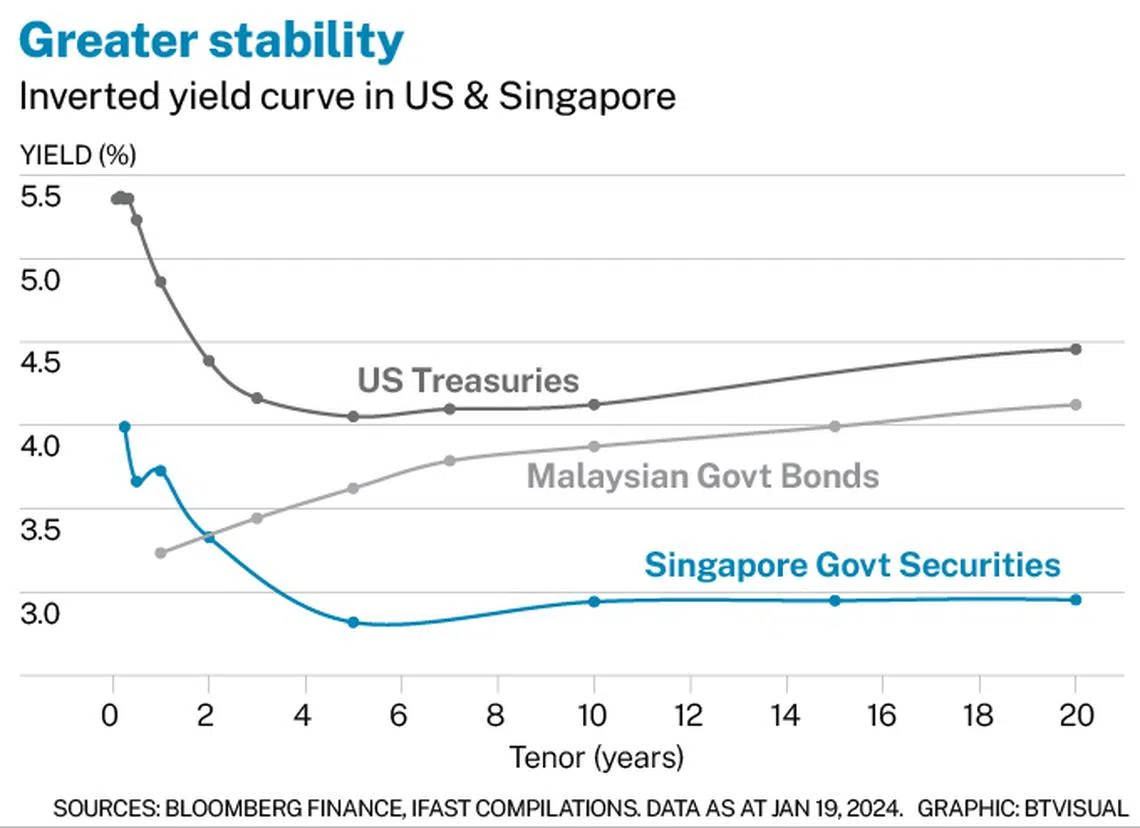
In 2024, we believe that bond yields and interest rates will remain elevated for a longer period. Inflation is unlikely to fall back towards policymakers’ target of 2 per cent. Especially as the risk of recession fades, the Fed may not be motivated to cut rates within the year. We also expect a potential imbalance between supply and demand for US Treasuries in 2024, which would put further upward pressure on Treasury yields. Hence, we think that long-term bond yields have room to rise.
Therefore, we remain positive on short-term US Treasuries (USTs) with tenors of less than two years. Owing to the rate hikes, yields of the short-term USTs are at their highest level since 2007, and remain attractive for investors who seek stable and decent returns with minimal risk.
Across the USD corporate bond space, we believe high investment-grade corporate bonds offer the most optimal investment value. While the spreads on these are marginally tighter than the historical average, yields are at the highest since 2008. These would be suitable for investors who seek additional return, in exchange for slightly higher credit risk.
On the other hand, high-yield issuers have seen a substantial increase in the cost of capital with the rise in interest rates. While we do not expect an imminent spike in default risk, credit risk and downgrade risk could potentially rise further in the higher-for-longer rate environment.
We believe investment-grade issuers will remain resilient, while high-yield issuers are at risk of greater financial pressure. On a valuation basis, high-yield bonds are relatively more expensive than investment-grade bonds as spreads have tightened drastically over the past few months.
Malaysian ringgit fixed income outlook
For Malaysia, we expect upside risk in inflation following the subsidy rationalisation, which is expected to be realised in various phases in the year, and the increase in the service tax rate, from 6 to 8 per cent from March onwards. The service tax will be applicable on all taxable services, excluding food and beverage and telecommunication services.
With the upcoming changes, the Malaysian government projects headline inflation to range between 2.1 and 3.6 per cent in 2024. We expect the inflation figures to land close to the upper limit of the projected range, but likely still insufficient to spur policymakers to raise Malaysia’s benchmark interest rate – the overnight policy rate (OPR).
As a result, we think the OPR will be sustained at 3 per cent in 2024. We have yet to see any signs in the economy that warrant further rate hikes. At the same time, a cut in OPR is unlikely as we expect policymakers to support the Malaysian ringgit’s (MYR) strength.
We have reason to believe investors’ confidence in Malaysia will improve in 2024. The government has made plans to reduce the fiscal deficit by paring down expenditures and implementing new taxes. We think this will positively impact Malaysia’s credit standing and fiscal health, thereby bolstering confidence in the economy and attracting more bond investors.
We particularly like the medium-tenor of between five and seven years, given the normal upward-sloping yield curve. MYR corporate bonds on the lower end of the investment grade space are preferred. This is because of their substantial spread above the risk-free rates and a considerable yield pick-up over higher investment-grade options.
Singapore dollar fixed income outlook
2023 had been a rough year for Singdollar (SGD) bonds, which suffered from volatile mark-to-market movements in prices. Higher interest rates also weighed on the number of SGD bond issuances in 2023, as the elevated cost of capital made it harder for Singapore corporates to issue SGD debt. In 2024, we expect to see greater yield stability in the year ahead, promoting more corporate issuances.
Given the trend observed in past rate cycles, we believe that yields in the medium to longer-tenor Singapore Government Securities (SGS) will gradually fall if the Federal Reserve maintains a rate pause. This should also result in significantly less volatility across yields as well.
For the Singapore Treasury Bills (T-bills), we expect yields to remain within the range of 3.7 to 3.9 per cent – mirroring the movement in yields across 2023. With US short-term Treasury yields staying higher for longer, this should allow the Singapore T-bills to stay within this range at least for the first half of 2024.
Assuming yields stabilise in 2024, conditions should become more favourable for Singapore corporates to consider debt issuance. This will ultimately provide more options for investors.
Firstly, corporates that relied on bank borrowings for recent refinancing might tap into medium-term notes to improve their debt maturity schedules and credit profiles. Secondly, pent-up demand for corporate issuances may allow corporates to potentially price their issuances more cheaply, reducing the cost of capital. Within the credit market, we continue to advocate for quality issuers in the SGD corporate bond space.
The writer is a fixed income analyst of the Bondsupermart team at iFast Financial, the Singapore subsidiary of mainboard-listed iFast Corporation
TRENDING NOW

Motoring tycoon Peter Kwee is back in court: Here are his previous legal battles

Demand, tech capabilities position Apac and AI as Skyscanner’s next growth frontiers: CEO Bryan Batista

Beyond the greenback, Vietnam’s big borrowers turn to Asian-currency bonds

Nvidia’s outlook cut to stable by Moody’s on governance concerns

