

Singapore set for manufacturing boom, modest income growth for banks
The Republic is poised for solid electronics-led export expansion in 2025, while its lenders are expected to maintain a stable net interest income
IN LATE 2023, we projected 4 per cent for Singapore’s 2024 gross domestic product (GDP) growth, which was notably more optimistic than the government’s initial 1 to 3 per cent forecast.
At the time, the estimate seemed ambitious.
However, through the course of the year, strong GDP results emerged in the second half. The government raised its forecast to 2 to 3 per cent in August, and then to around 3.5 per cent in November.
With the release of the full-year advanced estimate in January, our projection proved accurate; the Republic’s GDP grew by 4 per cent last year.
Hitting the headline figure was no coincidence. We correctly predicted the robust recovery in the manufacturing sector, led by booming electronics output, and the solid performance of the financial sector.
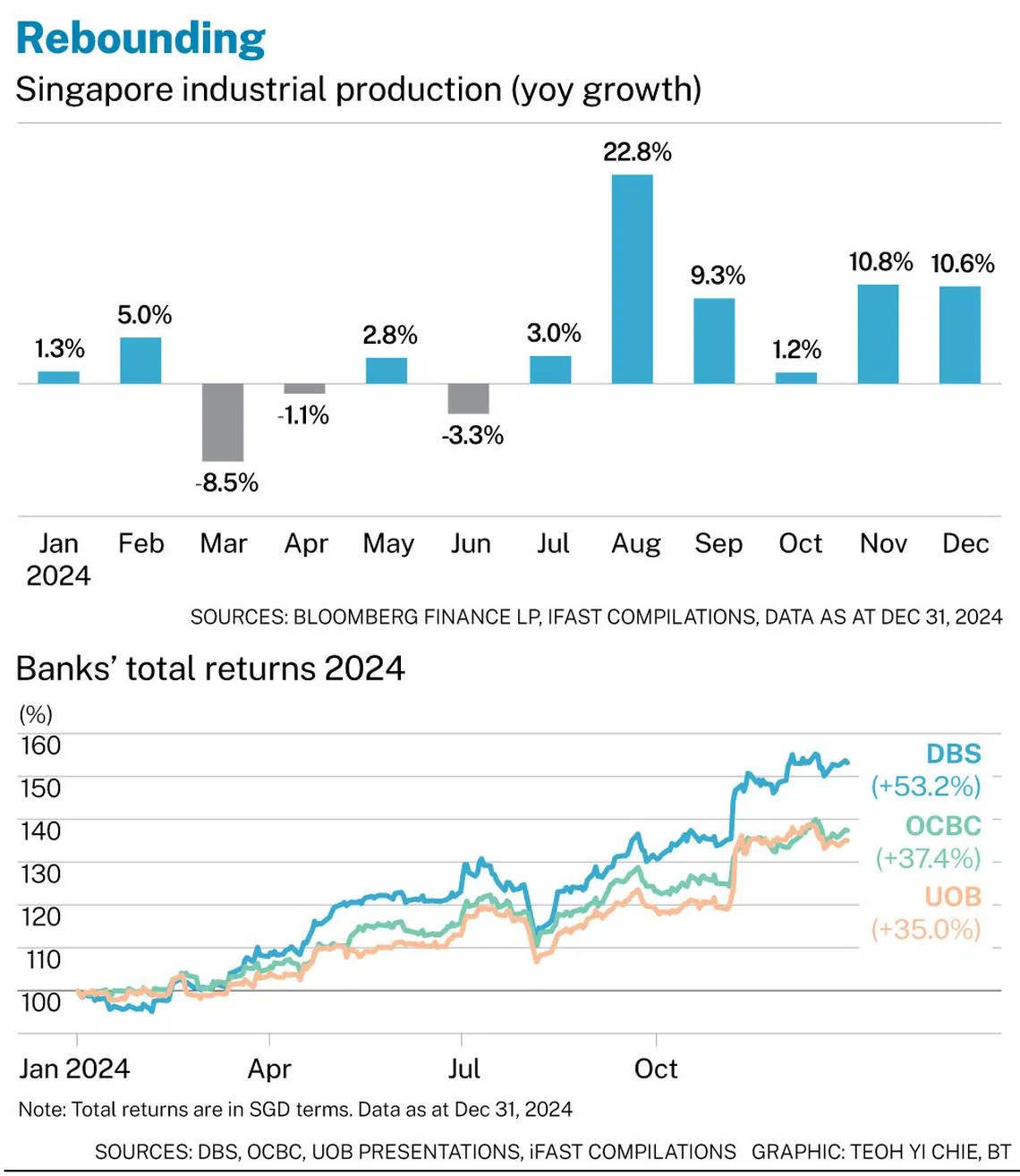
Manufacturing production saw particularly strong momentum in the second half. In December, electronics output sustained its expansion, with info-communications and consumer electronics surging by 41.2 per cent year on year (yoy), and semiconductors growing by 11.4 per cent yoy.
Playing a crucial role
We expect the manufacturing sector to continue its strong growth in 2025, with the electronics cluster leading the way. This expansion will be driven by the high demand for artificial intelligence data centres and servers, along with growing adoption of high-performance chips in consumer devices.
In 2024, upstream integrated circuit designers such as Nvidia and AMD, along with midstream foundries such as Taiwan Semiconductor Manufacturing Co and Samsung Electronics, experienced significant earnings growth.
We believe this growth is cascading down the value chain, benefiting Singapore, which plays a crucial role in the downstream semiconductor sector.
This upcycle is expected to help local companies – those involved in packaging, testing and equipment manufacturing – to clear inventory while boosting output and earnings growth.
The earnings of some local semiconductor equipment manufacturers have already begun to recover in 2024.
Frencken Group reported a 6.7 per cent yoy increase in revenue for 9M 2024. In the third quarter of 2024, its semiconductor segment led the growth with a robust 23 per cent yoy increase, driven by steady sales to European customers and a sustained recovery in Asia.
Similarly, Grand Venture Technology’s 9M 2024 revenue surged by 35.8 per cent yoy; its semiconductor segment’s revenue rose by an impressive 50.8 per cent.
While AEM Holdings and UMS Holdings faced prolonged inventory digestion and slower recovery among key customers in 2024, we remain optimistic about order momentum in 2025 and the industry’s overall growth.
With strong demand for semiconductors expected to persist, Singapore is poised for solid electronics-led export growth in 2025.
While export restrictions on chipmaking equipment to China may have some impact, it is likely to be limited. Semiconductor exports to China accounted for just 5.3 per cent of Singapore’s total exports in the first eleven months of 2024.
Additionally, the Republic’s focus on mid-to-lower-end semiconductor components means it will be less affected by these restrictions.
While US President Donald Trump’s return to the political spotlight and his trade policies could create trade uncertainties, Singapore’s small bilateral trade deficit with the United States makes it less likely to face direct tariffs.
Also, Singapore continues to benefit from supply chain diversification outside China, with the “China+1” trend expected to persist, supporting its industrial production and trade performance.
Record-breaking year
Another major driver of Singapore’s robust GDP growth and strong Straits Times Index performance in 2024 was the financial sector, led by the top three banks – DBS, OCBC and UOB – in particular.
Singapore banks had a record-breaking year, fuelled by resilient earnings, solid asset quality, and substantial capital returns to shareholders.
DBS led the charge with a 53.2 per cent total return, while OCBC and UOB also posted strong returns of more than 30 per cent.
In 2025, we expect the three banks to maintain a stable net interest income, as they continue to manage deposit costs, increase investments in fixed-rate assets, and extend portfolio durations to mitigate margin compression.
Slower rate cuts in the US and structurally higher interest rates compared to pre-2022 levels will also serve as a tailwind.
However, growth in this segment is likely to be limited due to a broad downtrend in interest rates and the subdued pace of loan growth, which has yet to offset narrower margins.
Wealth management fees will remain a bright spot.
By end-2024, the number of single-family offices in Singapore increased by 43 per cent yoy to 2,000, according to Monetary Authority of Singapore deputy chairman Chee Hong Tat.
He highlighted that MAS would continue to support the industry’s expansion, further cementing the country’s status as a leading hub for financial services and wealth management.
Thanks to strong government support, political and economic stability and a pro-business environment, Singapore’s appeal to ultra-high-net-worth individuals is likely to stay robust, especially amid escalating geopolitical tensions between major powers.
With stable net interest rates and strong growth in wealth management fees, we expect the local banks to achieve modest growth in 2025.
Even though the growth outlook may not be as strong as in 2024, which could limit the capital appreciation, banks’ resilient earnings and substantial excess capital above regulatory requirements reinforce the prospect of another year of strong shareholder returns.
With dividend yields exceeding 5 per cent and the possibility of additional share buybacks, the banks remain a solid pick for income-focused investors.
Stay invested in Singapore’s growth story
We expect Singapore’s economy to stay strong, supported by a continued rebound in the manufacturing sector, especially driven by the electronics upcycle.
Singapore banks are also set to achieve moderate income growth while delivering attractive shareholder returns.
Elsewhere, MAS has established a review group to enhance liquidity in the local stock market. We believe this initiative could result in a comprehensive plan that strengthens Singapore’s stock market for long-term growth, potentially driving an expansion in price-to-earnings multiples.
We recommend investors stay invested in Singapore’s growth story, as it has the potential for strong returns in 2025 and beyond.
The writer is a research analyst with the research and portfolio management team of FSMOne.com, the B2C division of iFast Financial, the Singapore subsidiary of iFast Corp
TRENDING NOW

LTA proposes combining car COE categories, adding rebate-surcharge system

StarHub to acquire MyRepublic’s mobile business amid ongoing telco consolidation

DBS, OCBC, UOB rout lops billions off STI as inflation, rate concerns spook investors

Grab CEO’s wife Chloe Tong on life with Anthony Tan and finding her purpose

