

Steady long-term return expected for gold: World Gold Council strategist
Near-term outlook depends on when Federal Reserve is expected to cut rates

Genevieve Cua
GOLD, under-owned by most investors, is expected to generate real returns over the long term of 2 per cent to 3 per cent a year, net of inflation, says John Reade, chief market strategist for the World Gold Council (WGC).
Hence, after a robust performance in 2020 when gold returned over 25 per cent, he says investors should temper their expectations.
“A year like 2020 is unusual. But we do think the next three years should deliver returns somewhat above our long-term expectations. The reason for that is the US may be in a rate-cutting environment, and the US dollar will be a bit weaker because of that. We’re looking for (nominal) returns, based on our core model, of 6 to 7 per cent over the next few years.”
In 2020, a confluence of factors caused gold to surge. Risk aversion and fear spiked with the onset of Covid-19; trade tensions between China and the US also exacerbated the uncertainty.
Gold is regarded as a safe-haven asset; its price rises in times of crisis. It is also historically negatively correlated with interest rates and the US dollar. Higher interest rates dilute the investment case for gold, whose returns are purely price-driven.
Gold fell 4 per cent in 2021 and rose marginally by 0.22 per cent in 2022. Its performance in 2022, at a time when sharply higher interest rates and inflation caused both equity and bond markets to tank, reflects its ability to help diversify portfolios.
Reade says gold will need to “break the all-time high convincingly”.
“That’s only going to happen when the Fed has clearly stopped hiking rates. In the meantime, gold will trade in a range – my guess is US$1,800 (per ounce) on the low end up to around US$2,000.
“Gold will perform well over the next few years. But we probably need rates to fall or the market to be convinced that those rate cuts are coming soon.”
Gold’s all-time high was US$2,074 in August 2020. Its spot price on Tuesday (Jul 11) was US$1,930. Year to date, gold has returned around 6 per cent.
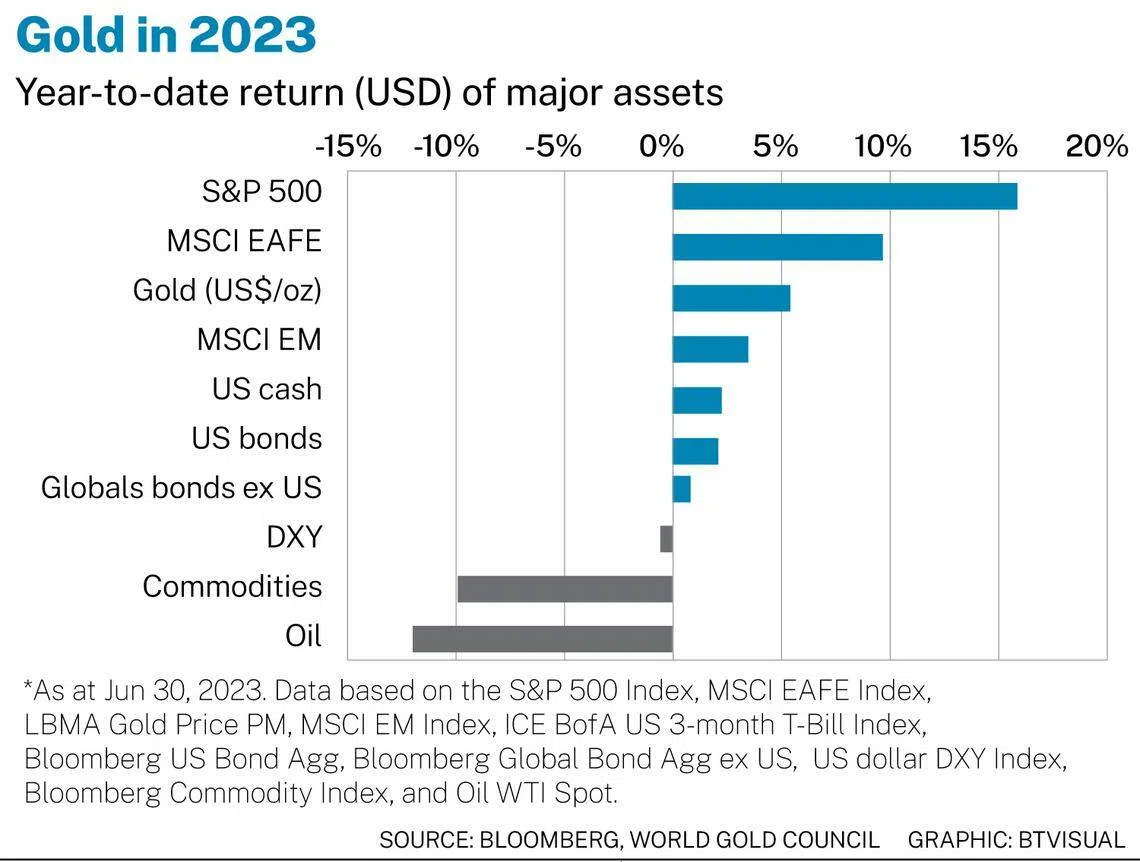
WGC’s mid-year outlook said: “As monetary policy likely transitions from tightening to on hold, market consensus is for a mild contraction in the US this year, and slow growth in developed markets. Should this scenario play out, our analysis suggests that gold will remain supported in 2023, especially given its robust performance in H1. But it may not break out significantly from the range we have seen so far this year.”
Reade says demand for gold has shifted since the founding of the WGC in 1987. At that time, two-thirds of demand was from developed markets. Today over 70 per cent of demand is from emerging markets (EM), particularly China and India.
EM’s rising prosperity is a structural factor supportive of gold prices, in addition to scarcity of supply. “The mining industry globally is struggling to grow volumes because of the shortage of discoveries of new, good deposits. There are also difficulties and delays in getting permits for projects.” Mine output adds around 3,500 tonnes a year of gold, equivalent to an annual 2 per cent increment.
Reade sees central bank buying since the 2008 global financial crisis as a secular trend. He adds that EM central banks could potentially raise their gold holdings. “There is a recognition among EM central banks that they should hold more gold. We’re seeing purchases by the BRIC (Brazil, Russia, India and China) countries…
“The MAS (Monetary Authority of Singapore) has also been buying gold over the last 18 months. That’s hugely significant because it’s an economy many Asean countries look up to.”
Central bank demand has been rising. In 2022, purchases by central banks more than doubled to 1,136 tonnes, a 55-year record high, up from 450 tonnes in 2021.
WGC’s 2023 central bank gold reserves survey found that 24 per cent of central banks intend to raise their reserves in the next 12 months. They are also more pessimistic about the future role of the US dollar, compared to previous surveys. In contrast, 62 per cent expect gold to have a greater share of total reserves, compared to 46 per cent last year.
Reade reckons investor allocation to gold is less than 1 per cent. “Pretty much every portfolio we’ve looked at around the world over different time periods would have benefited from having more gold. The range of ideal allocation depends on the time frame, but it’s probably somewhere between 4 and 8 per cent.”
TRENDING NOW

Could stablecoins be the future of money?

Vietnam’s northern provinces, not Hanoi or Ho Chi Minh City, are powering near 10% GDP growth

The Assembly Place expands beyond co-living as it targets 10,000 keys by 2030

Once staunchly pro-China, Malaysian Chinese businesses are now distancing themselves from Beijing

