Strategists see more upside to gold; silver a ‘credible’ alternative
Strategists now see the yellow metal as an effective portfolio diversifier and a hedge against inflation, geopolitical instability and currency depreciation

TEN to 20 years ago, few strategists actively recommended an exposure to gold. Historically, gold suffered decades of price stagnation and did not pay an income.
Today, gold’s status as a strategic asset has staged a remarkable turnaround; its record performance last year appears to have only burnished its desirability.
Strategists now see the metal as an effective portfolio diversifier, a hedge not only against inflation and geopolitical instability, but also against currency depreciation.
For retail investors in search of uncorrelated assets, gold is far more accessible, transparent and liquid than most other types of alternative investments – including private markets. While owning physical gold incurs storage costs, among others, the cost of a gold investment via a deposit account or exchange-traded fund (ETF) is relatively low.
A gold savings account at UOB incurs an annual charge of 0.25 per cent. The annual charge of a silver account is 0.375 per cent. The SPDR Gold ETF has an expense ratio of 0.4 per cent.
Kelvin Ng, UOB head of group global markets, said that holdings in the bank’s gold savings accounts rose by 4 per cent last year, and physical gold “notionally traded by our clients rose more than 30 per cent”.
Last year, gold rose 27 per cent, its best showing since 2010 and outperforming all other asset classes except Bitcoin. It closed at end-December at US$2,620 an ounce and is currently trading at about US$2,771.
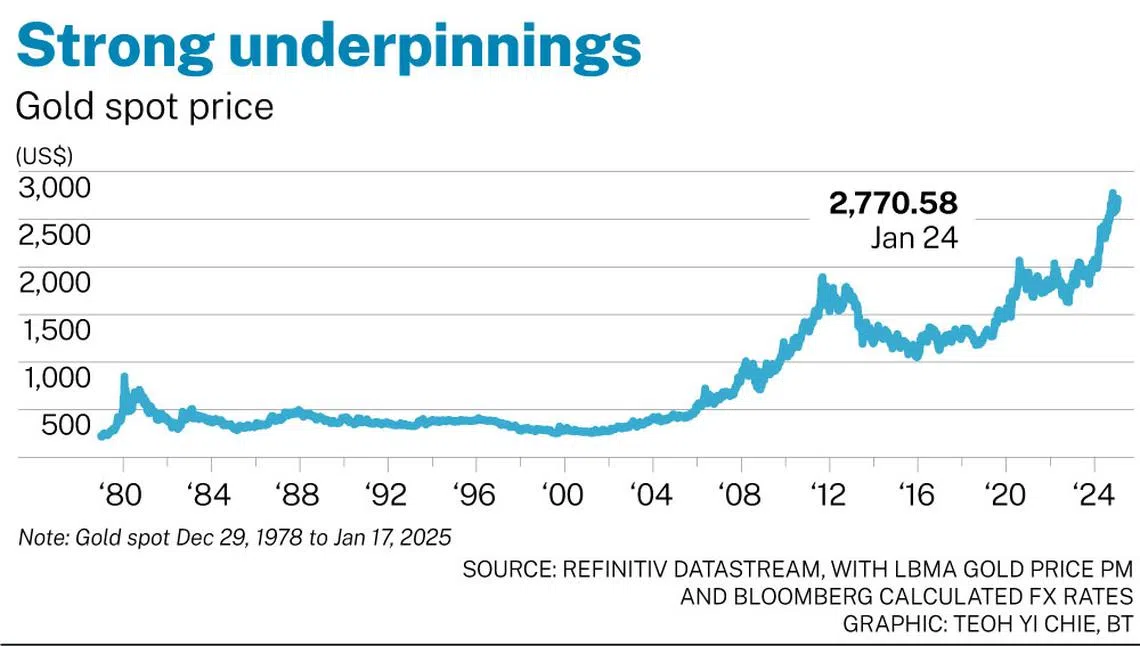
Some strategists reckon there is still upside from the current price. Ng believes gold’s safe-haven appeal remains intact among both central banks and retail investors, adding: “Both are driven by safe-haven needs to diversify, due to rising geopolitical concerns and uncertainties around the US dollar ahead of disruptive trade and fiscal policies from Trump 2.0.”
Among retail investors in particular, strong demand is driven by “the ongoing substantial depreciation of domestic currencies like the Indonesian rupiah, Chinese yuan and Vietnamese dong, which amplify the gains in gold prices in local currency terms”, he said.
“Our forecasts for 2025 are US$2,700 per ounce for Q1 2025; US$2,800 per ounce for Q2 2025; US$2,900 per ounce for Q3 2025; and US$3,000 per ounce for Q4 2025.”
Vasu Menon, OCBC managing director for investment strategy, believes gold’s phenomenal performance last year “may be the start of a paradigm shift as investors navigate a new world order of greater economic and political uncertainties in the coming decade”. He reckoned gold could rise to US$2,900 per ounce in the next 12 months.
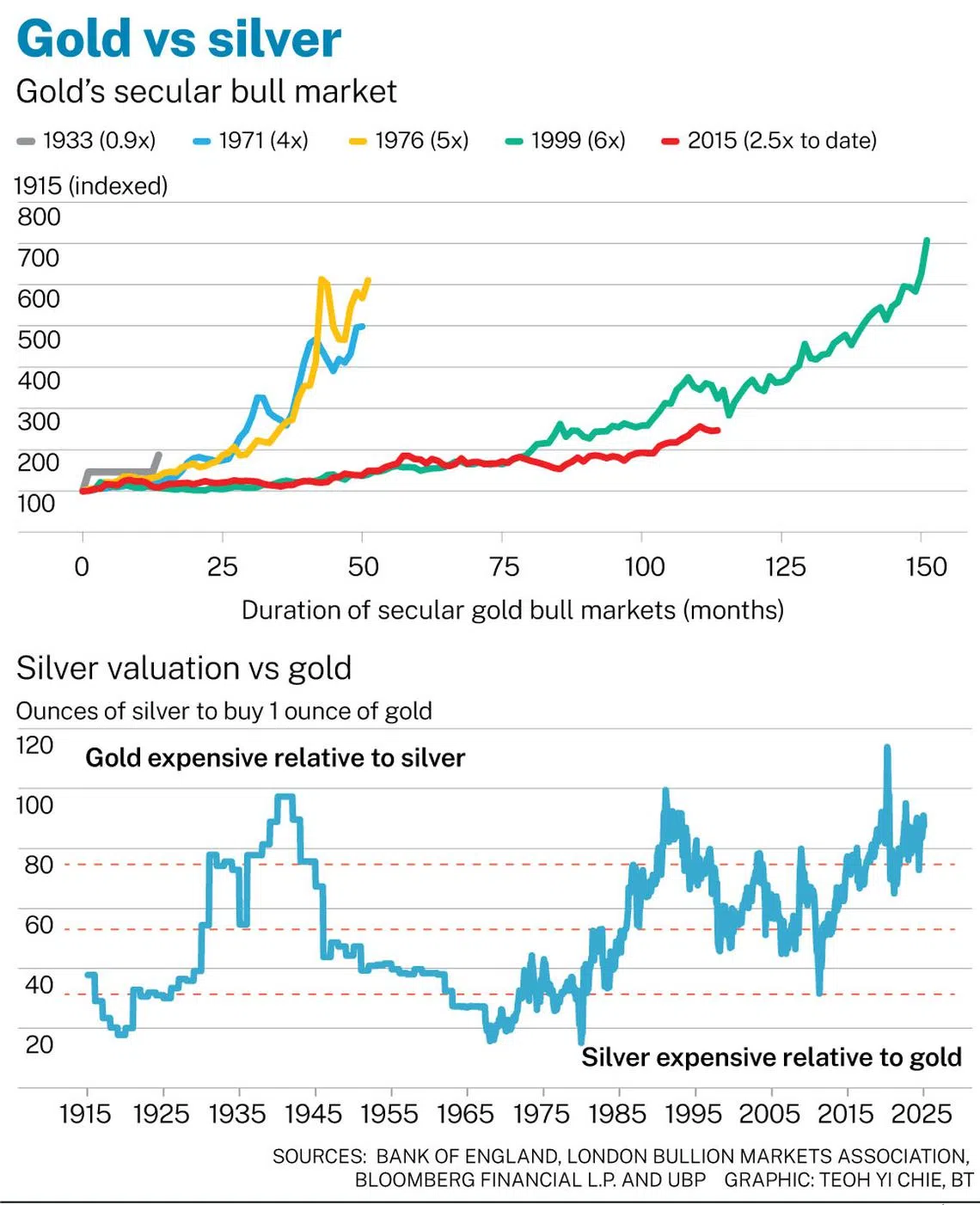
UBP chief investment officer Norman Villamin said: “Looking back, since the 1970s, the average secular bull market in gold returns four to six times your money. This market has given you roughly 2.5 times. We’re halfway there. We think gold will reach US$3,000 an ounce, so we think this pullback from nearly US$2,800 is an opportunity.” Gold hit a record US$2,788 last October on US election jitters.
Mark Richards, BNP Paribas head of dynamic multi-asset, said: “If US Treasury secretary-elect Scott Bessent really implements a tightening fiscal policy and reduces the fiscal deficit to 3 per cent, then the US may need to devalue the US dollar to support the economy – which will further support the prospects of gold, silver and even gold mining companies.”
Considering silver
For those who hesitate over gold’s strong recent surge, UBP’s Villamin said investors may look into silver. “If you don’t want to chase gold, we think silver today is a credible alternative based on silver’s value relative to gold. In more than 100 years, when the (gold-silver ratio) is where we are today – where roughly it takes 90 ounces of silver to buy an ounce of gold – when it’s that high, silver would outperform gold by almost 8 per cent a year.”
Silver’s price tends to be lower, but it also tends to be more volatile. Silver demand is mainly driven by industrial use. Silver spot price outstripped gold in 2024 with a rise of more than 30 per cent.
However, Menon cautioned that silver tends to be more speculative. “Silver has found interest from investors who have missed the move in gold, as well as those looking for a higher beta trade… The fundamental picture of improving industrial demand and scope for higher gold prices remains supportive of the outlook for silver given the positive spillover effects.”
The sustainability drive also helps to underpin silver demand, he said. “Demand prospects are promising, as silver is needed for solar panels, electric vehicles and 5G technology… With the global push towards a low-carbon future, silver demand is expected to rise in tandem with strong growth expected in the solar sector amid a supply deficit.”
DBS’ chief investment officer Hou Wey Fook said silver’s industrial demand may expose the metal to “more left-tail risk in the near term”, particularly in view of US President Donald Trump’s potential tariff hikes. “There is a possibility that silver might re-rate higher, but that will depend on whether China can achieve a broad-based recovery with further stimulus measures.”
Overweight gold
Meanwhile, gold has returned 8 per cent a year in US dollars since the collapse of the gold standard in 1971 until end-December 2024. This return is comparable to that of equities and higher than that of bonds, at a lower volatility than equities. It has shown negative correlation with equities, especially in sharp market pullbacks.
DBS advocated an overweight in gold in early 2024, said Hou, despite elevated rates and a strong US dollar. “This call played out very well for our clients as gold rose from US$2,063 at the start of the year... We continue to be bullish on this asset class in 2025.”
Manpreet Gill, Standard Chartered Bank’s chief investment officer (Africa, Middle East and Europe), said: “We have an overweight view on gold relative to bonds and cash over the next six to 12 months, and expect prices to move higher from current levels. Given limited supply, we expect (central bank buying) to underpin gold prices. Equity volatility or falling bond yields would be a bonus.”
Traditionally, gold moves in inverse relation to the US dollar and to interest rates and bond yields. As the US dollar strengthens, gold price falls. As rates rise, gold also tends to weaken as investors gravitate towards other higher-yielding assets.
“If US Treasury secretary-elect Scott Bessent really implements a tightening fiscal policy and reduces the fiscal deficit to 3 per cent, then the US may need to devalue the US dollar to support the economy – which will further support the prospects of gold, silver and even gold mining companies.”
Mark Richards, BNP Paribas head of dynamic multi-asset
Of late, however, these relationships appear to have been turned on their heads – albeit not completely. In a January commentary, the World Gold Council (WGC) said that uncertainty over bond yields may have dampened the negative correlation between yields and gold price. In December, however, following hawkish guidance by the Fed, markets dropped and gold also weakened.
If you are considering an investment or adding to your gold holding, it is best to be cautious and not to expect a repeat of 2024’s strong surge. WGC said that gold has to break out of “extreme overbought” territory in the short term.
“The long-term structural uptrend may get challenged in early 2025 as monthly momentum indicators suggest a ‘sell’ signal after five months in extreme overbought territory, with similar signals seen at the peaks in 2006, 2008, 2011 and 2020,” it noted.
“Longer term, the core uptrend looks well-cemented; and any near-term weakness could be viewed as an opportunity for investors to re-engage in gold at more attractive levels.”
In terms of demand components, as reflected in WGC data at end-September, jewellery demand softened on a year-on-year basis, but investment demand which includes ETF inflows rose by 132 per cent. In the third quarter of 2024, central bank buying slowed but buying year to date “was in line with 2022 and remains widespread”.
Over the past decade, central banks have steadily raised their gold holdings to diversify their reserves. WGC data showed that total purchases nearly doubled from about 600 tonnes in 2014 to a peak of 1,080 tonnes in 2022. In 2024 however, high prices may have inhibited buying activity and spurred some selling.
Wayne Gordon, UBS commodities strategist, noted that 2024 marked the fifth consecutive year of gains in gold, with central banks providing the “cornerstone” of demand.
“Central bank buying and higher global risk premiums have been key drivers of gold prices,” he said. His base case is for gold to rise to US$2,850, and he expects upside for silver as well.