

Strong fundamentals support further upside for Big Tech
Big Tech stocks’ valuations are backed by strong earnings growth. But the stock price surge may not be repeated in the second half of the year

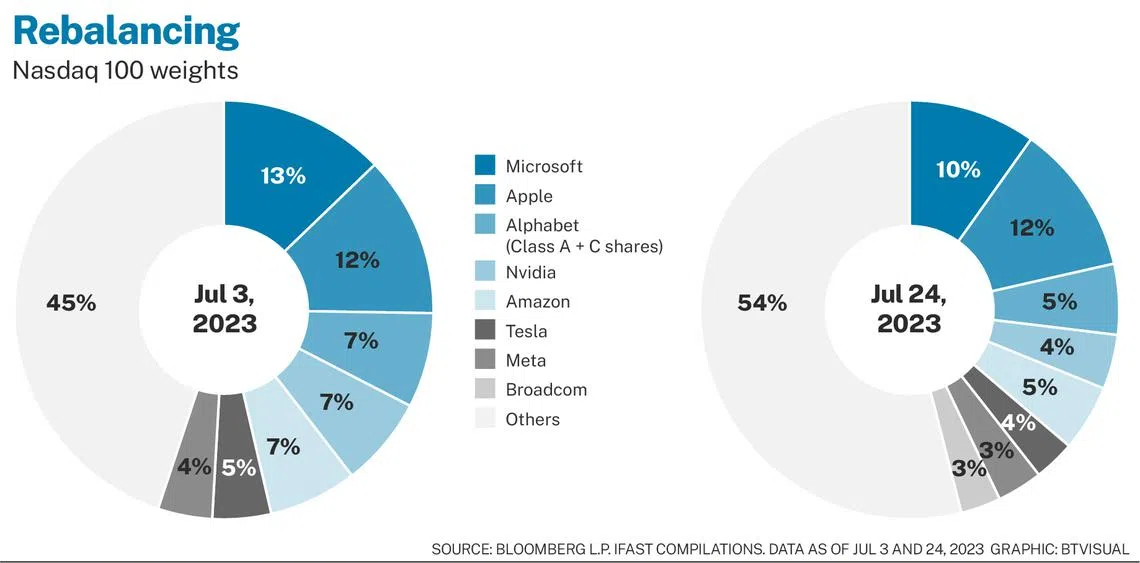
THE strong rally in the technology sector this year was led by a small group of mega-cap stocks known as the “Magnificent Seven” (Microsoft, Apple, Nvidia, Amazon, Tesla, Meta, and Alphabet). Consequently, the combined weightage of these seven names accounted for 55.09 per cent of the Nasdaq 100 Index as at Jul 3, 2023 (taking into account both share classes of Alphabet).
Due to the over-concentration in the Nasdaq 100 Index, a special rebalancing was conducted to redistribute the weights.
Notably, after the rebalancing, the individual weighting for each of the “Magnificent Seven” has declined, while Broadcom has become a more important constituent in the Nasdaq 100 Index.
Underpinned by robust earnings
Focusing on just the original FAAMG stocks: Meta Platforms (previously known as Facebook), Apple, Amazon, Microsoft and Alphabet (widely known as Google), we note that their long-term fundamentals remain intact. In fact, the recent earnings season has highlighted the resiliency of these Big Tech giants, and all of them mentioned that artificial intelligence (AI) will be a growth driver moving forward.
On top of cutting cost and tightening spending in the “year of efficiency”, Meta Platforms posted second-quarter results which surpassed Wall Street’s expectations, supported further by revenue from Reels and further growth in the number of active users of its suite of products.
Meanwhile, investments in AI over the years have also paid off, adding to a 7 per cent increase in time spent across the company’s platforms according to Mark Zuckerberg. By monetising its suite of products down the road, Meta can potentially unlock new revenue streams going forward.
Although Apple, the largest company in the world, reported a decline in sales for most of its hardware-related products in Q2 FY23 compared to the previous year, its more profitable services business grew 8 per cent in the recent quarter, accelerating from 5.5 per cent in the prior period.
Economic uncertainty may pose near-term challenges for hardware sales as consumers hold off large purchases. Still, Apple’s ecosystem is far-reaching. The company is able to effectively monetise the software component as its user base grows, setting it up for future growth.
Amazon’s earnings beat expectations by the largest amount since Q4 FY20, as cost-cutting measures and a stabilisation in Amazon Web Services (AWS) growth boosted both revenue and profits. Furthermore, advertising continues to be a booming business, in line with other big tech companies such as Meta and Google, whose ad revenue rose even as smaller rivals saw declines. Looking ahead, AWS will benefit from powering businesses’ AI demand.
Meanwhile, Microsoft also posted strong financial results, beating consensus estimates both on the top and bottom line, and attaining its highest gross sales and net income in a single quarter. Although revenue from its cloud service Azure, only grew 26 per cent in Q2 FY23, slowing down from the 27 per cent growth compared to the prior quarter, future growth prospects remain bright as heavy investments in AI can increase its market share in other markets, including advertising business and commercialising generative AI.
Lastly, Alphabet reported better-than-expected earnings in its recent Q2 FY23 results as revenues grew across most business segments, except for Google Network revenue which fell 5 per cent. In particular, its Google Cloud revenues rose 28 per cent and operating income hit a record US$395 million, compared to an operating loss in the second quarter last year.
These figures reflect the resilience of the search business and video platforms, on top of growing momentum in its cloud division, which is poised to take up a larger share of the business down the road. Moving ahead, continued innovation in AI will help to propel its services higher, as customer interest in its suite of AI-related offerings have surged.
What investors can do
While news headlines, technical reasons or macro factors may cause volatility, share prices are ultimately underpinned by company fundamentals and earnings. Just like stock splits and dividends, Nasdaq 100’s rebalancing does not change the valuation of the underlying securities. Hence, investors should not worry.
It would be unrealistic to expect Big Tech share prices to perform as remarkably in the second half of 2023. Still, analysts’ expectations of earnings growth remain strong; guidance by management is upbeat. These help to support valuations.
As tech stocks have rallied sharply this year, it will be prudent to be cautious about investing large lump sums. The world, however, is becoming increasingly digitalised and a core exposure to the technology sector remains important for long-term investors. We recommend investors to adopt dollar-cost averaging.
The Invesco QQQ ETF is technically not a pure technology exchange-traded fund (about 50 per cent allocation into technology as of Aug 4, 2023). Investors may consider other alternatives such as the Invesco Nasdaq Internet ETF, which invests in companies (mostly US) engaged in Internet-related businesses.
Lastly, investors should also continue to maintain a diversified portfolio as the macro backdrop slows. Consumer staples and healthcare are some defensive sectors to consider. For consumer staples, there is the Consumer Staples Select Sector SPDR Fund, and for healthcare, the iShares Global Healthcare ETF.
The writer is a research analyst of the research & portfolio management team at FSMOne.com, the B2C division of iFast Financial. The latter is the Singapore subsidiary of iFast Corporation Ltd.






