

Taking the measure of US stocks: the long view and valuations
At least two fund management firms have adjusted downwards their long-run expectations of returns for large-cap US equities, with a 10 to 15-year view


AFTER such a strong year for US and global stocks – thanks to US’ 73 per cent share of the MSCI World index – it may be tempting to pile more funds into US equities.
After all, the US remains the world’s largest economy and is the centre for tech and innovation, a supertrend by all accounts. No less than the Senior Minister Lee Hsien Loong affirmed GIC’s “faith in the US economy’s vibrance, dynamism and sheer resilience”.
During the GIC Insights 2024 dinner late last year, he said as much as a third of GIC’s long-term portfolio is invested in the US, where it has weathered boom and bust cycles.
The operative words are “long term” – particularly for investors with only a fraction of GIC’s resources. The US market’s strong surge has renewed concerns over valuations.
At least two fund management firms have adjusted downwards their long-run expectations of returns for large-cap US equities, with a 10 to 15-year view.
Howard Marks, co-chairman of Oaktree Capital, wrote in a recent investment memo that there is a strong relationship between starting valuations and subsequent annualised 10-year returns. Higher starting valuations consistently lead to lower returns, and vice versa.
“It shouldn’t come as a surprise that the return on an investment is significantly a function of the price paid for it,” he noted. “For that reason, investors clearly shouldn’t be indifferent to today’s market valuation.”
To be sure, the near-term view on the US market is cautious, and not only because of uncertainty over how incoming president Donald Trump’s tariffs would pan out. Last Friday (Jan 10), a stronger than expected December US jobs report, including lower unemployment, stoked inflation fears and appeared to affirm the US Federal Reserve’s cautious view on rates and inflation. Both stocks and bonds dropped; 30-year Treasury yields briefly touched 5 per cent.
Earlier, the December survey of fund managers by Bank of America found “super bullish” sentiment. Cash levels were at a record low, and allocation to US stocks at a record high.
But the drop in cash allocation from 4.3 per cent to 3.9 per cent triggered a contrarian sell signal, the second such signal in three months. Since 2011, there have been 12 prior sell signals which resulted in global equity (MSCI All Country World Index) returns of minus 2.4 per cent one month after, and minus 0.7 per cent three months after the sell signal was triggered.
Strategists have expressed caution over the prospect of similarly strong returns from US stocks this year as the past two years, for two main – and related – reasons. One is the historical pattern of returns. Second is valuations. Still, the 12-month view is relatively optimistic.
History repeats?
The S&P 500 last year returned nearly 25 per cent, after a 26 per cent showing in 2023. Michael Cembalest, JPMorgan Asset Management’s (JPMAM) chairman of markets and investment strategy, noted in his Eye on the Markets newsletter that two straight years of more than 20 per cent returns has occurred only 10 times since 1871.
“For investors, there’s little room for error with valuations this high; and valuations are now driving markets just as much as earnings growth,” he wrote. “Only during the 1990s’ bull market and the Roaring 20s did the good times continue for another two years. I expect a 10 to 15 per cent correction at some point in 2025.”
Still, he reckons US equities should end the year higher, adding: “Be sure to have plenty of liquidity to take advantage of what might be a volatile year.”
Based on a compilation by Cembalest, of the 10 episodes of back-to-back returns of at least 20 per cent over two consecutive years, returns in the next two subsequent years were mostly substantially lower, even if positive. The exception was in the years 1995 to 1998.
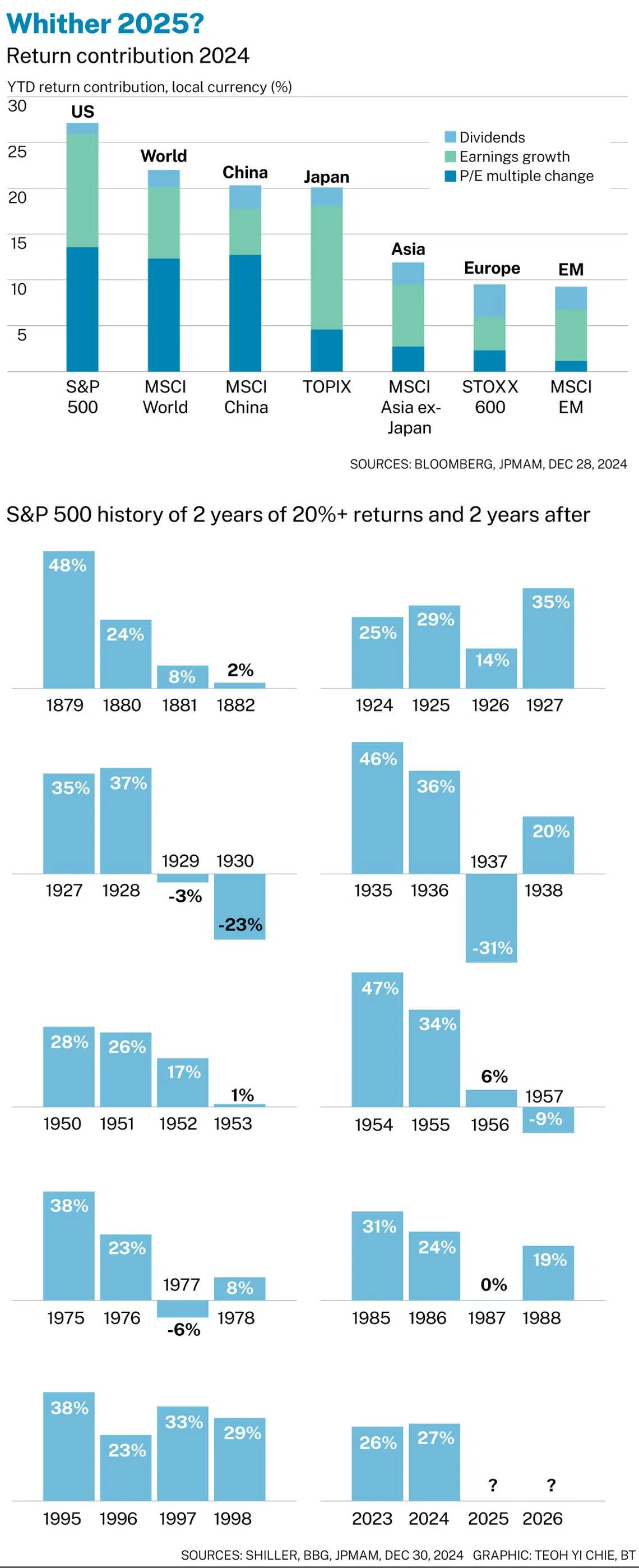
Citi, in early January, said in a strategy bulletin that “unusually depressed” returns in 2022 set the stage for the strong rebound in 2023 and 2024. It also remains optimistic about returns in 2025, albeit at a more muted pace.
“With our own expectation for US’ earnings per share gains of below 10 per cent in 2025 and 2026, we would not make the case for returns mapping a repeat performance of the 1990s boom,” said the report.
It added, however, that the similarity to the 1990s is a resurgence of the tech theme. “Good fundamentals and new technology (the Internet in the 1990s and AI the 2020s) are boosting investor confidence in the strength of future profits. This means a higher value is paid today for a stake in tomorrow’s economy.”
Ultimately, however, some caution is warranted, said Citi. “Fundamentally, we side with ‘AI profit optimists’. Nonetheless, that optimism has already generated a strong return behind us at the expense of future returns. While we don’t in any way exclude large-cap US tech investments, if one wants to seek returns where expectations are low, they need to turn elsewhere for potential opportunity.”
Valuation concerns
Valuations matter, especially for long-term portfolios. Valuations are a building block in the formulation of managers’ long-term capital market assumptions (CMA), which are revisited annually. The CMA enables institutions to re-evaluate the role of certain assets and decide on appropriate hedges.
Investment management company Invesco, in its CMA for 2025, posits a nominal return of 4.7 per cent for US large-cap equities; compared to 7 per cent in 2024. After inflation, the real return projection is 3 per cent. The 2025 estimate is its lowest yet since it started publishing CMA reports in 2017.
Valuations are the biggest headwind, it added. The equity risk premium, arrived at by subtracting the 12-month earnings yield of US equities from the 10-year Treasury yield, has slipped into negative territory – an indication that equities are overvalued against fixed income. It noted: “The signal has turned negative for the first time since 2002, meaning investors are theoretically compensated less per dollar of earnings from equities than coupons per dollar of fixed income.”
Invesco also raised concerns for global investors due to the outsized share of US stocks at 66 per cent in the MSCI ACWI, which has market capitalisation of US$77 trillion. The index’s US weighting far exceeds the US’ share of global gross domestic product of 26 per cent.
History, it said, is not predictive of returns, but helps to guide understanding of return drivers. “Global equities outside the US are more attractive on a forward basis than within the US due to higher expected dividend yields, significantly lower valuations (despite being slightly overvalued themselves), and the potential for a currency tailwind from an overvalued US dollar,” it added.
For opportunities outside the US, it points to emerging markets on the strength of “compelling” expected earnings growth rates. Within the US, small-cap equities also stand out.
JPMAM’s long-term CMA report was published last November, where it also adjusted projected returns from US large-cap equities to 6.7 per cent, from 7 per cent previously.
It believes returns for the next 10 to 15 years are elevated, compared to history – thanks to a healthier base for the global economy “set to deliver higher growth, strong capital investment trends and higher interest rates”.
It also expects the benefits of artificial intelligence (AI) and automation to accrue increasingly to the wider economy, supporting corporate earnings. “The promise of improved productivity, driven by automation and AI, as well as the tailwind from capital deepening, offset the valuation pressure with a positive boost to growth,” it added.
“Good fundamentals and new technology (the Internet in the 1990s and AI the 2020s) are boosting investor confidence in the strength of future profits. This means a higher value is paid today for a stake in tomorrow’s economy.”
Citi strategy bulletin






