Tara Climate Foundation commits US$15 million to tackle Asia energy crisis via agrisolar
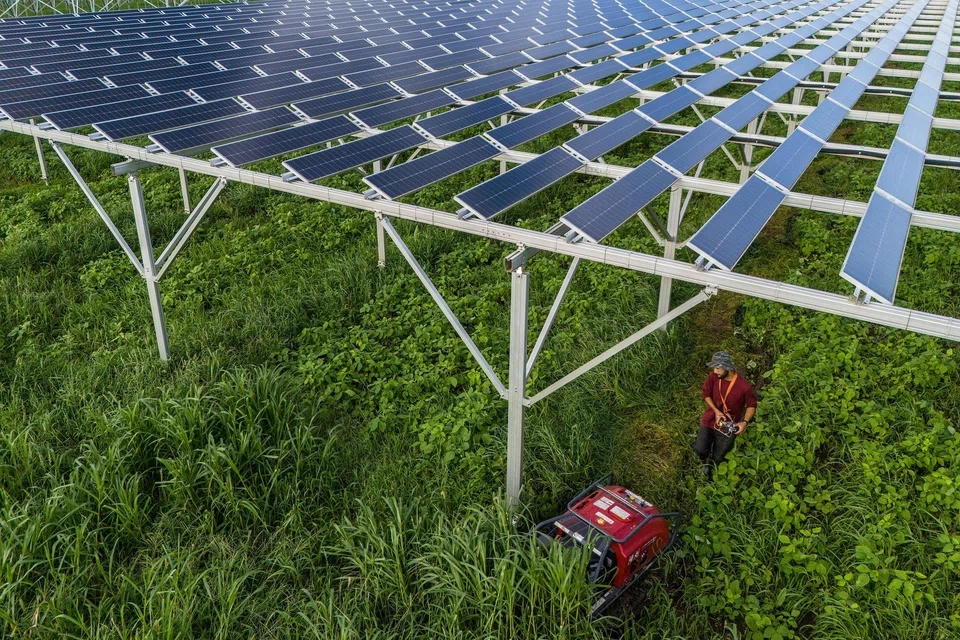
Agrisolar is a system combining farming with solar power generation on the same land
[SINGAPORE] Asian philanthropy is increasingly playing a catalytic role in supporting climate initiatives – and Tara Climate Foundation is an example of that support. The foundation is committing US$15 million over five years to tackle the ongoing energy crisis in Asia through agrisolar initiatives, it announced on Friday (Nov 27).
Agrisolar is a system combining farming with solar power generation on the same land. Farmers can grow crops beneath or alongside solar panels and generate income, while solar power can be used for activities such as irrigation and cooling. This reduces reliance on fossil fuels.
Jamie Choi, CEO of Tara Climate Foundation, said in an exclusive interview with The Business Times that there are nearly 100 million workers in fisheries, agriculture and forestry in this region. They could benefit from agrisolar, as the foundation targets projects that improve farmers’ livelihoods.
“Many of them are facing increasing pressures – whether it comes to energy costs or rising costs of fertilisers – and that’s on top of increasing climate shocks like El Nino, which is making life very difficult for them.”
Tara is looking to support technical research and pilots by partnering local organisations that work with communities on the ground, as well as connecting farmers to relevant partners to help them design and sustain projects.
Choi said: “If we were to test a hypothesis of agrisolar, can we have a model where we could work with renewable energy to not just propagate solar energy as a whole, but also boost farmers’ incomes and support them in generating electricity?”

The foundation will follow five principles: keeping agriculture the primary use of the land; co-designing projects with farmers; ensuring communities share fairly in the benefits; building trust on the ground; and supporting policy.
Agrisolar initiatives will be tailored to the circumstances and needs of each market, with Choi noting that there is no one-size-fits-all approach.
Addressing the energy transition
Agrisolar is part of Tara’s broader mission to address the energy transition, as the world moves away from fossil fuels to cleaner and more sustainable energy sources.


“We want to showcase that energy transition is not a faraway technical issue that feels difficult to grasp. Historically, the philanthropic centre in Asia has been focused on traditional areas like education and health,” said Choi. “Through initiatives like agrisolar, we want to show that climate change is an issue that Asian philanthropy has stakes in.”
Tara also wants to close the funding gap when it comes to climate issues in Asia. A 2026 report by ClimateWorks Foundation noted that only 2 per cent of global philanthropy goes towards preventing climate change, with only 14 per cent of tracked foundation funding reaching Asia and Oceania in 2024.

Tara is a grant-making foundation that pools funds from around 30 foundations. Instead of direct service delivery to communities, it works with partners to reach more communities on the ground. Choi noted that Tara takes a “whole-of-ecosystem approach” to philanthropy.
“That means we’re funding as diverse a range of organisations as possible to complement and supplement one another. This includes everything from think tanks to grassroots organisations to civil society organisations that are working with communities.”
She added that philanthropic funding plays a significant role as risk capital, as it can help to fund the evidence and research needed to inform policy.
“This is the catalytic role that we believe philanthropy can play – show the best solutions, share the evidence, share the trade-offs that are needed for governments and the private sector to make really informed choices.”
Most recently, Tara and the Tsao Family Foundation contributed anchor funding of US$850,000 to the El Nino Resilience Fund, which aims to raise US$3 million over two years to help vulnerable communities deal with climate issues associated with El Nino.
In 2025, the Just Energy Transition Community – of which Tara is a founding member – was launched to advance a just and inclusive energy transition in Asia, with a commitment of US$2.6 million.
The initiative supports the Peace and Equity Foundation in the Philippines, which helps cooperatives in the Mindanao region to design solar energy systems to increase coffee processing capacity.
Tara was established in 2021, and has since granted more than US$230 million to close to 400 partners across 12 Asian geographies.
Decoding Asia newsletter: your guide to navigating Asia in a new global order. Sign up here to get Decoding Asia newsletter. Delivered to your inbox. Free.
Copyright SPH Media. All rights reserved.