

US debt ceiling: A nation divided and indebted cannot stand
That a default may occur in the future is a risk that must be addressed. But a voluntary default is the financial equivalent of driving a car off a cliff
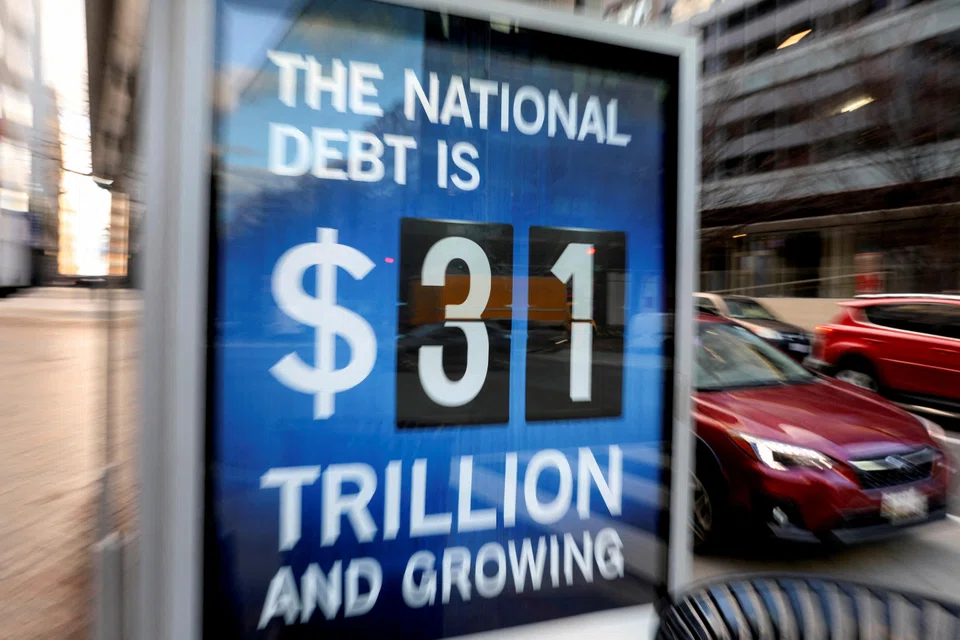

THE United States hit its US$31.4 trillion debt ceiling on Jan 19, 2023, a limit Congress approved only two years ago. The US Treasury is now taking extraordinary emergency measures to prevent the nation from defaulting.
The current battle over the debt ceiling reveals a painful reality that the nation must confront. There are two important principles at stake. The first is that maintaining US creditworthiness is essential to the nation’s economic health. To voluntarily default on the federal debt would compromise the very foundation of the country’s economic success. The second is that the current path of unsustainable fiscal deficits could lead to an involuntary default in the years ahead that would be just as catastrophic.
These uncomfortable truths have some critical implications:
1. Public debt isn’t what it used to be
In 1790, the survival of the US was far from certain. The country had won the Revolutionary War and ratified the Constitution, but its finances were in disarray. The states and the federal government couldn’t service their war debt or even pay their veterans. This affected the performance of the nation’s economy and the government’s ability to regulate it. But Alexander Hamilton, the first US Secretary of the Treasury, understood the essential role that the integrity of the nation’s credit played in ensuring economic prosperity. He coordinated the passage of several regulations that restored the nation’s creditworthiness. These programmes included the consolidation of war debt under the federal government, the institution of tariffs to fund outstanding debt payments, and the creation of a central bank.
Without these measures, the US may not have had the financial wherewithal to endure the exigencies to which Hamilton referred. Adhering to Hamiltonian financial principles helped the US persevere through the War of 1812, the Civil War and World War I.
When these exigencies ended, the country abided by Hamilton’s second principle and ran federal budget surpluses to extinguish the debt.
But that changed after World War II. Initially, the US paid down its debt as it had before, but by the 1960s, permanent peacetime deficits had become the norm. Over the next decade, this trend is expected to continue with the deficit averaging 5 per cent of GDP (gross domestic product) per year, according to the Congressional Budget Office’s (CBO) 2022 estimate. Such a trajectory is impossible to maintain indefinitely; yet the ageing population and secular declines in productivity threaten to make the problem even worse beyond 2032.
Why did the US change its philosophical approach to public credit? One reason is simply that it could. The US dollar became the world’s reserve currency after the Bretton Woods Agreement in 1945, and US Treasuries became an essential store of value for central banks and savers across the world. The massive expansion of entitlement programmes also played a role. This is not a political judgment. These programmes have real social benefits, but the corresponding costs exceed the nation’s ability to fund them. According to the CBO, social security and healthcare programmes such as Medicare and Medicaid account for much of the federal budget. By 2032, they will account for well over 50 per cent, and their costs will only grow as the population ages.
2. Don’t make the cure worse than the disease
The US cannot amass debt faster than the US economy grows forever. But it can for quite a while longer. So, defaulting on the debt by refusing to raise the debt limit constitutes an unforced, self-inflicted wound. At the height of the 2008 global financial crisis (GFC), Congress initially voted down the Troubled Asset Relief Program (Tarp), which immediately caused the panic to intensify. In a second vote, the measure passed and Tarp helped restore faith in the US financial system. No one knows what would have happened if the second attempt had failed, but it would have been disastrous.
The same is true for the debt ceiling. The US has never defaulted on its public debt, so we can’t predict the consequences. But they will be severe. The possibility of a default in the more distant future is a risk that must be addressed, but a voluntary default would be the financial equivalent of driving a car off a cliff rather than running out of gas.
Disadvantages of a divided nation
US political divisions are at a cyclical high, but they have been worse. After all, the nation went to war with itself in 1861. Nevertheless, the threat to US financial stability demands a unified effort. The longer unsustainable debt accumulation goes on, the more severe the consequences and the more draconian the countermeasures will ultimately have to be. As unwise as a voluntary default in 2023 might be, it would be equally irresponsible to saddle future generations with debts they cannot afford or that will require dramatic reductions in their living standards to repay.
Through wars, panics, depressions, pandemics, and natural disasters, the US has always managed to bring a divided people together to counter these threats. This unity has sometimes been reluctant and the degree of sacrifice unfairly distributed, but it has always accomplished the desired objectives for the whole.
The decline and collapse of great powers throughout history prove that there are no guarantees that the next existential crisis the US faces won’t be its last. The solutions to the debt problem will be painful and require sacrifice. Only time will tell whether the US will meet the challenge or succumb to decline like so many empires before it.
The writer, CFA, CFP, is an author and financial historian.
TRENDING NOW

Two Singapore-listed palm oil firms named in Greenpeace report on Indonesian plantation fires

Singapore Airlines flight returns to San Francisco after ‘unruly’ passenger incident

Singapore looking into which companies responsible for haze-causing fires: PM Wong

Deluge IPO 3.86 times subscribed ahead of SGX debut

