

Asia’s rich drive US$200 billion revival in complex equity notes
Issuance of structured products linked to Hong Kong and Singapore equities has surged 80% this year
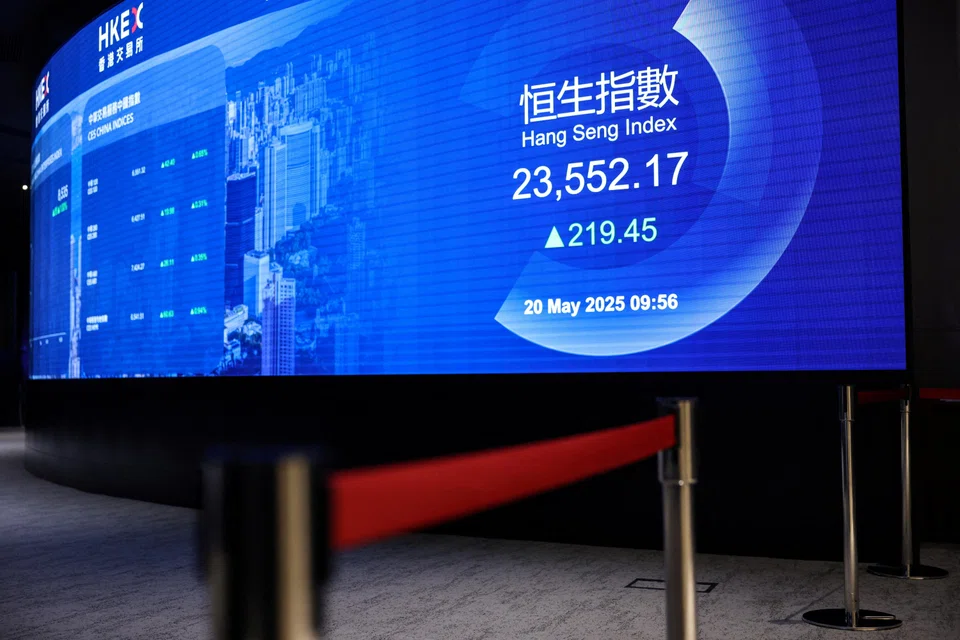
[HONG KONG] Rich Asian investors are ploughing record money into complex stock bets that saddled them with big losses just a few years ago.
Issuance of structured products linked to Hong Kong and Singapore equities has surged 80 per cent this year to a record of more than US$200 billion, according to estimates from BNP Paribas, one of the top issuers.
Products known as accumulators – which make their holders continuously buy stocks at preset levels – and fixed-coupon notes that offer monthly returns are particularly popular.
The revival coincides with a surge in Asia’s equities driven by the artificial intelligence frenzy.
Typically marketed by private banks to wealthy clients, structured-note bets this year have been concentrated in Chinese mega-caps such as Alibaba Group Holding and Tencent Holdings, a shift away from US names such as Nvidia.
The instruments help holders build exposure to stocks in a more controlled way, though their complex structure means losses can worsen under certain conditions.
“Issuance was very limited for the last few years, up until September of last year,” said Tony Lee, head of global equity-derivatives strategy at JPMorgan Chase, referring to notes tied to Asian stocks.
“Because of the recovery of the Chinese market, the product underlyings have shifted from US stocks into Hong Kong stocks.”
While US investors’ appetite towards structured products has been growing, Asia remains the main market.
SEE ALSO






More than 60 per cent of the global sales came from the region in the first seven months of 2025, led by China and Hong Kong, according to industry data provider SRP.
The instruments generally offer a smaller maximum payout than stocks, but some investors are lured by their regular, fixed payments that are usually higher than bond yields, or by the embedded protection they offer.
Yet the risks can be overlooked: The Lehman Brothers collapse in 2008, the Covid outbreak and China’s Internet crackdown that triggered a multi-year stock slump are just a few incidents that handed steep losses to investors.
Traded over-the-counter, accumulators are contracts that force investors to buy a set amount of underlying securities at a fixed price over regular intervals.
In a rising market, the purchase price is usually at a discount.
During downturns, however, holders are often locked into buying at above-market prices.
At CA Indosuez Wealth Management, some of the most-traded accumulators require investors to purchase double the initially agreed amount of Alibaba shares if the stock price drops more a certain amount, often between 10 and 20 per cent of the level at the start of the investment, according to Ting May Woo, the firm’s head of advisory solutions in Singapore.
For fixed-coupon notes, the return is typically tied to an asset such as an equity gauge, single stock or group of shares.
Barclays recently offered one that pays an annualised coupon of 9 per cent every month and has the principal linked to the performance of Alibaba, Tencent and Meituan, according to a term sheet seen by Bloomberg.
If any of the three stocks drops 28 per cent or more from its price at the investment entry, holders have to buy its shares at a higher price than the current trading level or settle in cash at losses.
AI concentration
Alibaba is the most popular underlying asset among the structured notes issued in Asia this year, according to Daniel So, senior trading strategist at Goldhorse Capital Management, which runs a fintech platform that offers pricing of structured notes.
The coupon offered by notes tied to Chinese AI names often ranges between 10 and 20 per cent annualised, higher than the 10 to 12 per cent for those tracking an index, he said.
Demand is surging as the stocks rally. Alibaba shares jumped nearly 90 per cent this year in Hong Kong, while the Hang Seng Tech Index rose 26 per cent to end years of underperformance against US peers.
At Royal Bank of Canada, between 30 and 40 per cent of the equity-linked notes tracked Hong Kong-listed equities in 2025, according to Kin Lok Lee, head of structured products for the wealth-management arm in Hong Kong.
That is up from about 20 per cent in 2024, when around 80 per cent of the fixed-coupon products were linked to US names, he added.
“Investors who buy these notes usually can accept the worst-case scenario – which is to buy these shares at pre-determined strike levels higher than market prices – because they hold the belief that these stocks will eventually recover,” Goldhorse’s So said.
It’s not uncommon for wealthy investors to take on leverage, allowing them to boost bets and amplify returns, according to CA Indosuez’s Woo.
Of course, the losses would also get amplified in an adverse scenario.
The challenge for BNP Paribas is to manage risk given that the current notes are concentrated on a small number of names, according to Charles-Edouard Garnier, the bank’s head of equity-derivatives sales for Asia-ex Japan.
Still, this year’s market gains have spurred risk taking and reinvestment as products terminated early with share prices climbing beyond knock-out levels before maturity.
“I wouldn’t be surprised to have another very decent growth next year, assuming that the market doesn’t collapse,” he said. BLOOMBERG
Decoding Asia newsletter: your guide to navigating Asia in a new global order. Sign up here to get Decoding Asia newsletter. Delivered to your inbox. Free.
Share with us your feedback on BT's products and services
TRENDING NOW

Once staunchly pro-China, Malaysian Chinese businesses are now distancing themselves from Beijing

Looking beyond looming CEO succession, should UOB potentially pursue a transformative merger?

Could stablecoins be the future of money?

Grab CEO’s wife Chloe Tong on life with Anthony Tan and finding her purpose

