Boding ill for China: new economic regime, rising geopolitical tensions
Chinese equities now warrant a significantly higher risk premium, and it is unwise to invest in the hope that things would improve. There are other more attractive options.
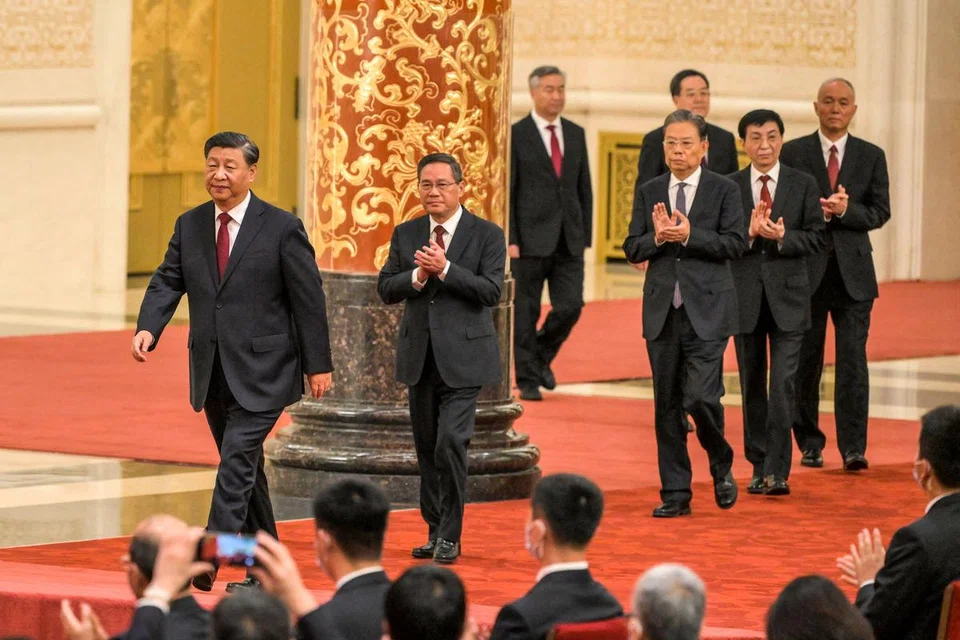
AS THE curtains fell on the 20th National Congress of the Chinese Communist Party, President Xi Jinping’s mandate was extended for an unprecedented third term. While this came as no surprise to investors, his picks for the party’s powerful seven-member Politburo Standing Committee were largely unexpected.
The top echelon of the party has been stacked with Xi’s allies, making him the most powerful leader since Mao Zedong. While we have been bullish on China over the past few years, the structural shifts set in motion by Xi’s consolidation of power at the top have led us to become more defensive on Chinese equities.
Zero-Covid policy unlikely to ease in the short term
Previously, even as we felt China was unlikely to budge from its zero-Covid policy, a gradual relaxation of zero-Covid seemed to be in the offing.
No longer. With the further consolidation of power by Xi, China is now, more than ever, unlikely to turn away from its draconian zero-Covid policy.
In the lead up to the National Congress, the People’s Daily, a state-run newspaper, endorsed the zero-Covid policy as a sustainable strategy that stabilises the economy and protects lives. During the National Congress, Xi doubled down on the stance that zero-Covid has saved lives and vowed to continue the stringent set of policies. The large-scale building of quarantine centres and isolation facilities in China also point to a more permanent zero-Covid stance.
With no end in sight, China’s economy will likely take more hits.
Shift to top-down, state-controlled economy
China’s embrace of a free market economy and private enterprise has led to decades of high economic growth. That is changing. Under Xi’s leadership, China has eschewed a free market economy in favour of a top-down, state-controlled economy that demands businesses conform to the aims of the Chinese Communist Party.
At the centre of this state-controlled model is state-owned enterprises (SOEs); Xi sees the state sector as the backbone of the national economy. In his work report at the National Congress, he emphasised the importance of ensuring that “state-owned capital and enterprises get stronger, do better and grow bigger’‘.
The increasing role of SOEs, however, means that the private sector has less room to prosper. The shift in the business climate has been most obvious in China’s crackdown on its technology sector, deeming it to have gained too much influence. In order for private companies to thrive, they now have to fall in line with party priorities, or risk facing irrelevance.
China’s shift to a state-controlled economy has several implications.
First, China’s economy will likely enter a low-growth period. While the government has not ditched economic growth as a priority, it is likely that the balance of priorities will be shifted towards security. Second, the long-term profitability of private companies is at risk, as state goals are now more important than profits. Third, with Xi likely to face even less opposition than during his first two terms, the risk of policy mistakes will be higher.
Geopolitical tensions with the West escalating
We are entering a new age of geopolitics, with the world becoming increasingly multi-polar and where peace may no longer be a sure thing. At the centre of it is rising US-China tensions, which have escalated dangerously in recent times, with the US banning the sale of advanced semiconductor chips to China. Earlier in August, Nancy Pelosi’s visit to Taiwan triggered an unprecedented military response from China.
Xi will likely serve out his third term with greater assertiveness in international relations, guided by a view that sees an increasingly hostile world bent on containing China’s rise. As such, Xi will likely steer China away from reconciliation with the West and increasingly adopt a harder line against Taiwan, ushering in a dangerous new era of hostility and economic tit for tat between the US and China.
This seismic geopolitical shift will also reshape global supply chains, as rising tensions have stoked distrust that is changing views on China’s reliability as a trade partner and supplier, causing countries to reassess their economic dependence on China.
As China becomes increasingly isolated from the world, its economy faces stagnation.
China no longer attractive; invest in these markets instead
We believe that Chinese equities now warrant a significantly higher country risk premium. At this point, it would be unwise to invest in Chinese equities in the hope that the situation would eventually improve (it likely won’t). As we’ve already experienced over the past year, every time investors got hopeful, any stock market rebounds were immediately snuffed out by renewed uncertainties.
With China no longer attractive, where else should investors turn?
At the asset class level, we now have a preference for fixed income over equities, as we are starting to see attractive value emerging within this asset class. Global bond yields have climbed to levels that were last seen during the global financial crisis.
Within fixed income, our preference is for short-duration bonds as short-term bond yields have moved significantly higher compared to long-term yields, implying that investors can receive alluring yields without having to take on greater duration risk. The Nikko AM Shenton Short Term Bond SGD, LionGlobal Short Duration Bond Cl A Dis SGD, and the United SGD Fund Cl A Acc SGD are all suitable options.
An unconstrained bond strategy, such as the Allianz Global Opportunistic Bond Cl AMg Dis H2-SGD, is also viable as it allows for better management of interest rate risk in this tough environment.
Within equities, the US and Japan now stand out as more attractive options compared to Chinese equities. For exposure to US and Japan, we recommend the JPMorgan Funds – US Value A (acc) USD and the JPMorgan Funds – Japan Equity A (dist) SGD, respectively.
Furthermore, given our expectation that inflation will likely stay higher for longer, commodity-linked equity strategies like the BlackRock Natural Resources Growth & Income A2 USD will also be among the winners. The shift of production away from China will also benefit several economies and regions, including Asean, which investors can access using the Principal Asean Dynamic Fund Class SGD.
The writer is a senior portfolio manager, research and portfolio management team, FSMOne.com. FSMOne.com is the business-to-consumer division of iFast Financial, the Singapore subsidiary of Singapore Exchange-listed iFast Corporation.