

Bright spots in industrial, logistics and data centre Reits
Amid macro volatility, investors should focus on well-managed Reits with resilient balance sheets and the capability to capitalise on structural tailwinds

SINGAPORE real estate investment trusts (Reits) are set to remain volatile this year, fuelled by trade disruptions, which would keep interest rates higher for longer. Our top sector picks are industrial/logistics and data centres. While we see opportunities in these segments, investors should remain selective, prioritising Reits with resilient balance sheets and the ability to capture structural tailwinds.
Resilience in industrials/logistics Reits
Trade tensions have intensified as the US imposed new tariffs, including a 10 per cent levy on Singapore’s exports. Tariffs raise concerns for export-driven economies, but Singapore remains relatively insulated, as 13 per cent of its exports were bound for the US in the first quarter of this year, against the 10-year historical average of 11 per cent. Regional peers like Vietnam, Indonesia and Malaysia face higher tariff burdens.
This comparatively lighter tariff burden makes Singapore’s exports more cost-competitive, which may help position the country as a stable and reliable trade partner in the eyes of US buyers.
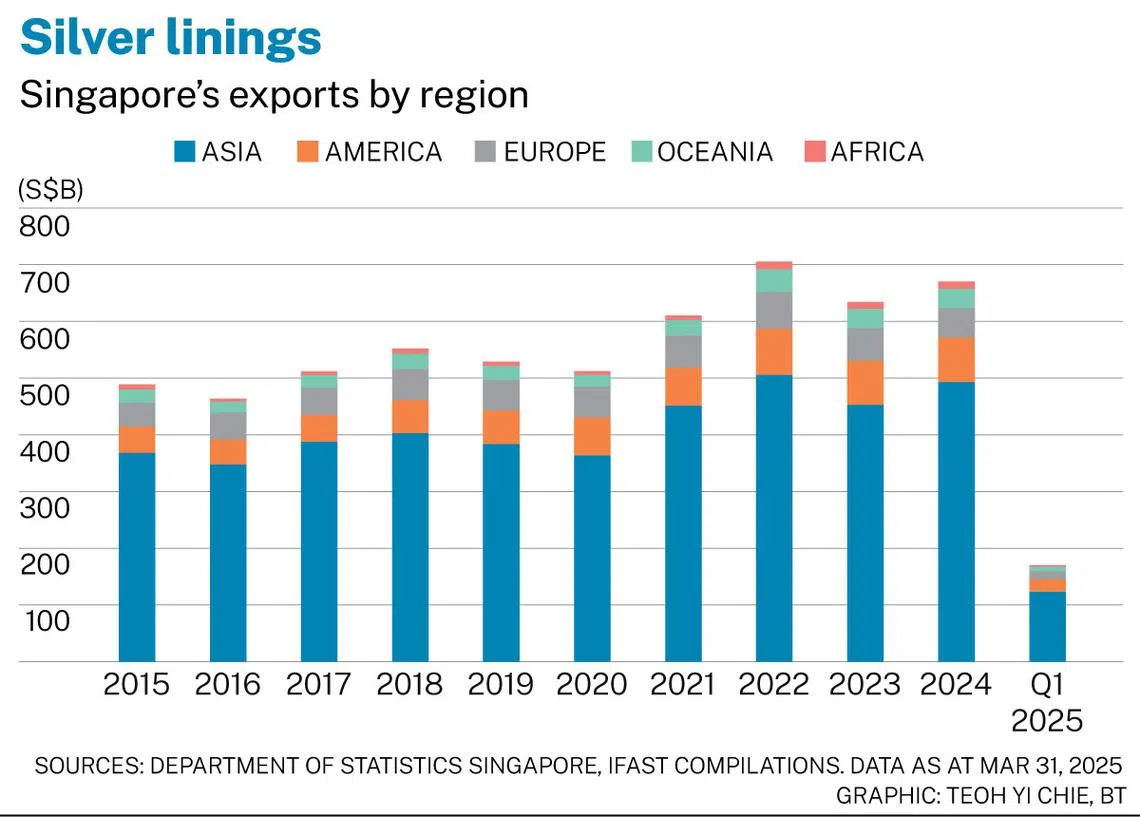
Additionally, as businesses reassess their global supply chains in light of rising geopolitical and trade tensions, Singapore stands to benefit from its reputation for stability, transparency and robust infrastructure. For instance, firms looking to diversify away from more heavily tariffed markets may view Singapore as an attractive alternative, not just for transshipment, but also as a base for value-added logistics services, light manufacturing and regional distribution.
This repositioning could lead to increased demand for logistics warehousing, as well as an increase in the volume of goods passing through in free trade zones, and more investment in smart logistics and supply chain technologies.
Despite the macroeconomic uncertainty, Singapore’s logistics ecosystem remains agile, with the Port of Singapore continuing to rank among the world’s busiest, and the expansion of Changi Airport’s air cargo capabilities. Also, the completion of Tuas Megaport in the 2040s will cement Singapore’s status as a global shipping and logistics powerhouse.
Singapore’s participation in multilateral trade agreements – like the Comprehensive and Progressive Agreement for Trans-Pacific Partnership, and Regional Comprehensive Economic Partnership – further strengthens its connectivity and trade resilience amid disruptions in trade with the US.
In short, while US tariffs pose risks to global trade, Singapore’s logistics sector is well-positioned to weather the storm. The combination of lower tariff exposure, strategic location and growing relevance in supply chain diversification means the sector may not only withstand the current wave of protectionism but also find opportunities within it.
As global manufacturers and buyers pivot towards more stable, transparent and strategically located hubs, the city-state is likely to emerge as a critical node in the next era of global trade. Hence, we see higher occupancy rates and greater rental reversions for Reits with exposure to industrial/logistics assets located in Singapore.
Data centre Reits: supercharged by AI and cloud
Demand for data centre (DC) capacity is accelerating, fuelled by the rise of artificial intelligence, cloud computing, and digitalisation. High-density computing needs, driven by applications like ChatGPT and autonomous technology, are increasing power requirements per rack and intensifying competition for space in key markets.
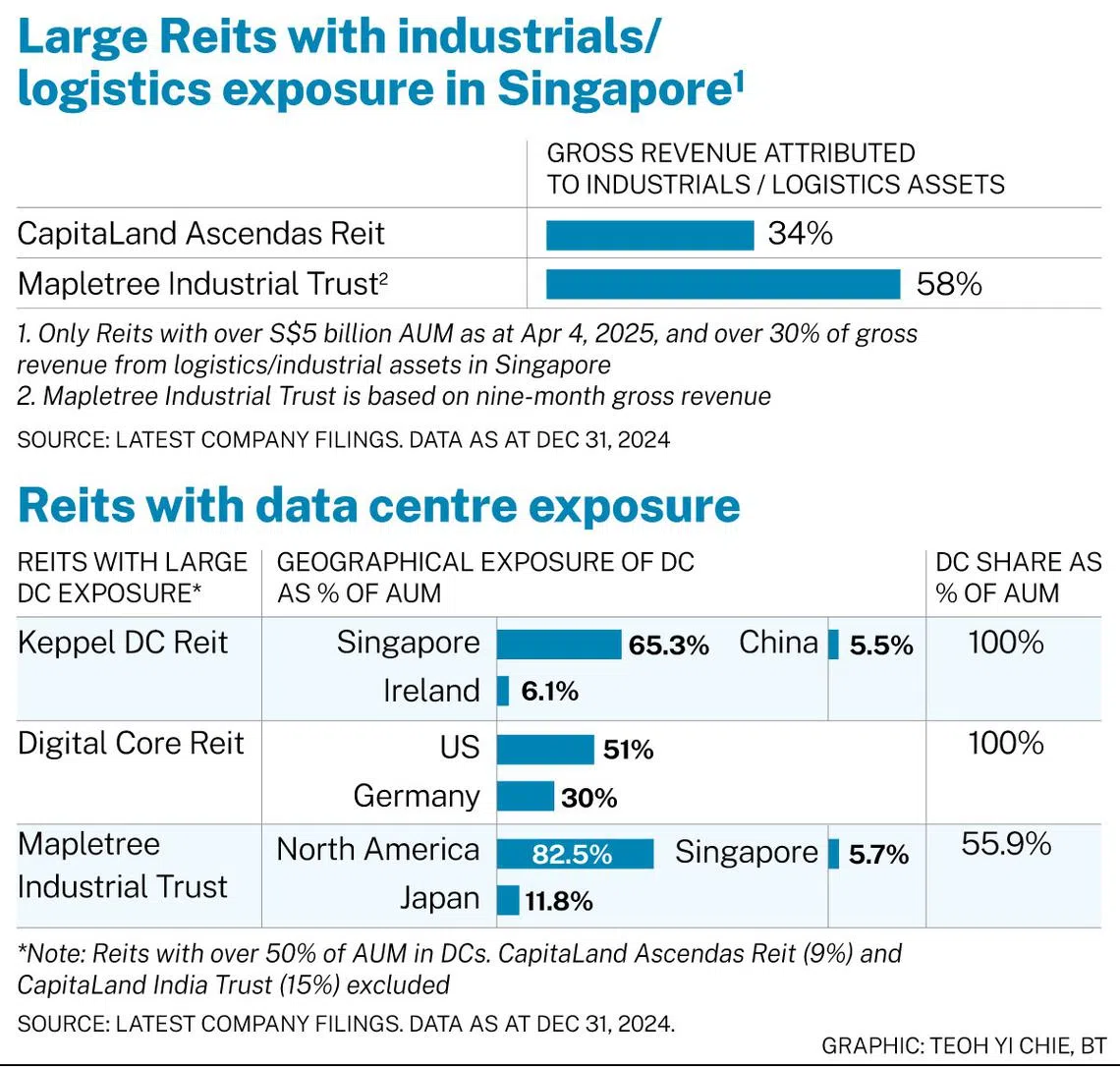
Singapore’s hyperscaler DC market is projected to grow at a compounded annual growth rate of 11.3 per cent, from US$639.5 million in 2023 to US$1.7 billion by 2032. Yet, supply remains constrained due to land and regulatory limits, including a moratorium on new DC builds unless energy efficiency benchmarks are met.
In response, Reits have turned to overseas markets such as North America, Europe and Japan. Mapletree Industrial Trust, for example, acquired DC assets in Osaka and Tokyo over the past two years.
As sustainability becomes increasingly important, ESG-compliant, energy-efficient DCs will be a key focus area. Reits like Keppel DC Reit are already aligning with this trend. Its recent full acquisition of Keppel Data Centre Campus in Singapore includes infrastructure designed to reduce energy and water usage, reflecting a broader industry push towards green DC operations.
On the Singapore Exchange, Keppel DC Reit and Digital Core Reit are pure-play DC Reits while Mapletree Industrial Trust has sizeable exposure to DCs.
Risks to watch in 2025
Investors should keep an eye on several key risks that could affect this leveraged sector:
- Higher-for-longer interest rates: Persistent inflation and trade frictions could keep borrowing costs elevated, impacting capital-intensive Reits.
- Geopolitical tensions: Disruptions in global trade routes (eg Red Sea tensions) may impact logistics and supply chains.
- Economic slowdown: A softening global economy, especially under renewed US protectionism, could dampen discretionary consumption and affect retail-linked logistics.
Time to accumulate selectively
Reit valuations have become more compelling. The FTSE ST Reit Index is trading beyond one standard deviation below its 10-year average forward P/B (price-to-book ratio), and yield spreads have improved from 2022 levels. This suggests a potential entry point for long-term investors looking to accumulate quality Reits at attractive levels.
However, selectivity remains key. Amid macro volatility, investors should focus on well-managed Reits with resilient balance sheets and the capability to capitalise on structural tailwinds, such as CapitaLand Ascendas Reit, Mapletree Industrial Trust and Keppel DC Reit.
The writer is a research analyst with the research and portfolio management team of FSMOne.com, a Singapore subsidiary of iFast Corporation
TRENDING NOW

Indonesia begins cutting natural gas exports to Singapore from Oct 24: reports

Singapore’s central gas buyer affirms Indonesia’s role as ‘important partner’ amid export review warning

KKR founders among investors buying 42% of Peter Lim’s Valencia; club valued at US$1.4 billion

NEA issues notices to 10 Singapore-based companies, including Wilmar and APP, over haze

