

Canadian pension fund La Caisse gears up to invest C$15 billion in Asia-Pacific
Infrastructure is expected to take up C$9 billion while credit and real estate will account for C$3 billion each


[SINGAPORE] La Caisse, one of the largest pension funds globally, aims to invest C$15 billion (S$13.9 billion) in the Asia-Pacific over the next three years – more than half of which will be in infrastructure, said its president and chief executive Charles Emond.
Of the total investment, infrastructure is expected to take up C$9 billion. Credit and real estate will account for C$3 billion each.
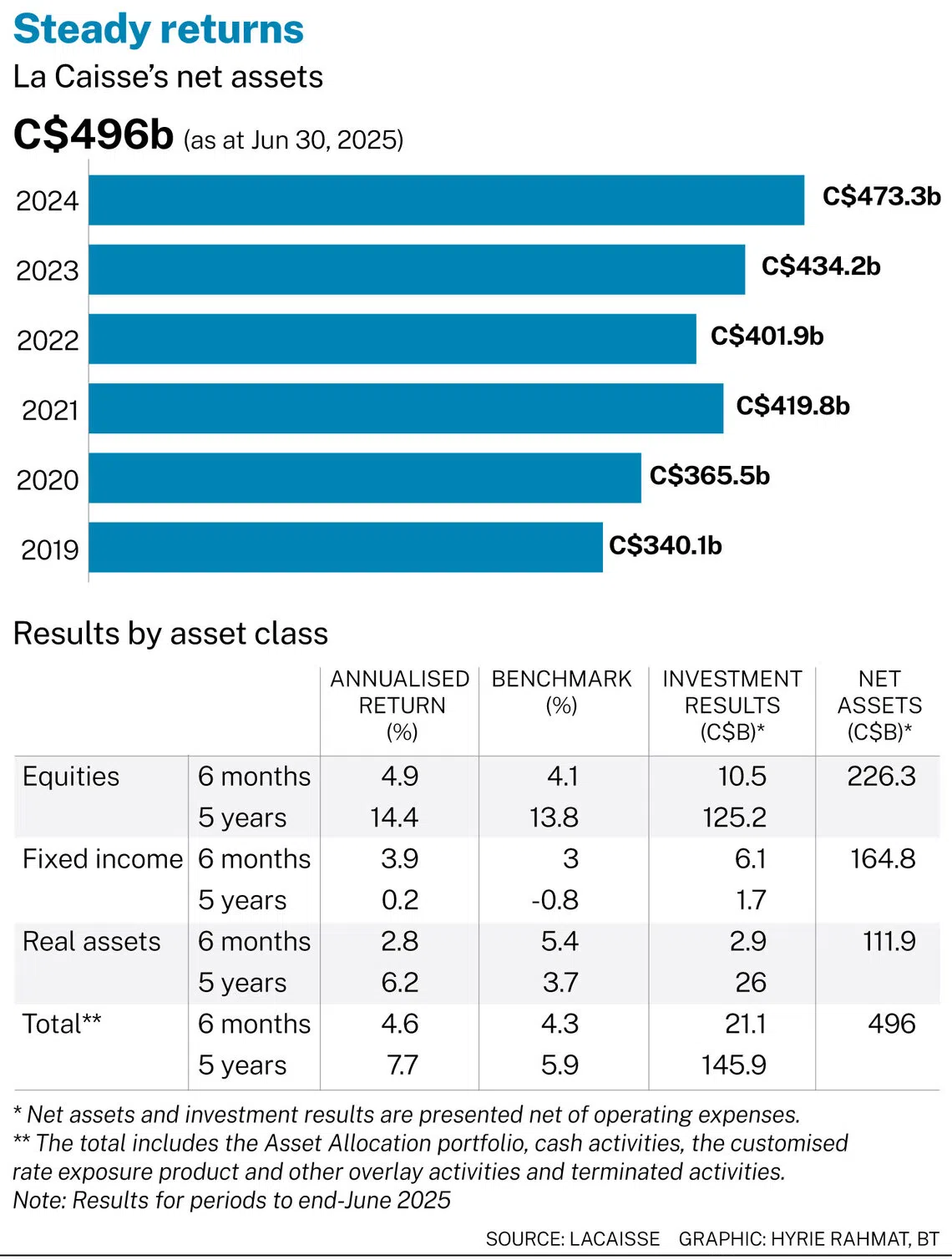
La Caisse manages around C$496 billion in assets at end-June, on behalf of 48 pension and insurance funds in the Quebec province of Canada. More than six million Quebecers contribute or receive benefits from the funds.
Investments in Apac account for 10 per cent of the total assets. Singapore, where it employs 60, is one of three global hubs, in addition to New York and London.
“Our goal is not to chase higher returns but to provide stability on the way up and down. In 2022 when stocks were down by 25 per cent, and fixed income by 20 per cent, our return was minus 5 per cent.”
Emond says two features differentiate La Caisse from other pension funds. One is its dual mandate to generate returns for its depositors, while contributing to Quebec’s economic development.
La Caisse aims to invest C$100 billion in Quebec by 2026. At end-2024, it has invested C$93 billion comprising support for entrepreneurs, investments in sustainable real estate and infrastructure, among others.
The second aspect is La Caisse’s commitment to sustainability.
“We believe in sustainability because with it, we can generate higher returns, and it is good risk management. As (one of) the largest institutional infrastructure investors in the world, we need to factor in the physical risk associated with climate change, and deliver returns for the next generation as well.”
The firm recently announced a new climate strategy; it aims to expand its investment in climate action from the current level of about C$158 billion to C$400 billion by 2030. The funds will be channelled into efforts to help companies to decarbonise as well as investments in climate solutions, including low-carbon technologies and infrastructure.
Currently more than 80 per cent of La Caisse’s portfolio comprises zero to low-emission assets. “But we need to make sure that the companies in our portfolio keep decarbonising. We want to invest in every sector to help decarbonisation and help the economy. We’ve cleaned up our act and we want to help companies do the same.”
La Caisse has reduced the carbon intensity of its portfolio by 69 per cent and more than trebled its low-carbon assets to C$58 billion by end-2024, surpassing targets set earlier.
Its investments in energy transition assets have outperformed conventional energy, with annualised return of nearly 12 per cent over five years, compared to the MSCI ACWI Energy index’s return of about 8 per cent. Renewable assets’ performance was twice as strong as the oil segment of the MSCI ACWI for the period.
La Caisse’s total portfolio generated a return of 9.4 per cent in 2024. Over five years, its annualised return was 6.2 per cent, and over 10 years, 7.2 per cent. Geographically, the US has the largest allocation at 38 per cent, followed by Canada at 30 per cent.
More than 46 per cent of assets or C$219.4 billion was invested in equities including private equity. Fixed income’s share was C$154 billion, and real assets – comprising real estate and infrastructure – came to C$105 billion.
Emond says that La Caisse will continue to invest heavily in the US, even though potential US dollar weakness gives it pause. He is also confident about mega-cap tech stocks that have driven returns.
“The Magnificent 7 have been quite a force to reckon with and markets are as concentrated as they have ever been. Public equities are also not the same as they were. Previously 20 per cent of the markets was run by algorithms, now it’s up to 70 per cent. That creates greater momentum that is tougher to reverse and there is a lot of influx from retail. If those things were to stop, things can unwind as fast as they have gone up,” he said. The Mag 7 stocks refer to Alphabet, Amazon, Apple, Meta Platforms, Microsoft, Nvidia and Tesla.
US investments have been immensely profitable for La Caisse.
“In the last five years, we made close to C$100 billion in the US. Will this continue? Are the Mag 7 stocks going to provide a lot of potential? For sure. The rest of the US market (may not), that’s why it’s pricey,” he said.
“Are we going to keep deploying in the US? Absolutely. It’s our neighbour, and the most liquid market. The US is like the AI superpower of names that you still need to own. The rest of the market is expensive. But we’re well diversified. The first half of 2025 has shown that you have to diversify.”
“The issue now is the macro questions – first off, the currency. Your view on the US and whether you should hedge (the dollar) can be a big differentiator. We are exposed but we hedge ourselves,” he added. “Our view is that even though temporarily the dollar may go up, in terms of fundamentals we expect structural weakness mid-term,” said Emond.






