
The Charlie Munger principles to invest and live by
The iconic investor left a lengthy record of the keys to his success, delivered with his trademark bluntness and humour
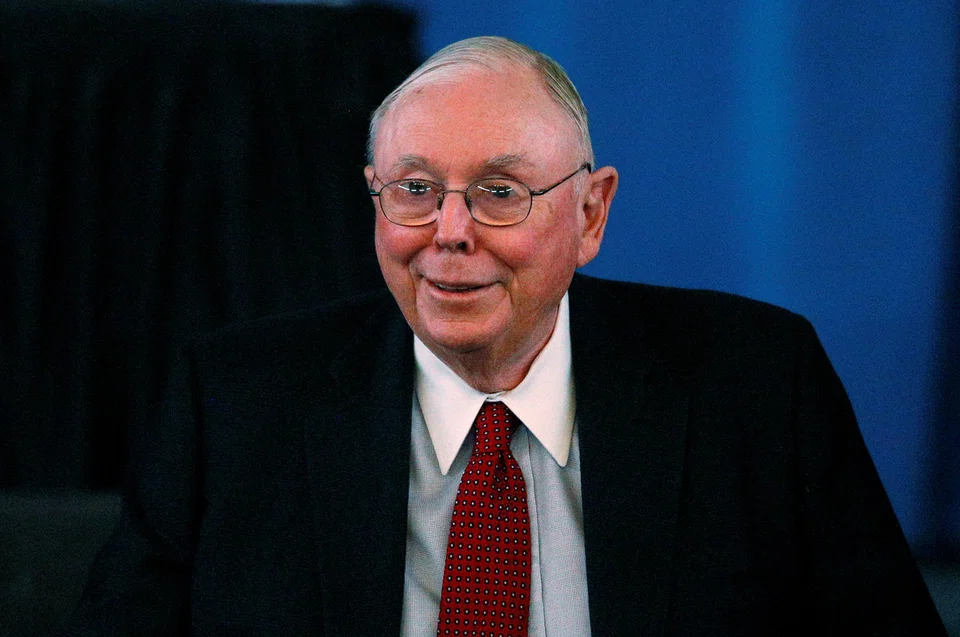
CHARLIE Munger, who worked with Warren Buffett to build Berkshire Hathaway into a global investing powerhouse, died on Thursday (Nov 28) at the age of 99. Among his many contributions, Munger was a prolific armchair philosopher, whose speeches and interviews included hundreds – maybe thousands – of nuggets about how to invest and live well.
Blunt, witty and scholarly in his assessments, here is my distillation of the Munger philosophy and how he lived by it. The overarching principles are mined from his remarks at Berkshire shareholder meetings and his classic 2007 commencement address to the USC Gould School of Law, which can be found here.
Take a multidisciplinary approach
Munger, a lawyer by training as well as an avid poker player, credited much of his success to his interest in seemingly everything. He advocated for learning “all the big ideas in all the big disciplines”, and his talks were peppered with references to Confucius, Charles Darwin, Benjamin Franklin, Isaac Newton and even Mozart. In a way, his sweeping academic interests seemed to mirror Berkshire’s portfolio, which currently includes holdings in Apple, auto insurer Geico and See’s Candies, a conveyor of chocolates and peanut brittle.
Munger tempered this interest in going broad with a resistance to diversification for diversification’s sake. “One of the inane things that’s taught in modern university education is that a vast diversification is absolutely mandatory in investing in common stocks,” Munger told the Berkshire faithful at the company’s annual meeting this year in May. “That is an insane idea. It’s not that easy to have a vast plethora of good opportunities that are easily identified.”
Plan for the worst
Munger was sometimes pigeonholed as the pessimist in the partnership. Certainly, he had a grimmer assessment than Buffett about the prospects of succeeding in the investing game today, in a world with more and more money in the hands of smart people “all trying to outsmart one another”. He and Buffett had a lively debate about just that at this year’s meeting:
Munger: It’s a radically different world from the world we started in. And I suppose it will have its opportunities, but it’s also going to have some unpleasant episodes.
Buffett: But they’re trying to outsmart each other in arenas that you don’t have to play.
Munger did not mind being cast as the glass-half-empty guy, and he rather considered it a sign of prudence. “It didn’t make me unhappy to anticipate trouble all the time and be ready to perform adequately if trouble came,” he said in his 2007 commencement speech, just months before the start of the recession and financial crisis. Over the next several years, Munger and Buffett famously burnished their reputations by deploying their sizable rainy-day fund in deeply beaten-up assets including Goldman Sachs Group and General Electric Co.
If a form of conservatism helped Munger, it may also have prevented him from investing in some of the most extraordinary companies of the past 20 years. In 2019, Munger lamented the fact that he missed the chance to buy Google parent Alphabet in the early days. Berkshire’s Geico was a Google advertising client at the time, and Munger said he and Buffett should have seen what a powerful business it was becoming.
“I feel like a horse’s ass for not identifying Google better,” Munger said. Moments later, he added: “We just sat there sucking our thumbs. So, we’re ashamed. We’re trying to atone” – a line that got good laughs, even though the opportunity cost to Berkshire shareholders was ultimately a serious matter.
Pursue quality (and modesty)
Munger may be best remembered for nudging Buffett, a cigar-butt value investor in the mold of Benjamin Graham, in the direction of paying up for the right “quality” companies – those with special products and deep competitive moats. Notably, Munger has downplayed some of the “mythology” around his role, but that was probably just his characteristic humility talking.
Here is his 2003 version of how Berkshire embraced “quality”, beginning with the purchase of See’s Candies in 1972 for US$25 million:
There’s some mythology in this idea that I’ve been this great enlightener of Warren Buffett. Warren hasn’t needed much enlightenment, but we both kept learning all the time... And See’s Candies did teach us both a wonderful lesson. And it’ll teach you a lesson if I tell you the full story. If See’s Candies had asked US$100,000 more, Warren and I would’ve walked. That’s how dumb we were at that time. And one of the reasons we didn’t walk is while we were making this wonderful decision we weren’t going to pay a dime more, (Munger’s pal) Ira Marshall said to us, “You guys are crazy. There are some things you should pay up for”, quality of business – quality, and so forth. “You’re underestimating quality.”
See’s has since generated billions in profit and is, needless to say, still in the Berkshire portfolio. But Buffett has his own version of the story – one that gives much more credit to Munger for the institutional evolution:
Charlie really did – it wasn’t just Ira Marshall – but Charlie emphasised the qualitative much more than I did when I started. He had a different background to some extent than I did, and I was enormously impressed by a terrific teacher, and for good reason. But it makes more sense, as we pointed out, to buy a wonderful business at a fair price, than a fair business at a wonderful price. And we’ve changed our – or I’ve changed my focus anyway, and Charlie already had it – over the years in that direction. And then of course, we have learnt by what we’ve seen.
Focus on what not to do
In his 2007 commencement speech, Munger shared his thoughts on what he called “inversion”. In other words: “What will really fail in life? What do you want to avoid?” He said he had made many good choices simply by focusing on what not to do. At the time, his examples included avoiding laziness, intense ideology and perverse associations (including working for people you don’t like or respect).
That is a clever mental trick, and it provides some context for Munger’s many memorable rants over the years on the ills of the investing world. And indeed, some of Berkshire’s best moves were the investment frenzies that they stayed out of (including during the dotcom bust.) In closing, here are a few of Munger’s epically blunt assessments of the many hype cycles he lived through in his decades with Berkshire and nearly a century on the planet:
- AI: “I am personally skeptical of some of the hype that has gone into artificial intelligence. I think old-fashioned intelligence works pretty well.”
- Crypto: “If somebody says, ‘I’m going to create something that sort of replaces the national currency’, it’s like saying I’m going to replace the national air. It’s asinine. It isn’t even slightly stupid, it’s massively stupid.”
- Meme stocks: “It gets very dangerous, and it’s really stupid to have a culture which encourages as much gambling in stocks by people who have the mindset of racetrack bettors, and of course it’s going to create trouble as it did.”
The investing world will certainly miss Munger’s irreplaceable bluntness and humour – especially when the next bubble comes along. But one way or another, his principles are certain to endure. BLOOMBERG
TRENDING NOW
Grab CEO’s wife Chloe Tong on life with Anthony Tan and finding her purpose
He built the Vingroup empire. Now South-east Asia’s richest man is handing some key roles to his sons
HDB reviewing ‘jumbo’ flat scheme after Telok Blangah unit listed for sale at S$2.18m
What role can Japan play in Asean’s future?



