

Debunking myths in private credit
As capital pours into the asset class, investors are being sold a story of low risk and stable returns. The reality is more complex.

INTEREST in private credit is growing in the Asia-Pacific region, with the private credit market poised to grow from US$59 billion in 2024 to US$92 billion by 2027, said a new report from the Alternative Investment Management Association. But is private credit – or more broadly speaking, private markets – the “promised land” that offers what investors seek in their portfolio?
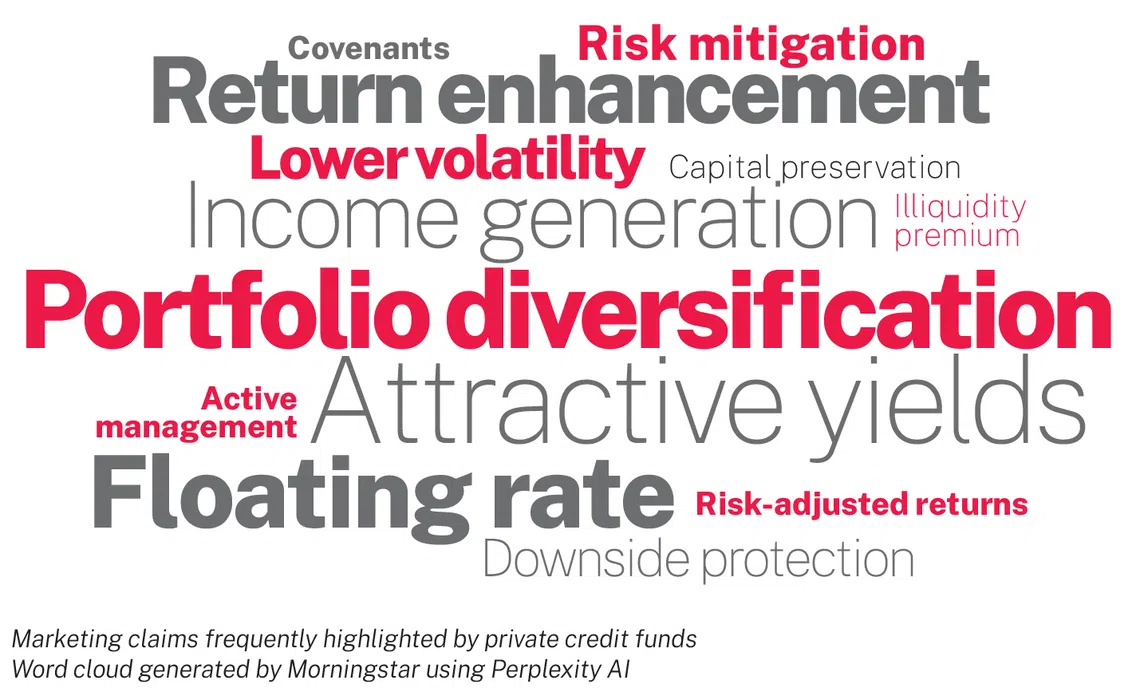
As private credit funds gain traction, investors should beware of aggressive marketing and slick sales pitches. While the sales pitches may be slick, investors should nonetheless tread with caution. Using generative artificial intelligence tools to review marketing materials from private credit funds (see word cloud below), Morningstar identified several recurring themes.
These commonly promoted narratives include claims that private credit offers: one, lower volatility; two, diversification benefits; three, lower risk than high-yield bonds; four, strong loss protection; and five, protection against interest rate volatility. Here we put these claims under scrutiny.
Claim 1: Private credit has lower volatility
Lower volatility is a frequently cited reason for investing in private credit. However, this is illusory; it is the lack of trading and limited price discovery in these instruments that creates low dispersion. The true volatility of any financial instrument can only be assessed in an active secondary market where participants continuously express their views and reprice risk. Without such market activity, private credit may appear more stable than it truly is – a phenomenon that has earned the moniker “volatility laundering”.
For example, during the tariff-driven market volatility in April 2025, which unsettled both equities and fixed-income securities in public markets, it would be difficult to argue that private credit issuers were immune to the same economic headwinds affecting their publicly traded peers. In reality, the underlying volatility in private credit is likely comparable to that of similar asset classes such as high-yield bonds.
Claim 2: Private credit offers diversification benefits
The idea that private credit offers diversification benefits is often overstated. Companies issuing private credit typically belong to similar industries and operate in the same markets as those issuing public bonds. While there may occasionally be opportunities to invest in unique business models or emerging industries through private credit, such cases are exceptions rather than the norm.
If the underlying borrowers are exposed to the same economic and sector risks as their public market counterparts, the diversification argument loses much of its strength.
Claim 3: Private credit is lower risk than high-yield bonds
Marketers tend to claim that private credit offers lower risk even though most private credit issuers fall into the below-investment-grade or non-rated categories. These securities also tend to offer higher coupons. If the risk were truly lower, issuers would not need to offer such high coupons to attract investors.
Still, proponents would argue that private credit funds provide faster and more flexible financing, or have skill in pricing more complex credit risks, and that borrowers are willing to pay a premium for this. This may hold true in some cases. Nonetheless, issuers ultimately aim to raise capital at the lowest possible cost, so higher rates largely reflect higher perceived risk, contrary to the original claim.
Indeed, the recent bankruptcy of automotive supplier First Brands, which led to a sharp drop in the company’s loan prices, highlights that private credit is not immune to credit risks, much like its publicly traded counterparts.
Claim 4: Security and covenants help restrict losses
Private credit funds often highlight the security or collateral embedded in their securities and strict covenants as reasons for potentially lower losses.
Security or collateral refers to the assets pledged by the borrower to the investor, which can be used to recover debt in the event of default. Covenants are restrictions placed on the borrower, such as limits on leverage or changes in ownership, designed to protect investors and reduce downside risk.
While these features can help lower losses after a default, they do not necessarily reduce the probability of default itself. Since private credit often involves lower-rated issues, credit risk can be higher.
Potential losses depend on both the likelihood of default and the extent of loss if a default occurs, meaning that security and covenants can help mitigate risk but do not necessarily reduce overall losses.
Claim 5: Private credit offers protection against interest rate volatility
The perceived benefit of private credit in shielding investors from interest rate volatility can be exaggerated. Most private credit transactions carry floating-rate coupons that reset periodically in line with prevailing interest rates.
While this structure proved beneficial to investors during periods of sharp rate increases, such as in 2022 and 2023, interest rates are cyclical; and when they decline, floating-rate instruments do not benefit in the same way as fixed-rate bonds.
Therefore, the floating-rate nature of private credit securities does not provide consistent protection across all interest rate environments. Similarly, while a swift increase in rates may not immediately impact private credit investors, if rates remain elevated, the debt servicing burden for issuers will materially increase, lifting the risk of future issuer distress.
Navigating private markets
Private credit can be complex, so investors should be careful not to take all marketing claims at face value. That said, private credit can play a role in an investor’s portfolio, provided the associated risks – such as limited liquidity and higher credit risk – are well understood. This asset class offers the potential for higher income, while skilled managers can access investment opportunities that are not always available in traditional markets.
However, selecting the right fund can be challenging given the complexity of the strategies, limited transparency, and high fees. Effectively evaluating these offerings requires a deep understanding of their complex strategies, and critically, their unique liquidity dynamics.
The writer is a senior analyst, manager research at Morningstar
TRENDING NOW

Once staunchly pro-China, Malaysian Chinese businesses are now distancing themselves from Beijing

Looking beyond looming CEO succession, should UOB potentially pursue a transformative merger?

Could stablecoins be the future of money?

Grab CEO’s wife Chloe Tong on life with Anthony Tan and finding her purpose

