

Emerging market bonds: Resilient amid slower rate cuts
Latin America stands out as one of the more compelling regions
 Add BT as a preferred source
FIXED income entered 2026 with a sense of constructiveness and resilience, albeit in a more complex environment.
Growth is holding up, inflation is easing unevenly, and central banks are still cutting rates, though at a slower pace, even as fiscal pressures begin to rebuild.
In this setting, emerging-market fixed income is increasingly a story about income, diversification and selective exposure to structural growth themes, including the global investment cycle being driven by artificial intelligence (AI).
Goldilocks backdrop with shifting tailwinds
At a high level, the macro environment remains constructive.
Global growth appears broadly stable, if unspectacular, while inflation has moderated enough to keep financial conditions supportive. Together, these dynamics form what many investors have described as a “Goldilocks” backdrop: neither too hot nor too cold and supportive of financial assets.
For emerging markets, several familiar tailwinds remain in place.
A softer US dollar has reduced pressure on emerging-market currencies and funding conditions. Commodities have found support, benefiting exporters across Latin America, Africa and parts of Asia. Meanwhile, the cumulative effect of global monetary easing over the past year has helped stabilise balance sheets and support credit fundamentals.
Yet, the nature of this support is evolving. The period of rapid rate cuts is likely behind us.
In the US, inflation progress has slowed as labour markets remain tight and fiscal spending remains expansive. The US Federal Reserve now faces a narrower path, balancing sticky inflation against signs of softening growth. Elsewhere, central banks continue to ease, but at a more measured pace.




At the same time, fiscal dynamics are becoming a defining feature of the cycle. Rising deficits and heavier issuance in developed markets have pushed term premiums higher, steepening yield curves in the US, Europe, UK and Japan.
This shift has important implications for duration risk and creates a relative contrast with parts of the emerging world.
Why the K-shaped reality matters for bonds
Beneath the surface, the global economy remains distinctly K-shaped. Asset prices, corporate earnings and capital-intensive sectors have continued to perform well, while labour markets and affordability lag. This divergence has meaningful consequences for fixed-income investors.
Rising inequality and cost-of-living pressures often translate into fiscal responses, such as higher social spending, subsidies or public investment, all of which place stress on sovereign balance sheets. Increased issuance can, in turn, pressure bond prices.
While emerging markets are not immune to these risks, many enter this phase with cleaner balance sheets and more conservative fiscal postures than their developed market counterparts. That relative positioning helps explain why emerging-market debt continues to attract capital.
Emerging markets policy discipline
One of the more underappreciated developments in recent years has been the improvement in policy discipline across many emerging economies.
Over the past four to five years, marked by a global pandemic, heightened geopolitical tensions and the fastest global tightening cycle in decades, several emerging-market countries have demonstrated greater orthodoxy in both fiscal management and monetary policy.
This evolution matters. As fiscal risks continue to build in developed markets, emerging markets’ relative restraint has increasingly positioned the asset class as a source of diversification rather than vulnerability.
Investors are not rotating out of US assets into emerging markets wholesale, but incremental allocations have begun to favour emerging markets, where valuations appear less stretched and compensation for risk remains more compelling.
Even with credit spreads toward the tighter end of historical ranges, base rates across many emerging markets remain elevated.
In absolute terms, yields are attractive, particularly relative to developed-market bonds. On a risk-adjusted basis, whether measured by volatility or duration, emerging-market fixed income continues to compare favourably within the global fixed-income universe.
Income over duration
In this environment, the fixed-income opportunity is increasingly about income rather than price appreciation. Much of the capital gains associated with falling rates have already been realised, and credit spreads have compressed meaningfully.
As a result, duration risk warrants caution. Longer-dated bonds are more exposed to fiscal-driven yield increases, while short to medium-duration strategies allow investors to capture income with less sensitivity to rising term premiums.
High-yield and selective corporate exposure within emerging markets remains particularly compelling, supported by constructive growth and improving balance sheets.
Latin America stands out as one of the more compelling regions within emerging-market fixed income.
Several longstanding overhangs, including corporate leverage concerns, have eased. Countries such as Brazil, Colombia and Peru face election cycles that may introduce volatility, but market-friendly outcomes could act as a tailwind. Importantly, base rates remain high across much of the region, providing room for income generation and, in some cases, further easing.
Central and Eastern Europe continue to offer selective value, particularly in markets where inflation has moderated sufficiently to allow further rate cuts. Fiscal discipline and improving external balances strengthen the case for selective exposure.
South Africa benefits from its role as a commodity exporter at a time when global capital investment is accelerating. Despite domestic challenges, high real yields and improving terms of trade support the investment case.
Asia presents a more nuanced picture. While rate-cut potential has diminished in more advanced markets, opportunities remain in reform-driven stories.
Sri Lanka, emerging from debt restructuring under International Monetary Fund (IMF) guidance, illustrates how policy credibility and structural reform can restore growth prospects and investor confidence.
AI a structural tailwind for select emerging-market exposure
One of the defining features of the current cycle is the scale of investment flowing into AI. This is not just an equity story; it has meaningful implications for fixed income, particularly in emerging markets.
On the one hand, AI investment is capital-intensive. Large, profitable companies are issuing debt to finance data centres, semiconductor fabrication and infrastructure, increasing supply and creating price pressure in parts of the bond market.
On the other hand, AI is generating a powerful demand shock for commodities and infrastructure – areas where many emerging markets play a critical role.
Copper-intensive economies in the Andes, including Chile and Peru, stand to benefit from electrification and data centre expansion. South Africa’s mineral wealth positions it as a beneficiary of the AI supply chain. Malaysia has emerged as a destination for data centres, while North-east Asian economies remain central to semiconductor manufacturing.
For fixed-income investors, these dynamics create opportunities to gain exposure to AI-linked growth through sovereigns and corporates with improving fundamentals, without relying solely on equity investments.
Emerging-market fixed income is no longer just a high-yield satellite allocation. In a world of slower rate cuts, rising fiscal risks and geopolitical uncertainty, it offers diversified income, improving policy credibility, and selective exposure to long-term growth themes such as AI-driven capital investment.
For investors willing to be selective across regions, sectors and duration, emerging-market debt could be one of the more compelling sources of income in 2026.
The writer is portfolio manager of the dynamic emerging markets bond strategy, T Rowe Price
Decoding Asia newsletter: your guide to navigating Asia in a new global order. Sign up here to get Decoding Asia newsletter. Delivered to your inbox. Free.
Share with us your feedback on BT's products and services
TRENDING NOW
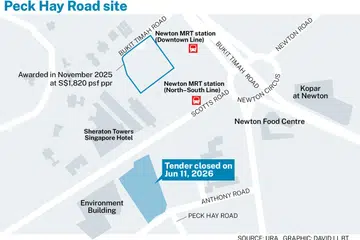
CDL, Hong Realty trump 3 other bidders with S$542.4 million offer at S$1,865 psf ppr for Peck Hay plot

‘I felt like dying’: Thai Singha beer scion speaks up after disclosure of alleged sexual abuse

Battle for Asia’s ultra-rich: ‘Singapore can’t afford to keep losing clients to Dubai, Hong Kong’

Evergrande’s liquidation prompts some PwC partners to shield assets, contemplate divorce

