

Ever heard of low volatility investment strategies? Here's how they can help investors during volatile times
Using advanced mathematical and statistical models developed by experienced industry professionals, Eastspring Investments' low volatility equity funds are designed to weather shocks during downturns
 Add BT as a preferred source
Stocks have historically provided higher returns over the long term but staying invested can be a roller coaster of emotions for many. Since the start of this year, the S&P 500 index, which tracks the biggest US stocks, has fallen around 20 per cent. The MSCI AC World Index (MSCI ACWI), a proxy for global stocks, declined by a similar quantum. Investors who piled into technology stocks, whether in the US or Asia, suffered even bigger losses over the same period with several prominent companies losing significant value.
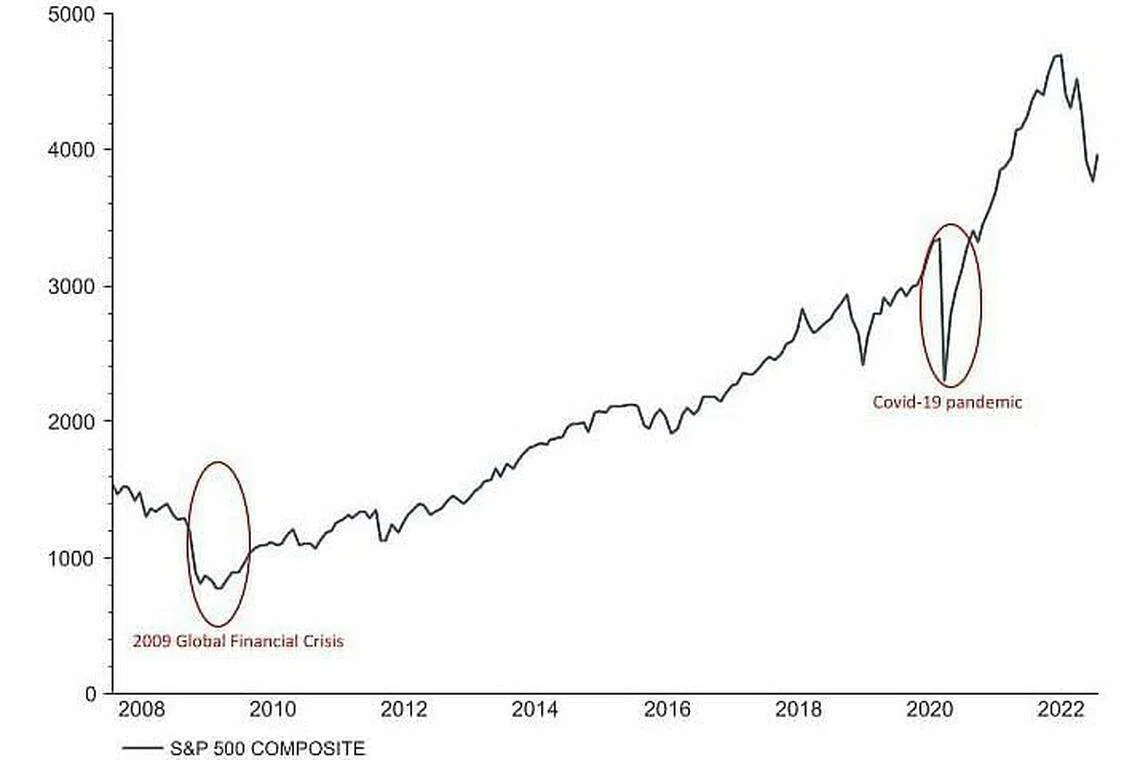
While investor sentiment is understandably very bearish now, the case for holding a diversified portfolio of stocks over the long term remains as strong as ever. For instance, the S&P 500 is still some 50 per cent above its lows in March 2020 when stock markets fell sharply as Covid-19 spread across the world. The index is also around five times its level at the height of the Global Financial Crisis in 20091.
Investors should therefore stay invested in stocks since it is difficult to predict when stocks will bottom or when they will resume their ascent, as evident in the chart below which shows the S&P 500 composite's performance post the 2009 Global Financial Crisis and the 2020 Covid-19 pandemic.
Giving investors greater peace of mind
While timing the market is tricky, investors can reduce the risk and volatility in their portfolios by following the right strategies - and entrusting their funds with the right manager.
Some fund managers use quantitative tools and techniques to identify stocks and build portfolios. These involve the use of sophisticated computer models to sort through reams of information.
For instance, models can be used to identify stocks that are less likely to fall in value during a recession. The same models can be used to identify companies that respond differently to market events, creating portfolios that are less volatile regardless of whether problems arise, where they take place and how long they last.
The advantages of quant investing includes the ability to track a much larger number of stocks and avoid human bias in the stock selection process.
The benefits of investing in quant-based lower volatility funds include greater peace of mind since investors should not suffer as big a loss when stock markets correct. The day-to-day fluctuations in the value of the investment should not waiver as much as a traditional market-cap weighted equity fund or index product.
In addition, low volatility portfolios tend to perform in line with if not better than more aggressive strategies over a full stock market cycle since the smaller losses during downturns mean fund managers have less catching up to do during an expansion phase. This effect compounds over time.
"We often characterise low volatility as a marathon runner strategy. Over short bursts, a sprinter may have the advantage; but over longer distances the marathon runner's strengths tend to win out," says Mr Chris Hughes, portfolio manager, quantitative strategies at Eastspring Investments, an asset management firm that is part of Prudential plc, an insurance giant.
Mr Hughes's team, which includes four members with PhD qualifications (including himself) and is Singapore-based, manages the Eastspring Investments - Asian Low Volatility Equity Fund and Eastspring Investments - Global Low Volatility Equity Fund. The funds were launched in 2016 and 2017 respectively and are available to investors in Singapore.
Quantitative tools to build portfolios
Eastspring's quant models incorporate over 30 unique signals, including quality, relative valuations, trading history, changes in earnings estimates and momentum indicators. The data for many stocks go back as far as 25 years.2
A unique aspect to the approach is that "low volatility is not a factor in our initial screening approach. Once we identify candidate stocks based on our multi-factor model, we then optimise the portfolio for low volatility," Mr Hughes says.
"The nirvana of quant investing is not necessarily having the most factors but finding factors that are able to add value and are uncorrelated with other known factors," he adds.
Prior to the launch, Eastspring's global and Asian low volatility funds have been back tested to see how they would have performed during previous stock market cycles and are reviewed regularly by Eastspring's in-house research team. This is not only to ensure objectivity, but also conviction in the underlying investment strategy, assumptions made in building and testing the quant model and its durability through time.
Protecting on the downside
In the 12 months leading up to June 2022, Eastspring's Global Low Volatility Equity Fund lost 5.5 per cent of its value in US dollar terms, compared to a 16 per cent drop in the MSCI ACWI.
"Our low volatility portfolios should offer good downside protection and look meaningfully different to market benchmarks and even low volatility indices and ETFs (exchange traded funds)," Mr Hughes says. "Looking for stocks that are attractive across multiple factors, irrespective of their volatility profile, leads us to a differentiated portfolio with desirable fundamental characteristics."
With a focus on risk, diversification is a key ingredient in the optimisation and portfolio management process. Eastspring's portfolios are designed to seek stocks across sectors, countries, and industries. The more stocks incorporated in the opportunity set, the more opportunities there are to dampen overall portfolio risk and ultimately outperform. However, Mr Hughes acknowledges that Eastspring's low volatility funds are less likely to own fast-growing but unprofitable technology companies because such stocks are typically more volatile due to the difficulty in valuing them.
Balancing growth with risk
Mr Hughes says stock markets go through cycles with periods of rapid growth and downturns. As such, it is important to consider a wide variety of factors when selecting companies to invest in, as timing factors are risky.
"When markets were performing well, factors like 'minimum volatility' and 'dividend yield' were neglected in the drive for growth. As a result, many investors capitulated to the growth trend just in time for the lustre to come off the internet and e-commerce names."
"A quantitative investment approach reduces behavioural biases and balances potential growth with risk mitigation," he adds.
Find out more about Eastspring's low volatility equity funds here.
Disclaimer: This advertisement has not been reviewed by the Monetary Authority of Singapore.
The Fund is a sub-fund of Eastspring Investments, an open-ended investment company with variable capital (Société d'Investissement à Capital Variable or SICAV) registered in the Grand Duchy of Luxembourg, which qualifies as an Undertakings for Collective Investment in Transferable Securities ("UCITS") under relevant EU legislation. The Management Company of the SICAV is Eastspring Investments (Luxembourg) S.A., Grand-Duchy of Luxembourg. All transactions into the Fund should be based on the Singapore Prospectus and Product Highlights Sheet ("PHS"). Such documents, together with the articles of incorporation of the SICAV and the most recent financial reports, may be obtained free of charge from Eastspring Investments (Luxembourg) S.A., or at relevant Eastspring Investments business units/website and their distribution partners.
This document is solely for information and does not have any regard to the specific investment objectives, financial or tax situation and the particular needs of any specific person who may receive this document. This document is not intended as an offer, a solicitation of offer or a recommendation, to deal in shares of securities or any financial instruments.
Please refer to the offering documents for details on fees and charges, dealing and redemption, product features, risk factors and seek professional advice before making any investment decision. An investment in the Fund is subject to investment risks, including the possible loss of the principal amount invested. The value of shares in the Fund and the income accruing to the shares, if any, may fall or rise. Where an investment is denominated in a currency other than the base currency of the Fund, exchange rates may have an adverse effect on the value, price or income of that investment. Investors should not make any investment decision solely based on this document. Investors may wish to seek advice from a financial adviser before purchasing shares of the Fund. In the event that an investor may choose not to seek advice from a financial adviser, the latter should consider carefully whether the Fund in question is suitable for him.
Past performance and the predictions, projections, or forecasts on the economy, securities markets or the economic trends of the markets are not necessarily indicative of the future or likely performance of Eastspring Investments or any of the funds managed by Eastspring Investments. There are limitations to the use of indices as proxies for the past performance in the respective asset classes/sector.
The Fund may use derivative instruments for efficient portfolio management and/or hedging purposes.
Distributions are not guaranteed and may fluctuate. Past distributions are not necessarily indicative of future trends, which may be lower. Distribution payouts and its frequency are determined by the Board of Directors, and can be made out of (a) income; or (b) net capital gains; or (c) capital of the Fund or a combination of any of (a) and/or (b) and/or (c). The payment of distributions should not be confused with the Fund's performance, rate of return or yield. Any payment of distributions by the Fund may result in an immediate decrease in the net asset value per share.
The preceding paragraph is only applicable if the Fund intends to pay dividends / distributions.
Eastspring Singapore is an ultimately wholly-owned subsidiary of Prudential plc of the United Kingdom. Eastspring Singapore and Prudential plc are not affiliated in any manner with Prudential Financial, Inc., a company whose principal place of business is in the United States of America or with the Prudential Assurance Company, a subsidiary of M&G plc, a company incorporated in the United Kingdom.
Footnotes:
1As of July 22, 2022
2The information provided herein are subject to change at the discretion of the Investment Manager without prior notice.

Decoding Asia newsletter: your guide to navigating Asia in a new global order. Sign up here to get Decoding Asia newsletter. Delivered to your inbox. Free.
Share with us your feedback on BT's products and services
TRENDING NOW

CSE Global independent director quits after clashes with chairman Eugene Lai over board refresh

What’s wrong with Orchard Road? Experts weigh in on the street’s cachet and its future

‘I felt like dying’: Thai Singha beer scion speaks up after disclosure of alleged sexual abuse

Rare brutalist Singapore house opens to the public before changing hands

