Fancy one or more mini-retirements? Start planning early for a multi-phase life
A recent survey by HSBC finds that most Singaporeans plan for two to three mini-retirements over their lifetime

[SINGAPORE] We’re likely to live longer lives than our parents or grandparents. Yet embracing longevity can be challenging.
How do you live out a long life meaningfully? Do you need to be wealthy to do so?
A book, The 100-Year Life: Living and Working in an Age of Longevity, gives us a road map. I’ve written about this book, published in 2016 by academics Lynda Gratton and Andrew Scott, a few years ago.
In re-reading some essential chapters, a couple of principles stood out. One, it is essential to let go of the concept that life is linear, progressing in three stages from formal education to a long career and then retirement, which could last two to three decades.
Instead, think of life as multi-phase, where education, for instance, need not be confined to the younger years.
Two, in preparing for a non-linear life, finances are important, but it’s not everything. The book prompts you to take stock of your total assets – particularly non-financial and intangible assets that arguably go a longer way towards enabling a more fulfilling life, than financial assets alone.
Why is this important? Once freed from the “straitjacket” of the three-stage life, new stages create opportunities “to craft a life that balances tangible and intangible assets, depreciation and accumulation”. “In a long life, you have the potential to build a cathedral rather than a shopping mall,” the authors wrote.
A recent survey by HSBC ties in with this concept. It found that most Singaporeans are already planning for a “multi-phase” life – that is, they plan for two to three mini-retirements over their lifetime, moving through “multiple phases of work, rest, caregiving, upskilling and reinvention”, said Ishan Sarkar, HSBC Singapore head of wealth and premier solutions. “This reflects a mindset shift: people want to live their wealth, not just accumulate it.”
But it is not just Singapore respondents who desire multiple planned pauses. The survey, part of a “Quality of Life” series, found that the trend is global. This reflects a shift in the traditional definition of wealth from money and physical assets, towards “a deeper desire for personal fulfilment, balance and purpose”, as Lavanya Chari, HSBC’s head of wealth and premier solutions (international wealth and premier banking), wrote in the survey’s foreword.
This is most distinct in younger generations. “Nearly half of Gen Z now define wealth in non-material terms, and a third say work-life balance is their ultimate marker of financial success,” she wrote.
In Singapore’s talent-strapped economy, this has implications for employers who wish to retain young and valued staff. Globally, a higher proportion of Gen Z and millennials desire two to three mini-retirements (53 and 51 per cent, respectively), versus Gen X (45 per cent) and baby boomers (41 per cent). Gen Z is defined as ages 21 to 28; millennials, 29 to 44; Gen X, 45 to 60; and baby boomers, 61 to 69.
Here are some insights on planning for and financing a multi-phase life.
Consider and nurture your intangible assets
As authors Gratton and Scott see it, there are three categories of intangible assets.
- Productive assets help individuals to be successful in their jobs; these include the knowledge and skills gained from education. But there are assets beyond that, such as the networks and relationships you build, and your professional social capital. These relationships include people you trust, who coach and support each other. Reputation is yet another intangible asset that one can leverage in the years when you may choose not to work full time.
- Vitality assets encompass fitness and health as well as friendships and loving family relationships. These assets grow more valuable over a longer life.
- Transformational assets refer to one’s capacity to navigate change and transitions. This quality is likely underappreciated, but it is becoming more essential today as structural changes including artificial intelligence could easily make your skills and job redundant. The essential qualities in this respect are self-knowledge, openness to new experiences and the ability to reach out to diverse networks.
Funding a multi-phase life
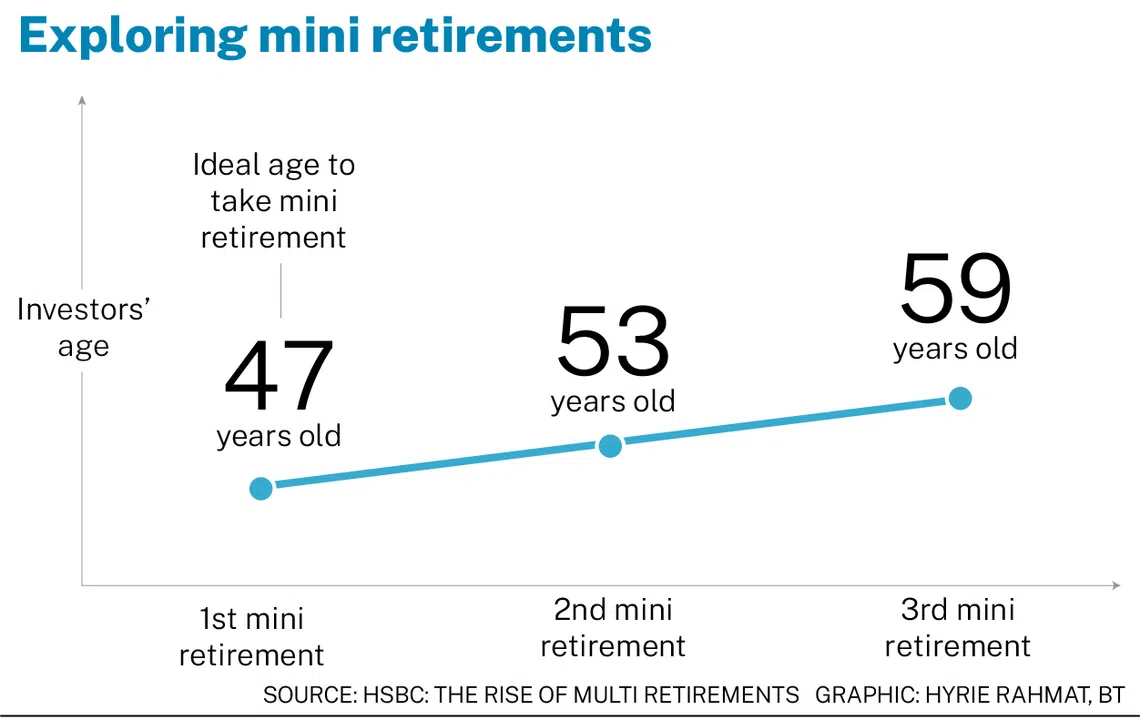
Mini-retirements, as HSBC’s survey found, typically last six to 12 months, and clients plan three to five years in advance. Purposes may vary depending on one’s life stage.
Those in their 20s to 30s typically seek exploration, travel and skills development. In the 40s to 50s, family time, caregiving and health may be the main objectives.
How costly is it? Sarkar said 40 per cent of Singapore respondents plan to keep expenditure under US$100,000, and 20 per cent aim for between US$100,000 and US$250,000. The global average spend per mini-retirement is around US$340,000.
More than half of Singapore respondents expect to fund this by personal savings and investment income. But 37 per cent indicated they may tap into retirement accounts.
Tapping retirement savings, however, is sub-optimal, said Sarkar. With a planning window of three to five years, individuals should be able to build a diversified income stream and plan for liquidity needs, he said. Beyond cash, some assets include short-duration capital-stable instruments, a diversified low-volatility portfolio, and income-generating assets such as dividends and rental income.
Sarkar also proffers some foundational principles:
- Be intentional and grounded in purpose. Those who take mini-retirements report higher satisfaction.
- Plan early and create a dedicated fund. Ringfence some savings for a mini-retirement to ensure you don’t draw on your retirement pot.
- Stress-test your plans with a financial planner or with financial tools. Factors to consider include inflation, mortgage obligations, dependants, healthcare and caregiving duties.
- Keep contributing to your retirement account.
- Plan your re-entry into work by maintaining ties with your network or doing part-time work.
Intentionally planning for a multi-phase life – and doing so early – can be challenging, but it’s also empowering. By taking stock of both your physical and intangible assets, you’d marshal your resources and network for a more fulfilling life. Longevity is a gift of time that not everyone is blessed with.