Five insights to put market volatility in perspective

YOU wouldn’t be human if you didn’t fear loss.
Nobel Prize-winning psychologist Daniel Kahneman demonstrated this with his loss-aversion theory, showing that people feel the pain of losing money more than they enjoy gains. Therefore, investors’ natural instinct is to flee the market when it starts to plummet, just as greed prompts us to jump back in when stocks are skyrocketing. Both can have negative impacts.
Given the uncertain environment, investors may have doubts about their investment approach. It is natural to seek calmer shores when markets are choppy. But it is equally important to step back, gain perspective and look towards the horizon.
History shows stock markets have always recovered from previous declines, although there is no guarantee downturns will lead to rebounds. Here are five insights that can help investors regain confidence and stay invested for the long haul.
When in doubt, zoom out
If you go back to 2018, the first Trump administration’s tariffs on China sparked a trade war that panicked markets and dominated the news. What’s more, two US government shutdowns, challenging Brexit negotiations and a contentious mid-term election further stoked market pessimism.
How did stocks react? Fears that a trade war between the two largest economies would lead to a global slowdown sent the S&P 500 down 4.4 per cent in 2018, falling as much as 19.4 per cent from Sep 20 to Dec 24 that year. But the index recovered sharply in 2019 – up 31.1 per cent – as trade deals were announced and consumer spending steadied.
Will market choppiness in 2025 give way to smoother sailing in 2026? There is no way to tell, but next year’s mid-term elections could shift the Trump administration’s focus to trade deals and more bread-and-butter issues that add economic optimism rather than uncertainty.
Markets typically recover quickly
While markets can be treacherous during periods of heightened volatility, they have often bounced back quickly. Indeed, stock market returns have typically been strongest after sharp declines. The average 12-month return from the S&P 500 immediately following a 15 per cent or greater decline is 52 per cent. That is why it is often best to remain calm and stay invested.
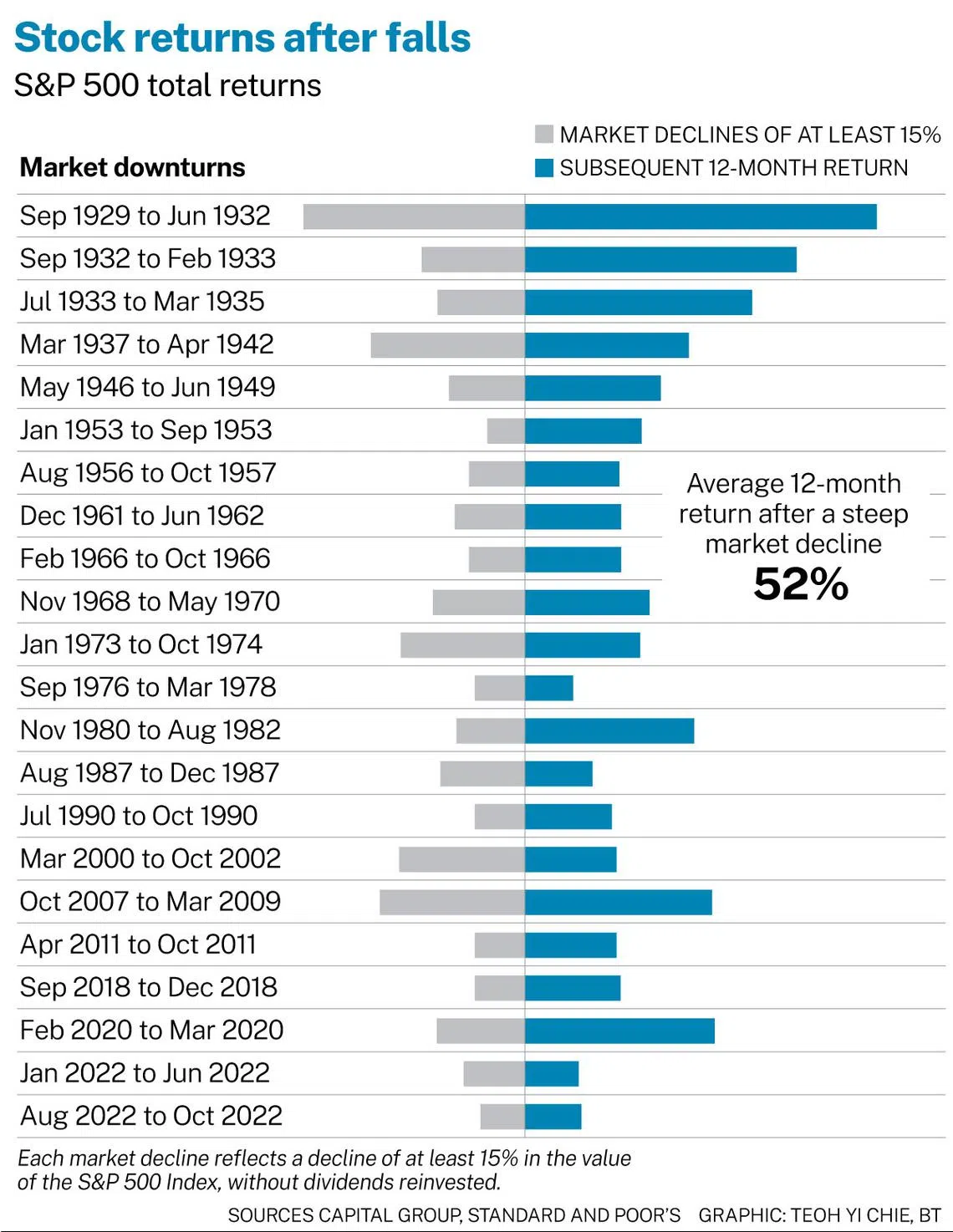
How often do market corrections of 10 per cent or more in the S&P turn into entrenched bear markets? Turns out, not often. More common are short periods of pullbacks ranging from 5 to 10 per cent. While these may feel unsettling, a drop of 5 per cent occurred twice per year on average, while corrections of 10 per cent or more happened every 18 months on average, from 1954 to 2024. And while intra-year declines are common, the good news is 37 of the last 49 calendar years have finished with positive returns for the index.

Bear markets have been relatively short-lived
A long-term focus can help investors put bear markets in perspective. From Jan 1, 1950, to Dec 31, 2024, there were 11 periods of 20 per cent-or-greater declines in the S&P 500. And while the average bear market decline of 33 per cent a year might have been painful to endure, missing out on the average bull market’s 265 per cent return could have been far worse.
Bear markets are also typically much shorter than bull markets. Bear periods have averaged 12 months, which can feel like an eternity, but pale in comparison with the 67 months of average bull markets – another reason why trying to time investment decisions is ill-advised.
Most bear markets coincide with recessions, which are also relatively infrequent. Without a recession, a growing economy can still spur positive corporate earnings growth, which supports equity prices. Market declines outside of a recession have tended to be shorter than those during a recession, lasting about six months versus 17.
Forecasting recessions is tough. Many investors, for example, were bracing for a recession when the Federal Reserve raised rates in 2022 to combat sky-high inflation. Instead, the US economy grew, and markets posted double-digit gains in 2023 and 2024.
Today, steep tariffs elevate the risk of a recession. Policy uncertainty is causing companies to pause investments and hiring while prompting consumers to reduce spending. But the economy has surprised to the upside before, and it’s too early to tell if widespread job losses, the hallmark of a recession, will occur.
Bonds offer balance
In periods of slowing economic growth, bonds often shine brightest. In fact, it is the reason why high-quality bond funds are often the foundation of a classic 60 per cent equities and 40 per cent bonds portfolio. While the exact allocation may shift, a diversified portfolio is intended to generate attractive returns while minimising risk.
Bonds tend to zig when equity markets zag, and so far this year that pattern is holding. Bonds have returned 1.88 per cent this year to Apr 15, compared to the 7.89 per cent decline for the S&P 500. An exception was 2022 when stocks and bonds both fell significantly in the face of rising inflation and rapid interest rate hikes by the Fed.
Markets are pencilling in rate cuts this year in anticipation of a tariff-induced economic slowdown. Fed officials face a challenging backdrop when it comes to determining an appropriate policy response. They need to balance labour market and growth concerns with potential inflationary pressures.
Still, significant economic downturns have typically been met with rate cuts, which should have helped boost returns for core bond funds during these periods, as represented by the Bloomberg US Aggregate Bond Index. Bonds should offer diversification in equity market downturns as their prices normally rise as yields fall.
Moreover, with bonds offering compelling income potential today, investors may be able to take on less risk with high-quality bonds while still meeting their return expectations.
Staying the course pays off for long-term investors
When markets are volatile, it is hard to resist the urge to do something. Suggestions to stay the course offer little comfort when markets and emotions are spiralling. But in many cases, the best course of action has been none at all.
The lesson? Market declines can be painful to endure, but rather than trying to time the market, investors would be wise to stay the course. To weather market volatility, they should seek diversification across stocks and bonds, while periodically examining their risk tolerance for elevated volatility.
Though it may feel like this time is different, markets have shown resilience throughout history when confronted by wars, pandemics and other crises.
The writer is head of client group (Southeast Asia), Capital Group
Decoding Asia newsletter: your guide to navigating Asia in a new global order. Sign up here to get Decoding Asia newsletter. Delivered to your inbox. Free.
Share with us your feedback on BT's products and services