Four growth and inflation scenarios for 2022
There is a wide range of possible outcomes based on the trajectories for growth and inflation for the rest of the year.

COMPARED to what has transpired over the prior 2 decades, the persistence of elevated price pressures is a crucial differentiating factor in this economic cycle. The many forces keeping inflation high around the world are increasing the risks that global economic growth heads lower. Macroeconomic uncertainty is high because investors are constantly reassessing how much and how fast central banks will raise rates to tamp down inflation and economic activity – and if they will deliver too much tightening and have to reverse course.
As such, market participants are likely to entertain a wide range of outcomes based on the trajectories for inflation and growth during the rest of 2022. Four potential macro backdrops arise: a growth scare; a soft landing; stagflation and an inflationary boom.
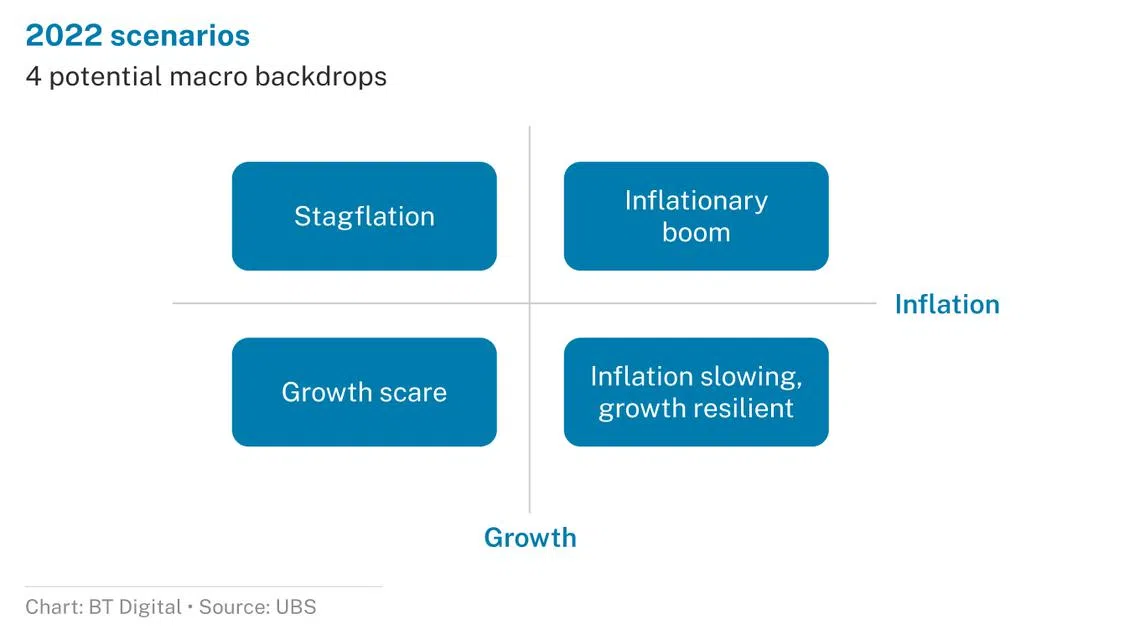
While there is no certainty as to which regime markets will eventually settle into over the next 6 to 12 months, our team at UBS Asset Management believes it is a close call between a growth scare that culminates in a recession and a soft landing. That said, however, sequencing is important.
While a soft landing is certainly achievable, the path to get there may feature a sharp deceleration in the data that makes it difficult for market participants to distinguish between a benign endgame and a recession. In other words, the market pricing of recession risk is more likely to increase than decrease in coming months, even if a recession is ultimately avoided.
The potential for a further inflationary shock (i.e. stagflation) complicates this picture, and could well be part of the path towards the ultimate landing zone of soft or hard landing. As such, being more oriented towards trades that are expected to perform well in the event of a growth scare and/or stagflation is the tactical asset allocation for now.
Growth scare
Global activity is already slowing, and central banks are indicating that a further deceleration in activity is needed to bring inflation sustainably lower.
Over the past few months, the increased speed and magnitude of tightening telegraphed by monetary policymakers to enforce a slower-growth, lower-inflation outcome are raising the odds that an economic downturn ultimately ensues. A recession may, in the eyes of central bankers, end up being a result that is preferred if the alternative is letting inflation expectations get out of hand. This makes a growth scare the most likely economic regime to be priced by market participants during the second half of 2022.
There are currently more signs that growth is slowing than inflation, hence central banks continue moving towards a restrictive policy stance. With yields and spreads higher and demand for goods slowing, businesses are also more likely to prioritise paying down debt over expansion plans.
Stagflation
Commodity prices – and central banks’ desire to protect inflation expectations from becoming unhinged to the upside – are the primary source of stagflationary risk to the global economy. Energy markets could face further supply-side vulnerabilities before demand cools appreciably. Given that activity is moderating, any move to a stagflationary backdrop would be a relatively temporary shift before markets aggressively priced the risk of growth and inflation falling through a recession, in our view.
Soft landing
While the market is likely to price in a higher risk of recession before the potential relief of a soft landing, the good news is that it is almost equally as unlikely for a recession to occur when private sector balance sheets are starting off in such a strong position.
The same forces that are presently contributing to slower growth can also, over time, propel inflation lower. The reorientation of spending towards services should help core goods prices normalise, perhaps rapidly. Any resolution of Russia’s war on Ukraine would also likely involve a partial, though not complete, reversal of some of the negative supply shocks in commodity markets.
While monetary policymakers can be flexible and pivot should inflation decelerate more than anticipated, we believe that central bankers will only turn dovish following considerably more damage to the economic outlook and risk assets, rather than through any benign “immaculate disinflation” dynamic playing out.
Inflationary boom
Developed market economies have been surprisingly resilient in 2022 in the face of negative supply shocks. However, the more activity holds up while inflation remains high, the more motivated central bankers will be to tamp down both. We think retaining something resembling an inflationary boom is the least likely outcome going forward, given the persistence of negative supply shocks and policy-induced tightening of financial conditions.
China stands out as a region that is poised to add to global growth momentum over the next 3 to 6 months. Improving public health outcomes should allow for the stimulus Beijing is pursuing to buoy economic activity more visibly. While we believe this positive impulse to growth will be overwhelmed by the slowing transpiring elsewhere, this expected improvement in Chinese macroeconomic performance relative to the rest of the world is an investable opportunity.
Asset allocation implications
From a market perspective, hot inflation is a problem with no good solutions in the near term. Headline inflationary pressures will likely constrain central banks from turning in a dovish direction. Economic data would also likely need to get materially worse – raising risks to earnings – before monetary policymakers would consider pivoting, considering the deterioration in the growth outlook.
Global stocks remain unattractive given this macro backdrop. Inflation, and the central bank response to quell it, are the key reasons why stocks are still expensive on a cross-asset basis despite declining by 20 per cent. In addition, earnings expectations in 12 months’ time continue to be revised higher, albeit modestly, despite the rising risks to the expansion.
Chinese equities, however, stand out to us as attractive because the country is not that afflicted by many of the headwinds weighing on other regions. Inflation is not very high, so policy is easing rather than tightening. Even with zero-Covid policies in effect, there should be fewer, not more, disruptions to economic activity going forward after the large-scale lockdowns earlier this year. In our view, the peak in the tech regulatory crackdown is in the rear-view mirror.
We place non-trivial odds on a stagflationary scenario in the near term, where spiking energy prices prompt central banks to act to curb inflation expectations. This informs our relative preference for energy stocks, which are likely to remain very inexpensive despite their strong outperformance year to date. The trade-off between slowing growth and elevated inflation also leaves us neutral on global government bonds for the time being.
The silver lining of the year-to-date weakness across financial markets is that medium-term forward returns for investors have improved considerably relative to 1 year ago. On a tactical basis, we expect patient investors to enjoy an even more attractive entry point for global equities, if a cyclical moderation in inflation allows central banks to shift in a more dovish direction, allowing global economic activity to inflect higher.
The writer is head of multi-asset strategy in the investment solutions team, UBS Asset Management.