

This fund uses AI to pick stocks – and avoids concentration risk
It evaluates more than 150 indicators across technical analysis, company fundamentals and academic research

CONCENTRATION risks in global stock markets are at multidecade highs, as investors flock to the seemingly compelling potential of all things related to artificial intelligence.
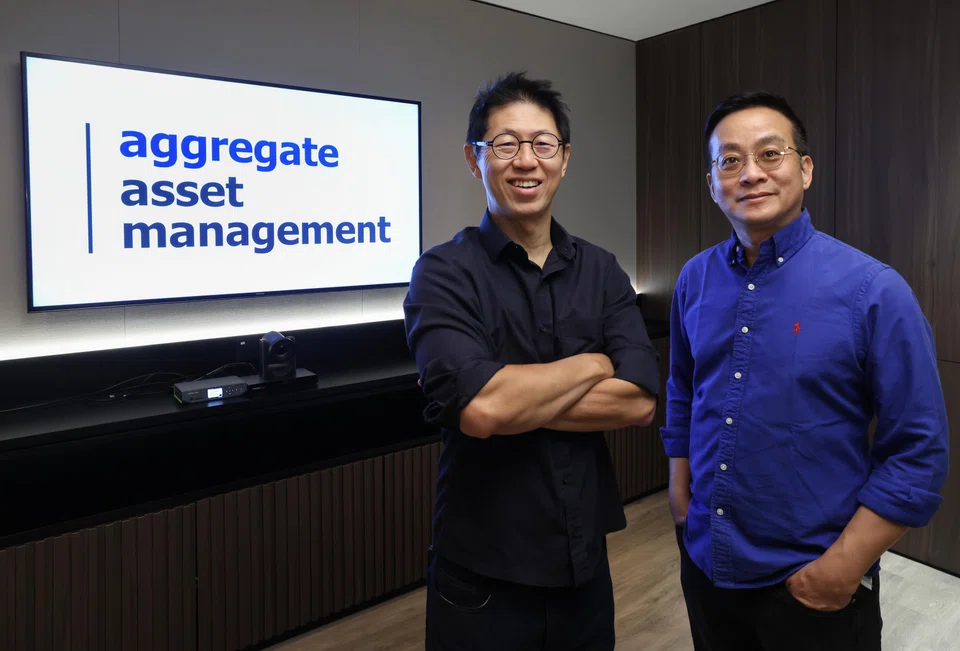
But if you are concerned about concentration risk, as AI-themed stocks take up an outsized share of market indices, home-grown boutique asset manager Aggregate Asset Management (AAM) offers an alternative.
The firm began deploying its own stock selection engine, which it developed using machine learning – a type of AI – around 2021. Since then, the Aggregate Value Fund (AVF) has pivoted from a focus on Asia equities into a global “ultra-diversified” strategy aimed at downside protection.
AAM co-founder Eric Kong, who is the firm’s fund manager and executive director, said: “Most of our investors use our fund as their retirement savings. So, the first rule is always to be safe.”
The numbers to date are gratifying. Before the use of machine learning, the AVF’s maximum drawdown between January 2013 and end-February 2021 was 28.8 per cent, compared with 16.5 per cent for the MSCI Apac Index and 20.5 per cent for the MSCI World Index.
The use of machine learning between February 2021 and end-June 2026 has reduced the maximum drawdown to 12.4 per cent, compared with 28.8 per cent for the MSCI Apac Index and 22.9 per cent for the MSCI World Index.
As at June 2026, the AVF delivered annualised returns of 5.56 per cent over five years, and 9.73 per cent over three years.
The decision to transition towards an ultra-diversified portfolio was prompted by losses. Prior to machine learning, the AVF portfolio comprised up to around 200 stocks, which by itself seemed diversified.
Even so, the fund incurred its worst drawdown of 28.8 per cent on its Hong Kong and China exposures around 2019, when Hong Kong was rocked by civil unrest and the stock market fell. At the time, roughly 40 per cent of the portfolio was invested in “deep value” stocks in Hong Kong and China.
Kong said: “I learned my lesson. You can diversify with 200 stocks but if you are in the wrong country you’re going to suffer that drawdown.”
Today’s markets are even more concentrated. The Magnificent 7 stocks (Alphabet, Amazon, Apple, Meta, Microsoft, Nvidia, Tesla) account for around 34 per cent of the S&P 500, and the information technology (IT) sector’s share is estimated at 38 per cent.
The MSCI World’s top 10 constituents, overwhelmingly Big Tech names, account for 24 per cent of the index. The US’ geographical share is 72 per cent.
AVF today has more than 850 stocks spread across 17 countries; no single stock exceeds 3 per cent. In terms of sectors, IT is the largest with 17 per cent share, followed by financials at 16 per cent.
Exposure to the US is around 17 per cent, followed by China at 14 per cent.
AAM began to develop its machine learning capabilities in 2016; Kong holds a degree in computer science. He tested and refined the model over five years.
Today the model evaluates more than 150 indicators across technical analysis, company fundamentals and academic research. It ranks stocks according to the strongest risk-return profile across each market.
Risk management is where human judgement becomes essential. Kong said: “The system will only tell you which stocks are the best in Singapore or the US. But it does not tell you how much money to put in… We wouldn’t put 65 per cent of our funds into the US because we don’t want to take that kind of risk.
“There are periods when we underperform the US, but clients understand that’s the trade-off to get stability.”
Being ultra-diversified also helps to mitigate the sequence-of-return risk, where a sharp downdraft at the start of retirement could deal a major blow to a retiree’s portfolio.
AAM was founded in 2012. The AVF, with assets of S$640 million, was incepted at the end of 2012.
The fund is available only to accredited investors. It does not charge an annual management fee. Instead, it takes a performance fee of 20 per cent of profits once the fund’s net asset value (NAV) exceeds a high-water mark – that is, its previous NAV record.
AAM believes this fee structure ensures alignment of interests with investors. “This high-water mark mechanism demands that the fund managers earn an absolute profit for the clients before they are rewarded,” it said on its website.
In its Jun 30 quarterly investor letter, it reported a new high-water mark for Class A shares.
AAM is often asked why it trails major market indices. The fund’s June newsletter, co-written by Kong and senior analyst Cheen Wee Kiang, said most investors have not yet internalised this fact: “It is not about our stocks at all. It’s about what the indices have become.”
In the first half of 2026, the iShares MSCI Taiwan exchange-traded fund (ETF) returned 68.45 per cent. But the median Taiwanese stock returned 2.79 per cent.
This conundrum is even more pronounced in South Korea, where the MA Tiger Kospi ETF gained 91 per cent, but the median stock fell by 20.5 per cent. Samsung and Hynix account for more than half the benchmark index.
“The market and the ‘average company’ have quietly become different things. A capitalisation-weighted index is no longer a statement about hundreds of businesses. Increasingly it is a very large position in a handful of AI-related stocks, held at full index weight by everyone who believes they bought the index.”
The newsletter said AVF’s stock-picking engine is finding the right companies in Korea, “to a degree we never previously recorded”.
But the AVF trails the market because of its refusal to place 40 to 50 per cent of the Korean exposure, for instance, into just two stocks. “The lag is not selection failure. It is the visible price of refusing a two-stock bet – and it would invert the day the pair stumbles.”
There is yet another caveat. The AVF has compounded at 7.26 per cent since the redesign, while the global equity benchmark compounded at 12.13 per cent.
“We earned roughly 60 per cent of the index’s return for half its drawdown. For an investor accumulating over decades with no need to withdraw, this is arguably a poor trade,” the newsletter said.
The AVF, however, is designed to accommodate a withdrawal rate of 5 per cent a year for retirees. “Withdrawing through a 29 per cent drawdown forces the sale of units at the bottom that never recover. Withdrawing through a 12 per cent drawdown barely dents the unit count.
“Shallow drawdowns are... the product. A retiree drawing from a capitalisation-weighted index today has their retirement sequenced to the fortunes of seven stocks.”
TRENDING NOW
Genting Singapore trails MBS, but helps anchor Malaysian parent group’s finances

He built the Vingroup empire. Now South-east Asia’s richest man is handing some key roles to his sons
CDL to invest S$5 billion, target S$6 billion divestments under refreshed strategy
Stocks to watch: CDL, Centurion, Oiltek, Geo Energy Resources

