

A global recession isn’t inevitable
But it wouldn’t take much additional advanced economy weakness to mechanically push the world into contraction.

WE CONTINUE to believe the global economy will narrowly avoid a recession, despite expecting the United States, Canada, and most of Europe to fall into recession at some point over the next year or so.
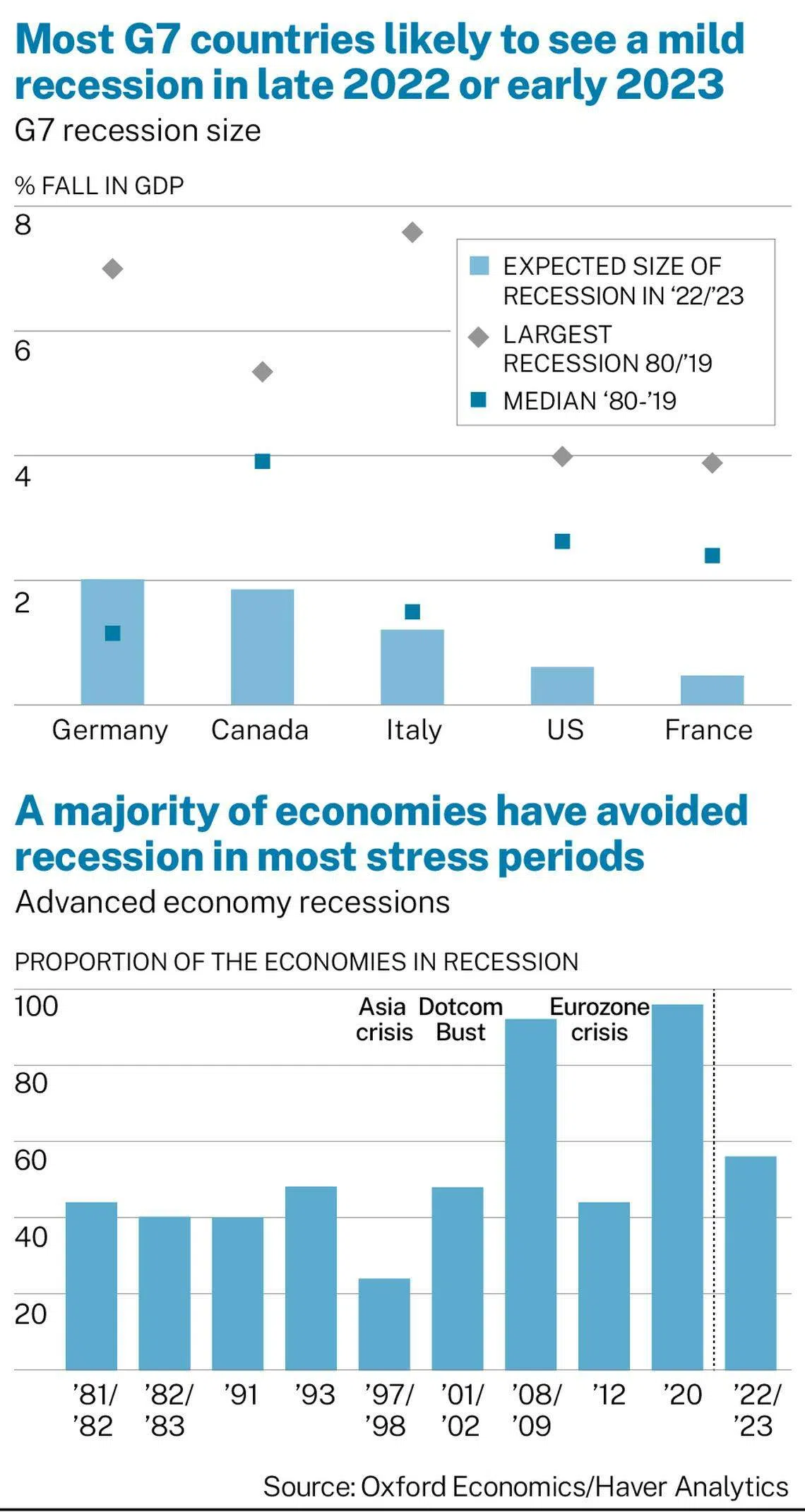
Avoidance of a global contraction while several large economies fall into recession wouldn’t necessarily be an unusual outcome. Since the 1980s, there have been 9 advanced economy recession clusters, but only 5 of these have coincided with 2 or more consecutive quarterly falls in global per capita gross domestic product (GDP) – the benchmark for a global recession.
It’s worth noting that all 5 US technical recessions since 1980 have coincided with a global recession. But we expect the upcoming peak-to-trough GDP fall in the US to be far smaller than in any of the previous 5 slumps. Therefore, it is reasonable to believe a global contraction could be avoided.
However, it wouldn’t take much additional advanced economy weakness to mechanically push the world into recession. But risks aren’t solely tilted to the downside. In particular, a sharp drop in European energy prices and/or decisive action by governments to protect the economy from the energy shock could lead to milder recessions in Europe.
Our recently revised forecasts now assume that 14 of a sample of 25 advanced economies will enter recession in late 2022 or early 2023. Most of Europe falls into recession, along with the US and Canada. The only region to escape 2 quarters or more of falling activity is Asia-Pacific. For most economies that do fall into recession, the duration is expected to be only 2 or 3 quarters, and all the quarterly contractions in activity within the advanced economies take place between Q3 2022 and Q2 2023.
Despite this broad-based weakness across the advanced economies, we don’t think a global recession – defined as global per capital GDP shrinking for more than 2 quarters – is inevitable. On balance, this view does not look inconsistent with historical experience.
The latest recession cluster in an historical context
Since 1980, about 80 per cent of recessions recorded by individual advanced economies have occurred in 9 distinct periods: 2 in the early 1980s, 2 in the early 1990s, the 1997 Asia crisis, the early 2000s dotcom bust, the global financial crisis, the eurozone crisis, and the coronavirus pandemic.
During the coronavirus pandemic and the global financial crisis periods, most advanced economies fell into recession. But these 2 stress periods should not be considered as standard. In other recession clusters, less than half of the advanced economies typically fell into recession. During 6 of the stress periods, only around 40 per cent to 50 per cent of advanced economies contracted for 2 consecutive quarters – a touch lower than the number of recessions we anticipate in late 2022/early 2023. During the Asian crisis period, recessions were mostly experienced in Asian countries included in the advanced economy aggregate.
The average peak-to-trough falls in GDP during the pandemic and global financial crisis periods were substantially larger than in the remaining 7 stress episodes. The Asian crisis also saw large falls in GDP, but these contractions occurred among a small group of economies. At 1.6 per cent, the dotcom bust stress period had the smallest average peak-to-trough decline in GDP. We assume that the average recession size in H2 2022/H1 2023 will be even smaller.
Advanced economy weakness doesn’t always push the global economy into recession
Only 5 of the previous 9 advanced economy stress periods have been associated with a global recession. Of these 5, the global financial crisis and the coronavirus pandemic were exceptionally large shocks. The other 3 were in the earlier stages of our sample period when the advanced economies’ share of world GDP was larger. Since the mid-1980s, the advanced economies’ share of global GDP has fallen from over 75 per cent to around 57 per cent. In the late 1990s and early 2000s, the dotcom, Asian, and eurozone crises didn’t push the global economy into recession.
Given this and our assumption that the average GDP declines during the upcoming recession phase will be smaller, our baseline forecast, which assumes that a global recession is narrowly avoided, seems reasonable.
However, there is truth in the old adage that when the US sneezes, the rest of the world catches a cold. During the 4 advanced economy stress periods that haven’t been associated with a global recession, the US economy had avoided a recession (based on the 2 consecutive quarterly falls in GDP definition, as opposed to the NBER methodology). We have also excluded the H1 2022 recession. By contrast, the other 5 advanced economy stress periods have all included the US falling into recession, and each of these episodes has coincided with a global recession.
This perhaps suggests the absence of a global recession in our forecast could be a bit hopeful. But it is worth noting that the expected peak-to-trough decline in US GDP in H1 2023 is much smaller than any of the preceding 5 recessions and well below the median US historical contraction. The remaining G7 economies that are predicted to fall into recession are also expected to experience relatively small contractions. If the US and other advanced economies are set for particularly mild recessions – at least from the perspective of peak-to-trough GDP fall – this time around, then the global economy is more likely to avoid recession.
Upside and downside risks to the outlook
While we still don’t see a global recession as the most likely outcome, it is fair to say that we expect world GDP growth in both Q1 and Q2 next year to be only just above population growth. If 2020 is excluded, this will mark the worst patch for the global economy since the global financial crisis. What’s more, it wouldn’t take much additional bad news to push our global forecast into recession territory. But in the grand scheme of things, whether the global GDP growth is a bit above or a bit below population growth is not too important.
Nonetheless, as we’ve previously noted, a lack of major imbalances and vulnerabilities in the advanced economies mean that we think that the most likely outcome is short and mild recessions. Economies should then begin to recover as the key drivers behind this year’s economic slowdown, such as high inflation and supply chain bottlenecks, ease. But even if the peak-to-trough falls in GDP are small, the coming quarters could still prove pretty painful for many firms and households.
Given the recent string of bad economic news, it is tempting to focus solely on the potential downside risks to our baseline view. Further bad news, more stubborn inflation, and poor management of the energy crisis in Europe could cause some economies to suffer longer and deeper contractions that result in much greater pain for the real economy and financial markets, rather than the short and mild recessions we currently forecast.
However, there are substantial risks in both directions, especially for the European economies. Sky-high energy prices, uncertainty about future movements of energy prices, and concerns about possible gas rationing are clearly taking a heavy toll on sentiment. While building the infrastructure to end dependency on Russia will take time, government action to cap energy prices and provide greater clarity about the medium-term outlook could limit the income and cost squeeze facing households and businesses. This would bolster confidence and potentially result in milder downturns as Europe enters winter. If European governments take more substantive action to support the economy through the energy crisis, then the chances of a global recession would be greatly reduced.
The writer is director of global macro research at Oxford Economics.
TRENDING NOW

32 companies, 6 individuals bag accolades at Singapore Corporate Awards 2026

He built the Vingroup empire. Now South-east Asia’s richest man is handing some key roles to his sons
URA to review guidelines on floor space to give developers more design flexibility: Chee Hong Tat

Chagee, Mixue and Luckin won the market. Sustaining their edge is the harder part

